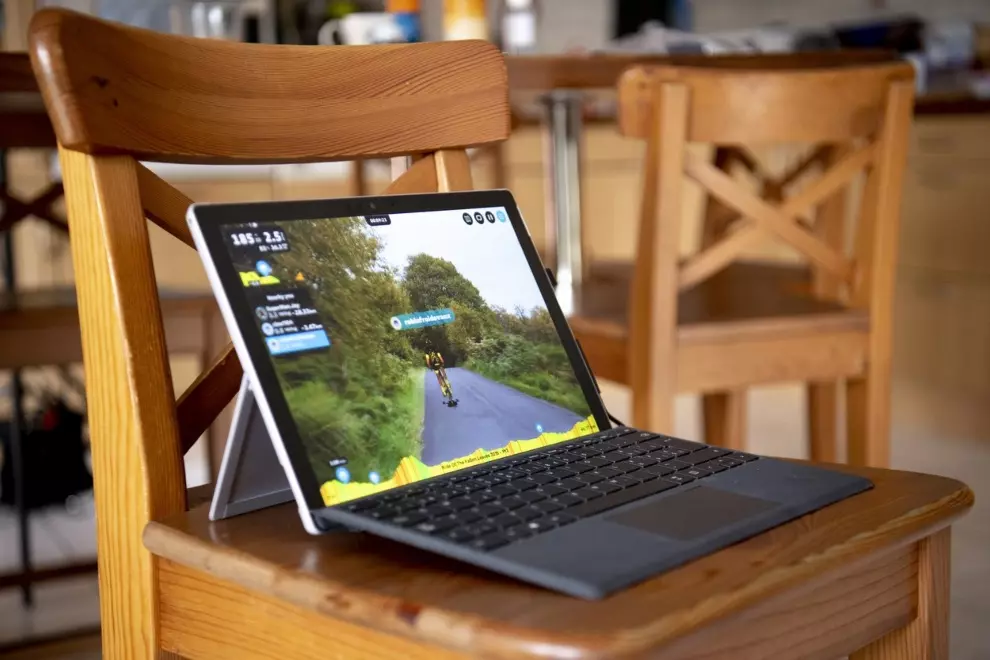
For me, it narrows down to two clear frontrunners: Zwift and Rouvy. I haven’t committed to either, but I’ve spent enough time thinking about them to know exactly why both appeal to me, and why neither is an obvious winner.
What pulls me towards Zwift
Zwift taps directly into something I already enjoy. I’ve spent years playing video games, and the idea of combining gaming with cycling feels almost suspiciously perfect. Zwift turns riding into something goal-driven. Every session comes with objectives, rewards, rankings and a sense of progression. You’re not just pedalling, you’re levelling up.
That’s hugely appealing. I can easily imagine myself logging in for what’s technically a hard interval session, but mentally framing it as a race, a challenge or a push up a leaderboard. Instead of focusing on how much the effort hurts, I’d be thinking about beating riders around me or unlocking the next achievement.
The racing element is particularly tempting. Being able to test yourself against others from home, without travel, logistics or weather concerns, sounds genuinely fun. Add to that a large, lively community and the sense that something is always happening, and it’s easy to see why Zwift has become the default choice for so many indoor riders.
But I can also see the downside for me, personally. That same game-like structure could very easily push me into riding too often and too hard. I know my competitive side well enough to recognise the risk. Zwift rewards frequency and intensity, and it would be tempting to chase progress every day rather than leave space for recovery or other winter sports.
There’s also the visual side. I understand why Zwift looks the way it does, but the animated style isn’t something I find particularly appealing. When I imagine riding indoors, I’m not looking for a game-like world. I’m looking for something that feels closer to cycling.
Why Rouvy might suit me better
Rouvy speaks to a different part of my cycling brain. Where Zwift adds layers of abstraction, Rouvy tries to strip them away. Its focus on real-world routes and photorealistic video appeals to my love of exploration, which is one of the main reasons I ride in the first place.
The idea of hopping on a trainer and riding iconic climbs like Alpe d’Huez, Stelvio or Mont Ventoux is incredibly attractive. Realistically, I may never get the chance to ride many of these roads in person. Being able to experience them, even as a close approximation, sounds exciting.
Even beyond famous climbs, there’s something appealing about discovering places I’ve never heard of. Watching real scenery roll by, mountains, forests, rivers, lakes, remote roads, that sounds far more calming than staring at a TV series or a stylised virtual world. If I’m riding indoors, I’d much rather look at something that resembles the real outdoors.
That said, Rouvy isn’t without its potential mismatches. Sweating through hard interval sessions might make it hard to appreciate beautiful scenery. When the effort ramps up, the sense of exploration might disappear anyway. There’s also less of a buzzing community feel compared to Zwift, fewer spontaneous races, and less social pressure to show up.
Paradoxically, though, more of my cycling friends who ride indoors seem to be on Rouvy rather than Zwift. That alone could make the experience feel more social for me than the platform’s overall numbers would suggest.
How most people actually choose (and switch)
From what I’ve seen and heard, very few riders make a perfectly informed choice from the start. Instead, most fall into one of three patterns.
First, many people simply choose the platform their friends are on. Group rides, shared experiences and familiar names matter more than feature lists. A smaller platform with the right people can feel more alive than a massive one full of strangers.
Second, a lot of riders start on Zwift and later move to Rouvy. Zwift’s energy, competition and constant stimulation work brilliantly at first, especially for riders chasing fitness gains. Over time, some realise they want something calmer and more immersive, particularly for longer rides.
Third, some riders use both. Zwift for short, hard sessions or racing. Rouvy for longer endurance rides and winter exploration. It’s not unusual for people to treat them as complementary rather than competing platforms, as long as your wallet allows.
Based purely on personality and preferences, I currently lean slightly towards Rouvy. It aligns better with why I ride and how I like to feel on the bike. But I can easily imagine Zwift winning me over through sheer momentum and competitive pull.
Until I try both, I won’t know which version of myself would emerge indoors. And that uncertainty is probably the most honest conclusion a first-timer can reach.