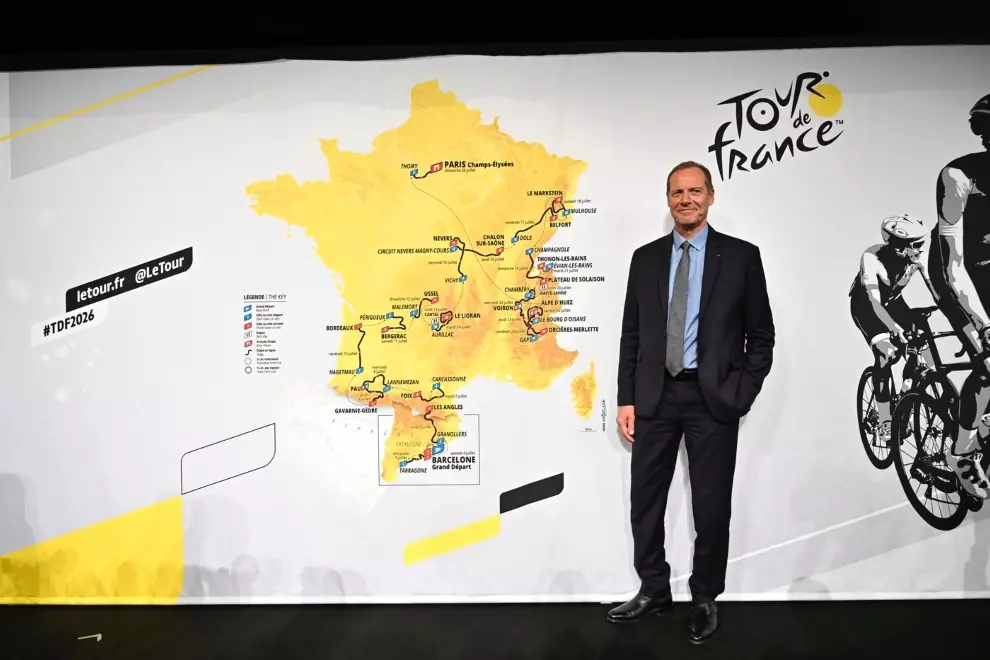
It’s a route that doesn’t wait for the Alps to bring the drama. Instead, it demands aggression, tactical discipline and stamina from day one.
Bold start in Barcelona
For the first time in history, the Tour will start in Barcelona, a city that previously hosted stages in 1957, 1965 and 2009 but has never opened the race. The Grand Départ features three distinct and decisive days in Catalonia.
Stage 1 – Team Time Trial, 19.7 km (Barcelona → Barcelona)
A short, technical loop around the city, with a climb up Montjuïc, the hill that once hosted the city’s Formula 1 circuit and 1992 Olympic complex.
It’s the first TTT to open the Tour since 1971, and the consequences could be huge. Strong collective engines like Visma–Lease a Bike, UAE Team Emirates or INEOS Grenadiers could carve out real GC gaps before the race even hits open roads.
Stage 2 – Tarragona → Barcelona (~178 km)
A scenic coastal run north along the Mediterranean, punctuated by exposed sections where crosswinds could cause havoc. Expect a reduced-bunch sprint or late-attack finish as riders climb back over Montjuïc to the city centre.
Stage 3 – Granollers → Les Angles (Pyrenees)
Just three days in, the peloton heads straight for altitude. The final climb to Les Angles (1,600 m) isn’t monstrous but it’s long enough to expose anyone still shaking off travel legs. GC contenders will already be measuring each other.
This opening block is designed to be restless — no processional stages, no calm before the storm.
Zobrazit příspěvek na Instagramu
Crossing France: Constant tests
After crossing the border into France, the Tour carves a jagged diagonal line across the country, dipping in and out of every major mountain chain before reaching the Alps.
The first week closes with a mountain summit in Gavarnie-Gèdre, deep in the Pyrenees, a high-altitude test where lighter climbers like Landa, Rodríguez or Caruso might fancy early raids.
The second week takes riders through the Massif Central, where rolling, exposed roads and heat often do more damage than gradients. Expect opportunists and breakaway experts such as Matej Mohorič or Magnus Cort to target these stages.
A visit to the Vosges brings shorter, punchier climbs that will suit explosive riders, think Pidcock, Alaphilippe or Skjelmose.
A key addition is the Plateau de Solaison, climbing for the first time in Tour history. It’s a brutal ascent averaging 9% and could serve as a GC sorting point before the Alps even arrive.
Zobrazit příspěvek na Instagramu
Time trials
Two race-against-the-clock tests feature in 2026:
- The Barcelona TTT to open the race (Stage 1).
- A late individual time trial, expected to take place near Lake Geneva.
The second could prove decisive. At roughly 35 km with rolling terrain, it’s perfectly placed to reshuffle the top ten before the final two mountain showdowns. A disciplined all-rounder, someone like Pogačar or Evenepoel, could turn small gaps into minutes.
The decisive Alpine double
The organisers have saved the biggest theatre for the end. The final Alpine block looks absolutely savage:
Stage 19 – Gap → Alpe d’Huez
A long transition that grows steadily more vertical, climbing through La Mure, Ornon, and finishing on the 21 hairpins of Alpe d’Huez. Expect fireworks from the GC contenders and perhaps the first real cracks among the pure climbers.
Stage 20 – Bourg d’Oisans → Alpe d’Huez (via Croix de Fer, Télégraphe & Galibier)
The Queen Stage. Nearly 5,000 metres of elevation gain, a double ascent of Alpe d’Huez (including the lesser-known Col de Sarenne descent and return climb), and two legendary passes that could make or break yellow dreams.
The Tour hasn’t used this configuration before; it’s a masterstroke of geography and sadism.
The GC battle will almost certainly be settled here. Whoever wears yellow at the top of the Alpe on Stage 20 will likely parade it through Paris the next day.
Zobrazit příspěvek na Instagramu
Back to Paris
The final stage brings the peloton back to Paris for the traditional sprint showdown, but there’s a twist: a Montmartre circuit returns, with its cobbled slopes and postcard skyline views. It’s one for the sprinters who can handle a punchy finish: Philipsen, Pedersen, Jakobsen, maybe even Girmay.
Who the route favours
- Tadej Pogačar: The mix of early climbing, a late time trial and multiple summit finishes is practically written for him.
- Jonas Vingegaard: Will love the Lioran and Galibier climbs but may lose early seconds in the TTT.
- Remco Evenepoel: The two time trials could play perfectly if he can survive the Alpine brutality.
- Carlos Rodríguez / Juan Ayuso: Dark horses — comfortable in heat, strong on medium-mountain terrain, both could shine in Catalonia and the Pyrenees.
- Primož Roglič: A route that rewards control and power; if he arrives healthy, he’ll be dangerous.
Zobrazit příspěvek na Instagramu
What to expect
Early tension. The Barcelona TTT will immediately stretch the GC.
Crosswind drama. Stages 2–4 along the Mediterranean coast could see the peloton split to pieces.
Relentless middle week. The Massif Central and Vosges may look tame, but the rolling terrain could decide the green jersey and eliminate tired legs before the Alps.
High-altitude suffering. With summit finishes in Les Angles, Gavarnie, Solaison and double Alpe d’Huez, recovery will be the true differentiator.
The 2026 Tour de France has all the ingredients of a classic: an ambitious foreign start, a route that discourages passivity, and a finale built for legends. It’s less about defending yellow and more about daring to take it. We cannot wait for it to start.