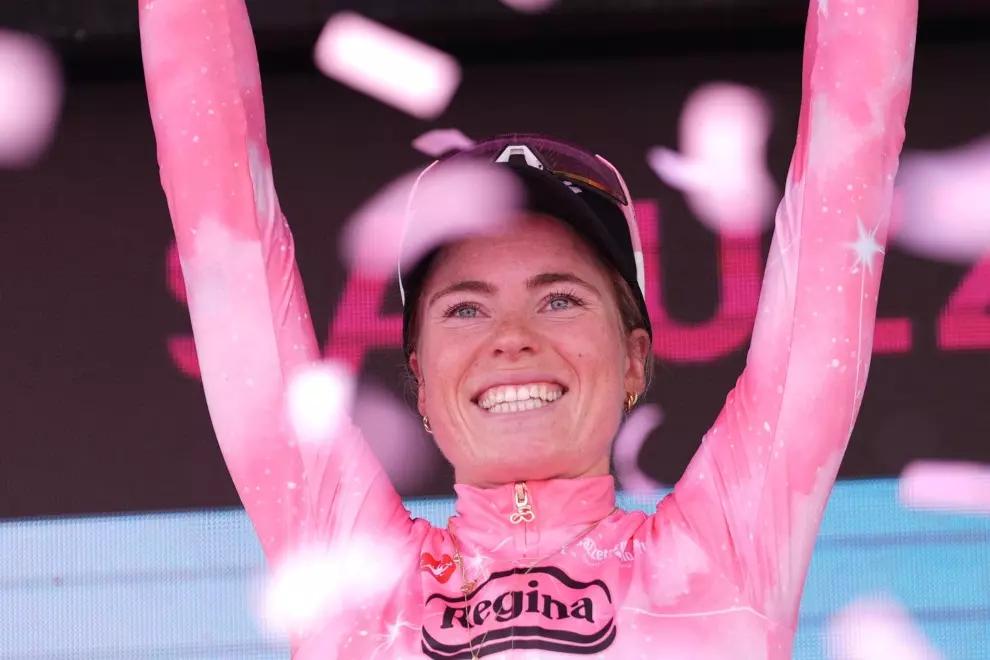
When the race finished in Saluzzo on Sunday, it was Demi Vollering standing atop the podium in pink, completing a remarkable achievement: victory in the Giro d’Italia Women and, with it, the full set of women’s Grand Tours after previous wins at the Tour de France Femmes and La Vuelta Femenina.
Yet the final result tells only part of the story. This was a Giro defined by tactical battles, a resurgent champion, emerging stars, sprint domination, and a final weekend that kept the general classification uncertain until the very last mountain stage.
A race built around the mountains
The route itself was a major talking point long before the riders rolled out from Cesenatico. Organisers expanded the race to nine stages and designed a parcours that steadily increased in difficulty, culminating in the legendary Colle delle Finestre and a demanding final day around Saluzzo. The uphill time trial to Nevegal added another crucial GC battleground.
Many observers predicted that the Giro would come down to a showdown between Vollering and Anna van der Breggen. Few expected just how closely matched they would be.
Early chaos and Elisa Balsamo’s sprint showcase
The opening days belonged largely to the sprinters, and no rider took greater advantage than Elisa Balsamo. The Lidl–Trek rider was consistently the fastest finisher in the race, collecting multiple stage victories and emerging as one of the standout performers of the week. By the time the race reached its second half, Balsamo had established herself as the dominant sprinter of the Giro.
The opening stage also produced one of the race’s earliest controversies. A bike-weight infringement led to the disqualification of Lorena Wiebes from the results, creating an unexpected shake-up and helping elevate Balsamo into an early leadership position. It was an unusual moment that served to remind everyone how little margin for error exists at the highest level of professional cycling.
Anna van der Breggen turns back the clock
While the sprinters collected headlines early on, the general classification battle truly ignited on Stage 4. The uphill individual time trial to Nevegal looked tailor-made for riders capable of combining climbing strength with time-trial power and Van der Breggen seized the opportunity magnificently.
The four-time Giro winner produced one of the rides of the race, taking significant time from her rivals and moving into the maglia rosa. For many fans, it felt like a reminder of why she dominated women’s cycling for so many years.
At that moment, SD Worx-Protime appeared firmly in control. Van der Breggen had the jersey, the experience, and a team capable of defending it.
But Vollering was only getting started.
View this post on Instagram
Vollering strikes back in the Dolomites
Stage 5 delivered the first major mountain showdown. The route through the Dolomites finally gave the climbers room to attack, and Vollering responded exactly as a race favourite should. She claimed victory on the stage and immediately cut into Van der Breggen’s advantage.
Suddenly, the Giro had become the duel everyone wanted. Van der Breggen held pink, and Vollering looked like the strongest pure climber. Neither rider really appeared capable of decisively breaking the other, and the tension only increased as the race moved toward its decisive weekend.
New faces announce themselves
One of the most encouraging aspects of this Giro was the emergence of a new generation of talent. Young riders such as Isabella Holmgren and Antonia Niedermaier repeatedly featured alongside the sport’s biggest stars. Rather than merely surviving in elite company, they actively influenced the race and challenged for stage victories and podium positions.
Holmgren in particular impressed with her climbing and composure under pressure, while Niedermaier remained consistently present in the GC battle.
The Queen Stage delivers
The Giro’s defining moment came on Stage 8. The stage was originally designed to finish beyond the famous Colle delle Finestre, one of cycling’s most iconic climbs. However, organisers were forced to shorten the route due to safety concerns about unstable ice and avalanche risk. The finish was moved slightly lower on the mountain, reducing the distance but not the difficulty.
What followed was still spectacular to witness. The gravel sectors of the Finestre created a dramatic backdrop for the GC battle. Vollering attacked repeatedly, testing Van der Breggen at every opportunity. Holmgren and Niedermaier matched many of the accelerations, creating an elite selection at the front.
In the end, Vollering won the stage after an explosive finish, but Van der Breggen refused to crack completely. The maglia rosa remained on her shoulders heading into the final day.
For many races, that would have been the decisive moment. But not this one.
A final stage worthy of the Giro
The Giro entered Stage 9 with the overall classification still unresolved, as Van der Breggen held the pink jersey but Vollering remained within striking distance. The final mountainous circuit around Saluzzo offered one last chance to overturn the race, and Vollering chose aggression.
Rather than waiting for a sprint or hoping for small gains, she launched a bold tactical offensive. According to her post-race comments, she essentially decided to race as though she had nothing to lose. When Niedermaier moved ahead, Vollering made the most of the situation, forcing Van der Breggen into difficult decisions. Then, with roughly 39 kilometres remaining, she launched the attack that ultimately won the Giro.
Van der Breggen could not follow. The race leader fought valiantly, but Vollering’s climbing strength finally created the separation she had been seeking all week.
Up the road, Elisa Longo Borghini took a prestigious stage victory in Saluzzo, while Vollering finished close enough to secure the overall triumph.
After nine days of racing, the Giro had finally found its winner.
The major winners
Demi Vollering
Everything about Vollering’s victory felt earned. She lost time in the time trial, attacked repeatedly in the mountains, won key stages, and ultimately overturned the race on the final day. It was a champion’s performance built as much on persistence as on strength. Her Giro title also completes an extraordinary Grand Tour collection.
Anna van der Breggen
Despite losing pink on the final day, Van der Breggen leaves the race with her reputation enhanced. Many wondered whether she could still compete at the very highest level in a Grand Tour battle. She answered that question emphatically, wearing pink deep into the race and pushing Vollering all the way to the finish.
Elisa Balsamo
No rider dominated a specific aspect of the race more completely than Balsamo dominated the sprints. Her haul of stage victories made her one of the most visible riders of the entire Giro.
The next generation
Holmgren and Niedermaier emerged as genuine future Grand Tour contenders. Their performances suggested that the next era of women’s stage racing may arrive sooner than expected.
Women’s cycling itself
The 2026 Giro d’Italia Women move to a June calendar slot, increased visibility, expanded coverage, and a more ambitious route all reflected the continued growth of women’s cycling. Most importantly, the race gave fans exactly what they want from a Grand Tour: uncertainty, attacking racing, tactical complexity, and a champion who had to fight until the final day.
Cheers to more epic women’s racing to come in the weeks ahead!