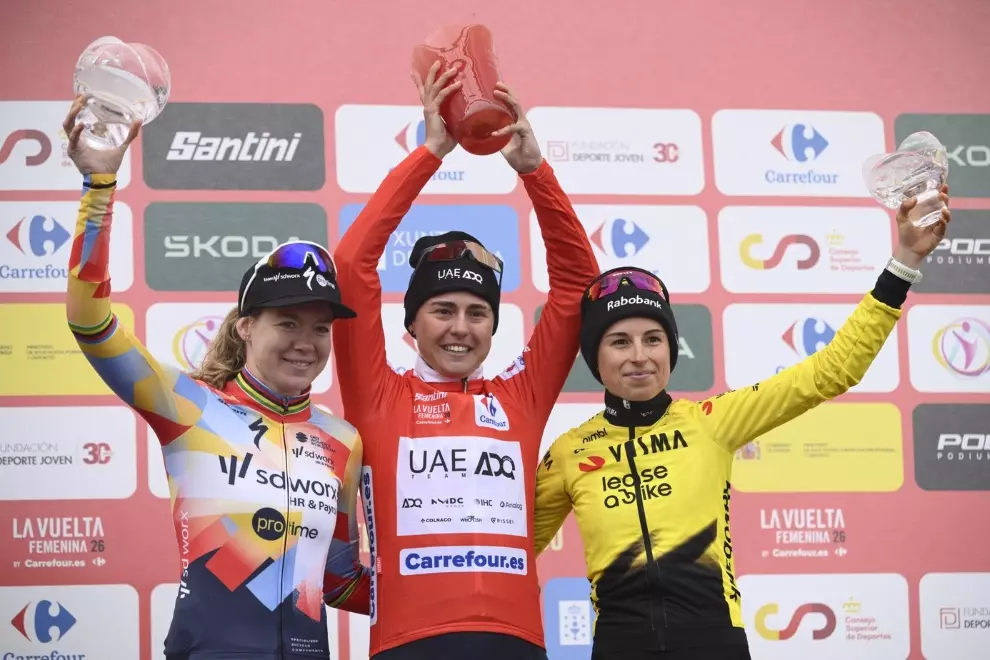
For years, women’s cycling has evolved steadily rather than suddenly. Established names remained at the top, younger riders arrived gradually, and the hierarchy rarely shifted all at once.
This Vuelta felt different.
Across seven stages in northern Spain, riders between 20 and 25 years old didn’t just animate the race — they shaped it. They won stages, fought for jerseys, controlled finales, climbed with the best, and in the end, one of them won the entire race.
Paula Blasi became the first Spanish winner of La Vuelta Femenina by taking the race on the Alto de L’Angliru, the hardest climb in professional cycling and a fitting place for the balance of power to shift.
Paula Blasi is no longer a surprise
Three weeks ago, Blasi’s Amstel Gold Race victory felt unexpected. After this Vuelta, it no longer does.
The 23-year-old rode with the kind of confidence usually associated with riders who have been winning for years. On Les Praeres, she was the last rider capable of staying with Anna van der Breggen before finally cracking. What stood out wasn’t the result — second place on a brutal summit finish is already exceptional — but her reaction afterwards. She looked frustrated not to have held on longer.
The next day, she reversed the dynamic completely.
On the Angliru, Blasi attacked the rider many still consider the benchmark climber of the modern era and rode into the red jersey. It wasn’t cautious or opportunistic racing. It was direct.
The symbolism mattered too. This was the final Vuelta for Mavi García, who carried Spanish women’s cycling through years when opportunities and visibility looked very different. Blasi winning the race in García’s final appearance felt less like coincidence and more like a handover.
View this post on Instagram
Franziska Koch has become far more than a Classics rider
Franziska Koch arrived at the Vuelta after a spring that already included victory at Paris-Roubaix. Even so, it would have been difficult to predict how central she would become to this race.
She sprinted consistently, handled pressure well, wore red, fought for green all week, and stayed competitive everywhere except the steepest summit finishes.
What stood out most was intent. Koch and FDJ-SUEZ raced with a clear objective from the opening stage. Every intermediate sprint mattered, every placing mattered, every second mattered.
There was also versatility to it. Modern stage racing increasingly rewards riders who can survive almost every terrain rather than dominate one specific area. Koch looks increasingly built for that kind of racing.
Sarah Van Dam showed she belongs at this level
The crash of Marianne Vos on stage 1 reshaped Visma-Lease a Bike’s approach immediately.
Into that vacuum stepped Sarah Van Dam.
The 24-year-old wasn’t suddenly transformed into a pure sprinter, but on selective finishes and reduced-group run-ins, she looked increasingly comfortable racing against the very best riders in the peloton. That matters in a race calendar that now contains more punchy, technical finales than straightforward bunch sprints.
Visma came into the race expecting Vos to lead those situations. They left knowing they may already have another option developing internally.
Marion Bunel’s race was built before the mountains
Grand Tours are often analysed through summit finishes, but GC results are usually decided earlier than that.
Marion Bunel understood that perfectly.
The Visma-Lease a Bike rider stayed calm and avoided problems through the nervous opening days. Something easier to overlook than a spectacular attack, but just as important. When the race finally reached the climbs that suited her, she still had the position and energy to use them.
The reward was a podium finish overall.
For young climbers, surviving the flat and transitional stages is often the final step toward becoming genuine GC riders. Bunel looked much closer to that complete package here.
Petra Stiasny finally got the moment she deserved
Not every breakthrough happens immediately.
After several difficult years and repeated setbacks, Petra Stiasny finally found her stage victory on the Angliru. It was one of the purest climbing performances of the week: small rider, steep gradients, no hesitation.
The image of Stiasny climbing alone through the fog on the Angliru felt like one of those moments cycling tends to remember for a long time.
SD Worx-Protime are no longer untouchable
The absolute dominance of SD Worx-Protime from 2023 and 2024 has faded slightly, mostly because the rest of the peloton has improved dramatically.
But this Vuelta was a reminder that the team remains one of the deepest and most adaptable squads in the sport.
Kopecky won, Mischa Bredewold won, Van der Breggen won and finished second overall, and the team took the points classification and team standings. That would count as a historic race for almost anyone else.
The difference now is that other teams — and especially younger riders — no longer seem intimidated by them.
The crashes remain impossible to ignore
The race also reinforced something less positive.
Wet roads, nervous positioning battles and technical finales once again produced multiple crashes that directly shaped the race. Vos abandoned after stage 1. Rüegg lost the red jersey and left the race with a fractured shoulder. Several other contenders disappeared before the mountains even began.
Crashes have always existed in cycling and always will, but women’s racing is getting faster, deeper and more aggressive every season. The sport is evolving quickly. Safety measures need to evolve with it.
The sport feels different now
Perhaps that’s the biggest takeaway from this Vuelta.
Not that one generation replaced another overnight, but that the peloton suddenly feels wider open. Younger riders are arriving without hesitation, racing proactively, and expecting to win rather than hoping to compete.
For years, the future of women’s cycling felt easy to predict.
Right now, it feels much more interesting than that.