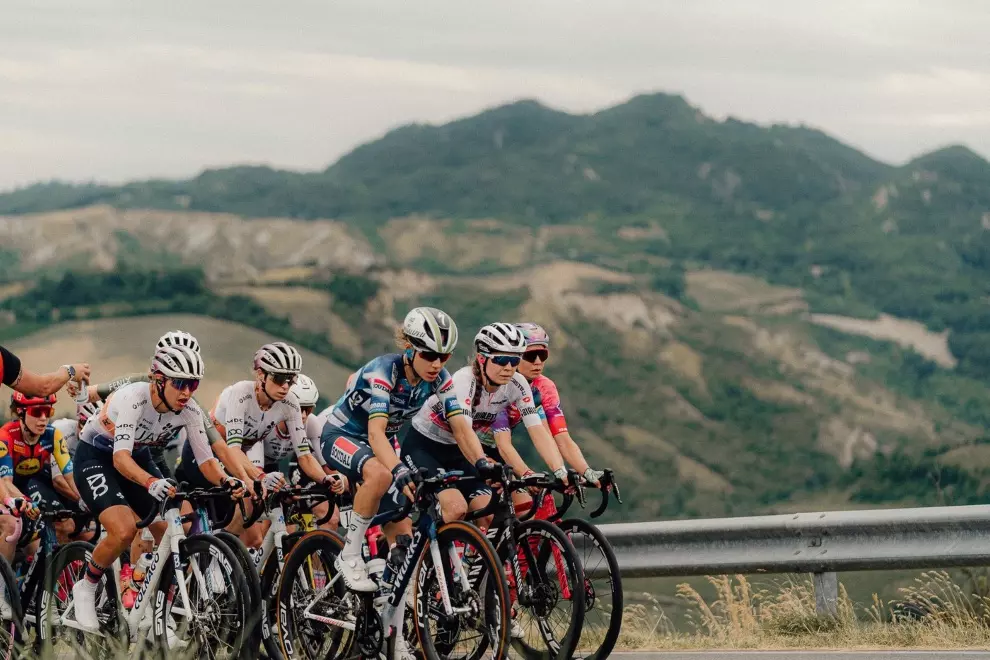
The growth of women’s cycling over the last decade has been remarkable, to say the least. From better salaries, expanded calendars, live television coverage to dedicated development pathways and the return of major races like the Tour de France Femmes, the sport has been transformed. Not to mention, women’s racing has also become genuinely addictive to watch.
The racing is aggressive, attacks come from far out, favourites are willing to take risks, and races frequently remain undecided until the final kilometres. While men’s cycling still delivers spectacular moments, women’s racing often feels less scripted and more open to chaos.
So how did women’s cycling become the most exciting racing in the sport?
The races are shorter, but the action isn’t
One of the most notable differences between men’s and women’s racing is distance. Women’s races are generally shorter, whether we’re talking about one-day classics or stage races. Critics once used that fact to diminish women’s cycling, but somewhat ironically, it is partially responsible for why the racing is so entertaining.
Shorter race distances compress the action as riders have less time to wait, fewer opportunities to recover from mistakes, and less room for teams to control the race through sheer attrition. The result is full on intensity from the moment the flag drops. You can see it in the classics every spring: attacks start earlier, teams are forced to make decisions sooner, and riders who might sit patiently in a men’s race often have to commit much earlier in a women’s event.
The 2026 season has provided plenty of examples. Whether it was the relentless aggression of the cobbled classics, the tactical fireworks of the Ardennes, or the constant attacks that animated the Giro d’Italia Women, races frequently exploded long before conventional wisdom suggested they should.
Dominance exists, but not in the way it used to
For years, one criticism of women’s cycling was that a handful of teams appeared unbeatable. Yet as the sport has professionalised, the opposite has happened. More teams have gained resources, more riders have developed into leaders, and the talent pool has deepened dramatically.
You just need to took at the current WorldTour landscape for proff. Demi Vollering may be the strongest stage racer in the world, but Anna van der Breggen’s remarkable comeback has added another layer to every stage race she enters. Puck Pieterse continues to blur the lines between disciplines, bringing her mountain-bike explosiveness to the road. Elisa Longo Borghini remains one of the peloton’s smartest and most versatile racers. At the same time, riders like Marlen Reusser, Katarzyna Niewiadoma-Phinney, Lotte Kopecky, and Lorena Wiebes can win races in entirely different ways.
The recent Giro d’Italia Women was a perfect example. Vollering arrived as the favourite but entered the final stage trailing Van der Breggen. Rather than waiting for a safer opportunity, she launched a decisive attack nearly 40 kilometres from the finish and overturned the race on the final day. The Giro remained uncertain until the very last mountain stage, exactly the kind of drama fans crave.
The rivalries feel personal
Rivalries have defined every great era of cycling. Merckx and Ocana. Hinault and Fignon. Van der Poel and Van Aert. Women’s cycling is currently producing rivalries that feel equally compelling but often more accessible.
Part of this stems from the Peloton’s size and the relative youth of the professional scene. Fans have been able to watch many of today’s stars grow from promising juniors into champions. The relationship between Vollering and Van der Breggen may be one of the defining storylines of 2026, but it’s far from the only one. Fans have watched Niewiadoma-Phinney and Vollering trade blows in the biggest stage races for years. Kopecky and Pieterse have produced some of the most explosive battles in the Classics, while Longo Borghini continues to insert herself into races through tactical savvy and sheer determination.
Even riders who aren’t direct rivals often shape each other’s careers. Marianne Vos remains a benchmark against which generations of riders have measured themselves and young stars entering the peloton are racing against athletes they grew up watching.
Tactical chaos is often rewarded
Perhaps the biggest reason women’s racing is so enjoyable is that unpredictability remains a feature, not a bug. In men’s cycling, the strongest teams can often control races with astonishing precision. Years of optimisation, larger budgets, and immense squad depth sometimes produce races where fans can accurately predict the outcome hours before the finish.
Watch almost any major women’s race, and you’ll see situations that would never survive the tactical discipline of the men’s WorldTour. Breakaways gain more freedom, underdogs undeniably have more opportunities, and race favourites are often forced to improvise.
Puck Pieterse has become one of the best examples of this dynamic. Her willingness to attack from unexpected distances or force selections on terrain that doesn’t appear decisive often creates races that feel impossible to script. Riders like Longo Borghini have built entire careers on exploiting these moments of uncertainty.
Fans can still connect with the athletes
Professional cycling’s growth has brought many benefits, but it has also created distance between athletes and fans. Women’s cycling, though, has managed to grow without completely losing its accessibility.
At races, riders are often more approachable. Social media interactions feel less heavily managed, and fans can still develop genuine connections with athletes rather than viewing them as distant celebrities.
The success of riders like Uttrup Ludwig, Vollering, Niewiadoma-Phinney, Kopecky, Longo Borghini, Vos, and Pieterse has been shared in a more personal way, and fans feel invested in their journeys. They know the setbacks, the comebacks, the near misses, and the personalities behind the performances.
The future looks even better
The most exciting part may be that women’s cycling still feels like it’s really only getting started.
The Women’s WorldTour calendar is deeper than ever, and teams across the board are investing more heavily in development. Junior pathways are becoming more structured, and the talent pipeline is extraordinary.
Zoe Bäckstedt continues to develop into one of the sport’s most versatile young talents, Isabella Holmgren has already shown she can compete with the world’s best climbers despite her age, and riders like Cat Ferguson represent another wave of athletes arriving through increasingly sophisticated development systems. That means the next generation won’t simply replace today’s champions, but will be ready in time to challenge them.
The sweet spot
Every sport goes through phases, and women’s cycling currently occupies a rare sweet spot.
The sport is professional enough that the performances are extraordinary, and the athletes are among the most complete and talented cyclists the world has ever seen. Yet it remains open enough that races still feel unpredictable, emotional, and genuinely exciting.
Perhaps that’s why so many cycling fans who start watching women’s racing quickly become devoted followers. They are after the feeling that absolutely anything could happen, and quite often, it does.