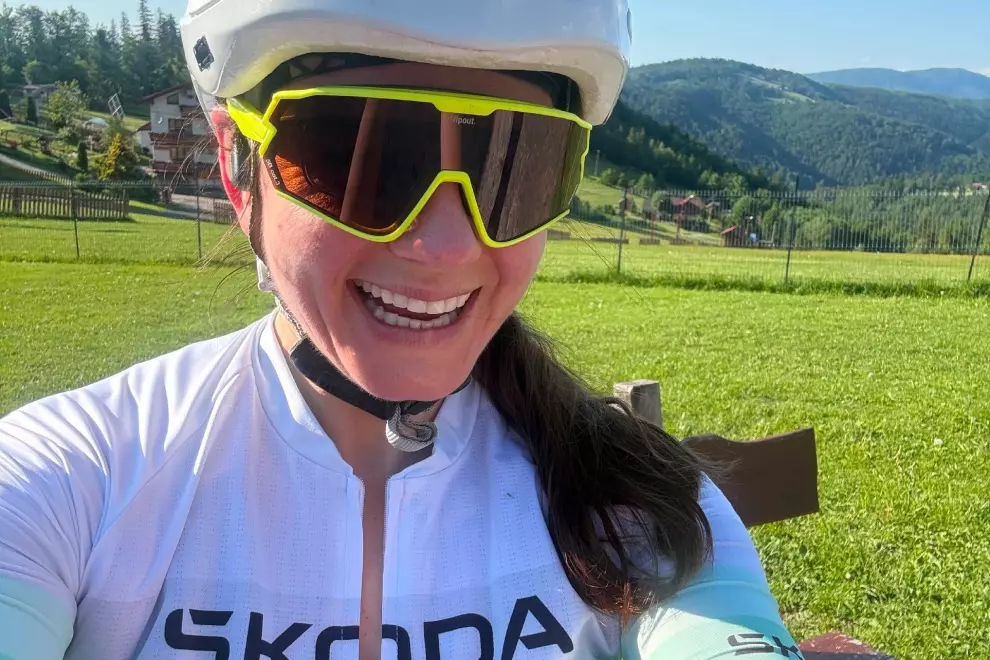
From the very beginning, Zwolska’s expectations were modest. “The goal was to finish the race,” she says. “Finishing itself seemed difficult and unattainable.” So uncertain was she about the outcome that she often joked about being last. “I kept saying I wanted to finish last because someone has to be the last, but at the same time, I simply dreamed of reaching the finish line.”
That dream carried her through months of training that often felt impossible to balance with the realities of running a mountain hut. Looking back now, there are things she would change. More climbing-specific preparation tops the list. “If I were to prepare again, I would do more uphill runs during training,” she says, recognising that her demanding work schedule left little room for additional cycling. Yet when race day finally arrived, something unexpected happened.
“I surprised myself,” she admits. For much of the event, she was riding stronger than she had imagined. “I was doing very well until the 60-kilometre mark.” On the famous climb through Ząb, she found herself overtaking other riders and maintaining a solid pace afterwards. For someone who had spent months questioning her fitness and worrying about whether she belonged on the start line, it was a powerful moment of validation. The race eventually delivered the suffering she had anticipated. “The last 40 kilometres against the wind took their toll,” she says. Fatigue accumulated and every kilometre became harder. But she kept moving.
Zobrazit příspěvek na Instagramu
That determination was perhaps most remarkable given how she felt before the start. “I was very stressed,” she recalls. Surrounded by riders discussing expected times and results, she struggled to believe she was capable of completing the challenge herself. “I didn’t believe it was possible for me.” Then came the finish line. Not euphoria. Not triumph. Relief. “It’s great that it’s over,” she laughs. “The last few climbs were brutal.” It is an answer that perfectly captures the honesty that defined Zwolska’s journey from the beginning. For Ewa, The Unseen Stage was never about becoming a different person. It was about discovering what was already there.
Now, as she returns to everyday life, some things remain unchanged. She still views cycling as freedom, exploration, and discovery. “I’m returning to romantic cycling,” she says, joking about the contrast between adventure riding and training by watts and power zones. Yet something has shifted. She now finds herself wanting to revisit climbs, compare efforts, and see how she measures up against her previous self. The rider who once doubted she belonged at L’Étape has started thinking like an athlete.
Most importantly, she no longer questions whether accepting the challenge was the right decision. “It was a beautiful adventure,” she says. “It showed me what preparation for training looks like, what cycling is in a sense, and I’m glad I took up this challenge.” And if the opportunity came once more? “If you asked me again,” she says, “I would do it.” For someone who once feared she would fail before she even started, that may be the greatest finish-line victory of all.