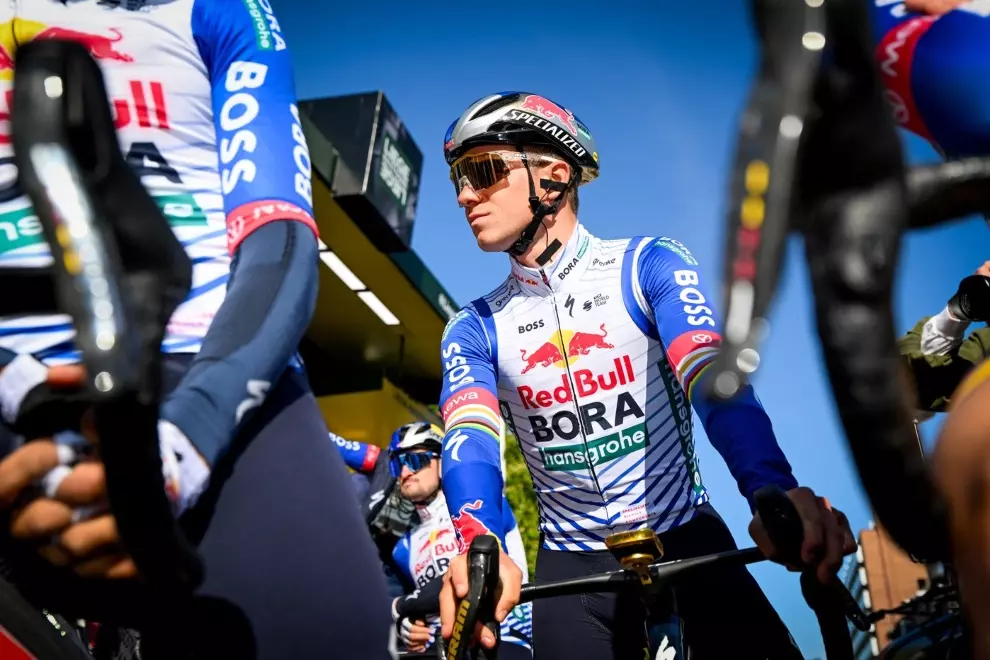
The issue is Evenepoel’s climbing
In fact, the issue they are trying to redress is nothing less than Evenepoel’s DNA, specifically his compact, stocky body that enables him to have an ideal aerodynamic profile on the bike, but makes it harder for him to produce the power-to-weight ratio necessary to climb with Tadej Pogačar and Jonas Vingegaard (and perhaps Paul Seixas) on the Tour’s longest and steepest mountains.
“The Volta a Catalunya made it clear that we needed to continue emphasizing climbing,” Red Bull sports director Klaas Lodewyck told Het Laatste Nieuws. “Well, we are taking the time for that.” In that race, in March, Evenepoel struggled on the climbs, finishing fifth in the GC, more than 2 minutes behind Vingegaard.
He’d had the same issues in the two previous Tours he rode in. In 2024, he finished third, 9:18 behind Pogačar and 3 minutes behind Vingegaard, who was still weakened from the effects of his catastrophic crash in the Itzulia Basque Country. In 2025, Evenepoel abandoned the Tour in the second week, after being dropped on the Tourmalet, due to extreme fatigue. At the time, he was already 7 minutes behind Pogačar. No wonder, then, that his coaches are resorting to a different approach. But is it the right one?
In its defense, Lodewyck pointed out to Het Laatste Nieuws that Evenepoel “barely saw any action in the nearly two months leading up to” the 2022 Vuelta a España, which he won. But that’s not quite true. Less than two months before the start of the Vuelta he rode in the Belgian Road Race and Time Trial Championships, and three weeks before the race he won the one-day San Sebastian Classic.
And the riders he defeated in the Vuelta – Enric Mas (Movistar) and Juan Ayuso (then UAE Team Emirates, now Lidl Trek) – were not of the level of riders he will face in July: Mas has never won a stage in the Tour and Ayuso had just turned 20 and been a WorldTour rider for only one year.
More important is the fact that in the modern era no one has ever won the Tour de France after going two full months without racing. The usual blueprint for winning the race has the rider competing in both the spring Classics and at least one week-long stage race like the Critérium du Dauphiné or the Tour de Suisse in the runup to the Tour.
To be fair, Vingegaard’s strategy for this year’s Tour is also unorthodox, riding in the Giro d’Italia and then spending the five weeks between the two races first resting and then building on his superb performance in that race. But at least that strategy is a proven one; Pogačar used it in 2024 to win the rare Giro-Tour double, a feat the Visma–Lease a Bike leader is attempting to duplicate.
Evenepoel’s last race before the Tour was at Liège-Bastogne-Liège in late April. Which means that when he hits the pedals on stage 1 of the Tour, on July 4 in Barcelona, he will have gone 68 days without a race. Many people in the sport believe it’s a bad strategy, not because of fitness issues, but because dealing with the intensity, positioning, and speed of the Tour without the race-day experience of recent competitive racing is a huge gamble.
Perhaps the coaches at Red Bull are also not quite sure, which is the reason they have a fail-safe option in the improving Florian Lipowitz, who will be riding as co-leader. He finished third in last year’s Tour and, if Evenepoel does falter, he will give a good account of himself and might again finish on the podium.
A strategy for winning the Tour?
Obviously, a lot of thought and planning has gone into Evenepoel’s pre-Tour training. His program during this 68-day period is based on four specific targets to address his relative weakness on major mountain climbs: extended altitude adaptation, shifting his time trial engine to the long climbing efforts required in the Tour, deliberate weight management and route reconnaissance.
Evenepoel began with a long-term, isolated base camp in the Sierra Nevada mountains in Spain. The goal there has been to maximize the physiological benefits of altitude – such as increased red blood cell production and oxygen delivery – over a continuous training period, rather than breaking it up with travel to races. So, the early weeks of his training focused entirely on long, grueling endurance training sessions to build a massive aerobic base. In June, the emphasis turned to sustained climbs at high altitude, to prepare him for the Tour’s most brutal mountains.
Weight management is problematic during three weeks of intense racing because it requires a high caloric intake that makes precise nutritional adjustments difficult. In his controlled training environment, Evenepoel’s nutrition and energy output can be regulated to help him shed weight safely. But there is the potential problem of the effect of significant weight loss ahead of the Tour de France on his body.
As retired great Alberto Contador said last year, “From one year to the next, losing that weight for the Tour de France is dangerous. . . . At a certain point you reach an incredible weight, where you’ve never been, [but then] the body comes and bursts. Forget about the Tour de France if that happens.” This might have been what happened to Evenepoel in last year’s race.
He knows the risk. “I have genes to gain weight easily,” he said in April. “I notice that in my explosiveness and three-minute [power] values as well. In April, those are better than in the summer, because then, just like with weight, I also lose some muscle and absolute power. It is a matter of finding the right balance in that, but currently that is neatly under control.”
Finally, the open schedule allows Evenepoel to combine his training with targeted reconnaissance rides of key Tour de France stages, so that he will be familiar with the important alpine descents and climbs when he gets there. It all sounds reasonable, but it’s all speculation until July 4.
Stage 1 of this year’s Tour is a team time trial in Barcelona, and he excels at the discipline. That will be an early test of how much, if at all, his weight-shedding has affected his power. Evenepoel will certainly want to take the yellow jersey early and so is using a brand-new Specialized time trial bike that, he and his team hope, will compensate for his lighter frame.
A bigger test will come five days later, on stage 6, which proposes more than 4,100 meters of climbing, including the Tourmalet (17.1km @ 7.2%). His rivals’ teams will surely put the new, slimmer Evenepoel to the sword as soon and as often as they can. How his training strategy helps him to respond to the challenges is just one of the numerous unknowns that has made the 2026 Tour de France one of the most anticipated races in a long time.
And if he wins the Tour, or at least does considerably better than before, you can bet the ranch that other teams will be trying the no-race Tour strategy next year.