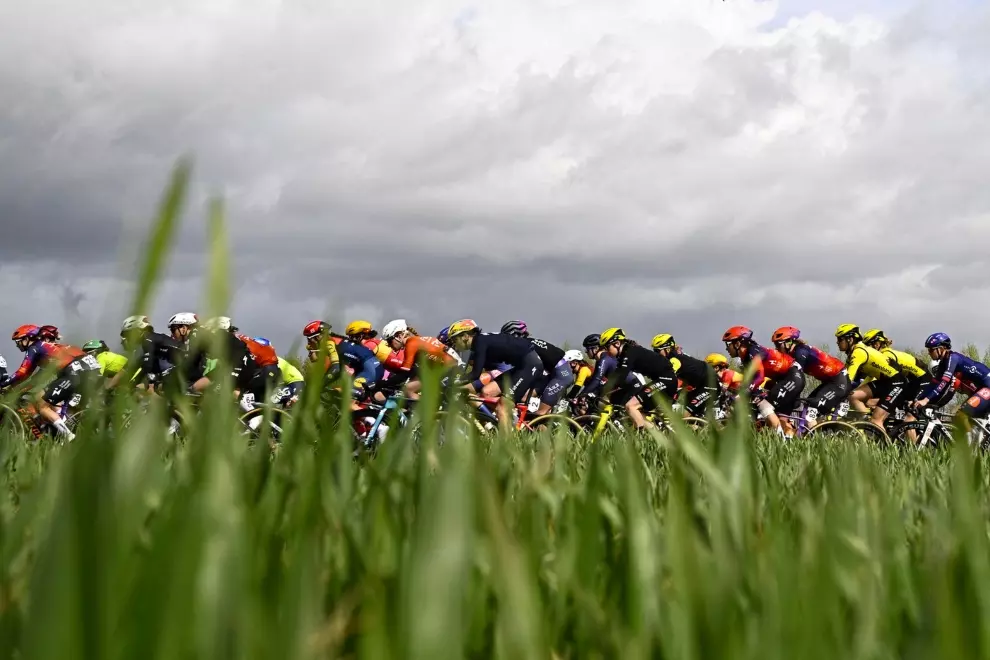
On paper, the transition between April and May represents little more than a change in format. One-day races give way to multi-day stage race showdowns. Cobbles and short climbs give way to longer efforts, general classification battles, and time gaps measured in seconds rather than bike lengths.
But if you’ve watched closely, or raced it, the change doesn’t feel neat like that. I’d venture to say it feels rather more like the ground shifting under your feet.
What April actually does to riders
By the time the peloton leaves the Ardennes, after Liège-Bastogne-Liège Femmes, no one is fresh. The Classics take tremendous energy and force riders into a constant state of reaction. Positioning, crashes, wind splits, mechanicals, everything happens fast, and usually at the worst possible moment.
Take Strade Bianche Donne and Paris-Roubaix Femmes as examples. Here, we often see races explode far from the finish. Gravel sectors don’t care about tactics in the same way, and if you’re out of position, chances are you’re just out of the race. Riders like Annemiek van Vleuten and Lizzie Deignan have built entire victories on forcing the race open early and trusting their engine to hold.
At the inaugural Paris-Roubaix Femmes in 2021, Lizzie Deignan attacked with around 80 km to go, an almost irrational move in any other context, and it worked because the race behind collapsed into hesitation and disorganization.
That kind of move is basically impossible to replicate in a stage race. If you go that early on Stage 2 of a week-long race, you’re not winning, you’re just spending energy you’ll need later.
All of that builds a certain kind of rider by the end of April: sharp, aggressive, and used to solving problems immediately. And that can all add up to a rather tricky period of transition.
The first days of May feel like a trap
When La Vuelta Femenina starts, it doesn’t look different immediately. The roads are wider, the terrain more varied, but the bunch still moves with that same nervous energy, and typically you’re still following the same riders who excelled in the Classic.
But the consequences of attacks and breakaways start to change dramatically. An effort that would win you a race in April might cost you the race in May. A rider follows a move on Stage 2 that doesn’t matter, spends just a little too much, and then on Stage 5, on a climb that actually decides the general classification, they’re missing that little bit of extra juice in the tank.
At the 2023 La Vuelta Femenina, for example, Annemiek van Vleuten didn’t dominate from the start; she actually lost time in the opening team time trial. But instead of chasing it immediately, she waited. When the race hit the mountains on Stage 5 to Lagos de Covadonga, she rode her own tempo, let others crack around her, and took back over a minute in one effort. Riders who had been aggressive earlier in the week simply couldn’t respond.
Stage racing isn’t won in those early moves, but it can absolutely be lost there.
The riders who learn to do less
This is where the shift becomes visible, not in who attacks, but in who doesn’t. Demi Vollering is probably the clearest modern example of this. In the Classics, she’s present, attentive, ready to follow the decisive move. But in stage races, especially in Spain, what stands out is her patience.
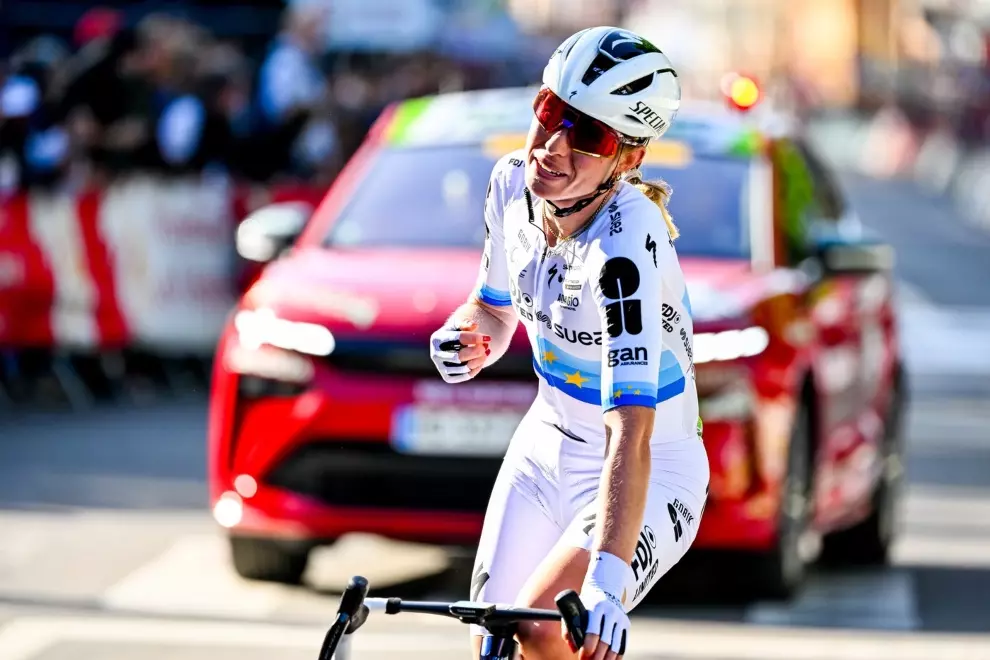
That restraint is learned, and it’s basically the opposite of what the Classics condition you to do. Vollering’s win at the 2023 Tour de France Femmes is a great long-arc example. On Stage 7 (Tourmalet), she didn’t respond to every acceleration early on the climb. She let her team set the tempo, then made a sustained move that no one could match, taking the yellow jersey.
Earlier in her career, she was more reactive, covering moves, following attacks. Now, she’s choosing them. This also highlights how the transition into May isn’t just physical but also cognitive. Riders have to override weeks of instinct.
The accumulation effect
There’s also a moment in most stage races where pure strength stops solving the problem. You can see it in how riders like Annemiek van Vleuten approached races like La Vuelta Femenina or the Giro in her later career. She had become a total expert at setting a tempo that gradually removed everyone else from the equation.
The effect is slower, but more reliable, and you see gaps appearing incrementally, opening up meter by meter. There’s another layer to this shift that doesn’t show up in results sheets: the accumulation of everything that’s already happened.
By May, riders aren’t just carrying fitness, they’re carrying damage from small crashes, repeated efforts, travel, and stress. Riders who were constantly visible in April, always in the break, always following moves, sometimes find themselves just slightly below their best when it matters most.
Teams finally get their say
Another important change in May is that teams start to matter more than individuals. In the Classics, even the best teams can be undone by positioning or bad luck. A crash at the wrong moment, a split in the wind, a missed move, it doesn’t take much.
Strong teams can correct mistakes by assuming more control over pace, protecting their leader, and gradually shaping the outcome.
The difference is easiest to see in how teams like Team SD Worx–Protime race a stage race. At the 2023 Tour de France Femmes, they didn’t chase everything; they set a tempo that made chasing unnecessary. By the time Demi Vollering attacked on the Tourmalet, the race had already been reduced to the riders who could survive that pace.
Why this part of the season feels different
The Classics are easy to read: one day, one result, one decisive moment. You can drop into the final 30 kilometers and understand everything. Stage racing, on the other hand, asks for more patience from fans. A small time gap on Stage 3 matters, or a missed split on Stage 2 might come back to bite you later. A domestique’s effort, barely noticeable in isolation, might be the reason a leader survives a climb two days later.
At the 2022 Giro d’Italia Women, Marta Cavalli was one of the strongest climbers in the race and won a major mountain stage. But over the course of the week, small time losses, positioning, splits, and minor gaps added up, and she ultimately lost the overall to Annemiek van Vleuten, who was simply more consistent across every stage.
Winning the Tour of Flanders or Paris-Roubaix Femmes requires a certain kind of brilliance, instinctive, aggressive, immediate. Winning a stage race requires a different kind of approach: controlled, patient, and just as ruthless, but in a quieter way.
How to stay dialed into the action
In a matter of days, the peloton rolls into La Vuelta Femenina, and all of this stops being theoretical. It’s one of the first chances in the season to see who has actually made the shift successfully.
There’s the obvious layer of GC contenders, riders like Kasia Niewiadoma, who has spent years balancing instinct with restraint, or Gaia Realini, whose climbing can tilt a race in a single stage if she arrives with the right legs. Juliette Labous is another who tends to rise through consistency as the days add up.
You also have riders like Cecilie Uttrup Ludwig and Elisa Longo Borghini, who are aggressive by nature. And then there’s a newer layer coming through. Shirin van Anrooij, still early in her stage racing trajectory, but already showing the kind of composure that suggests she understands the long game. Or Neve Bradbury, part of a younger generation learning quickly how to manage effort across a week rather than a single result.
And then there’s always the unknown—the rider who carries just enough from April into May, who finds themselves in the right move, on the right day, with legs that hold when others don’t. We can’t wait to find out who will make history over the coming weeks. From La Vuelta to the Giro and beyond, stay tuned as we see who is going to ride away on top in 2026!