A winner’s win and a winning loss
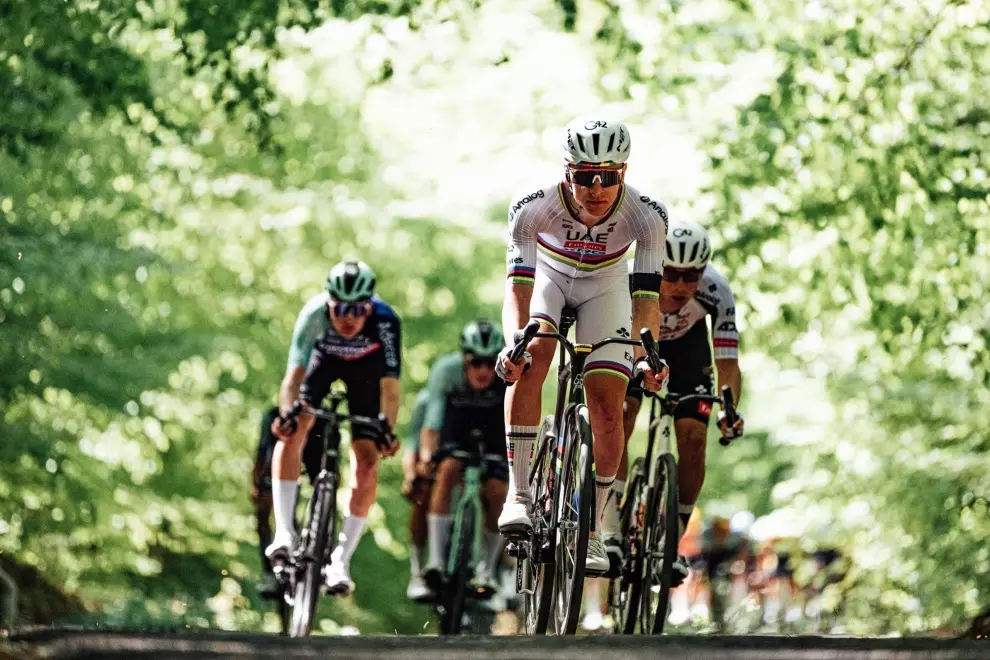
As he had in the last two editions of the race, Pogačar (UAE Team Emirates–XRG) attacked about 35 km from the finish, on the slopes of the Côte de la Redoute (1.6 km @ 9.4%, max. 20%), and for the first time in a long time he wasn’t alone when he sat up again. Because the 19-year-old Seixas (Decathlon CMA CGM) was right on his wheel, and he stayed there all the way to the summit, as Remco Evenepoel (Red Bull–BORA–hansgrohe) and the other pretenders to the throne were left behind as if glued to the spot.
For 30 minutes, and 20 km, this cycling fan’s heart beat double time as Seixas rode with Pogačar down the descent and on the flat, even taking turns in front, and the hope grew that the Slovenian great had finally met an equal. But on the cruel Côte de la Roche-aux-Faucons (1.3 km @ 11%, max. 16%), the last of 11 categorized climbs, it all changed. Pogačar put the hammer down once, looked back at Seixas, who was still there. Then, with 14 km left to ride in the race and 580 meters from the summit, he accelerated again, and this time the courageous French teenager cracked.
At the end, Pogačar’s winning margin was 45 seconds, which says little about how impressive Seixas’ performance was. After last year’s Il Lombardia, where he finished seventh, this was only the second time he had ridden such a long one-day race, 259.5 km, which included nearly 4,400 meters of altitude gained. And to go toe-to-toe with one of the greatest riders of all time, and beat Evenepoel and other top riders by 1 minute, makes him a winner too in my book. I mean, he’s still just a kid.
Pogačar was certainly impressed and waited for him at the finish line to pay him his respect. Later, he told TNT Sports, “On La Redoute I was really going deep, and I could see that Seixas was a little bit on the elastic. But over the top he came next to me and I was like, ‘OK, really impressed’, and then he was also pulling quite strong all the way.
“He worked and we opened up a big gap, which was good for us, and then I was maybe, in the back of my head, preparing already to do a sprint, because he was so strong. But I then tried on Roche-aux-Faucons with my pace. I know the climb super well, and it suits me well, and luckily, he dropped. But I was prepared to go head-to-head in a sprint with him [at the finish].”
Zobrazit příspěvek na Instagramu
Seixas was visibly disappointed when he crossed the finish line. “I wasn’t too far away from winning,” he said. “I gave it everything, but Tadej was stronger than me. I was already having difficulty on La Redoute, but I held on. I did a few turns after that, but then he went again and I just couldn’t go with him.” How many riders have said that in the past? But how many of them were 19 years old?
Evenepoel won the sprint for the final spot on the podium, finishing 1:42 behind the winner, a disappointment for the Olympic champion as he finished the spring classics season with one victory and two third places to show for the three Ardennes classics he rode in. Still, he tried to be upbeat. “Third in the end is a pretty okay result,” he said. “I think I had to kind of recover a bit from being in the break, and then I gave it the maximum to go for the podium. Being again on the podium is a good feeling.”
A crash, a split, and now what?
The race may have ended with a bang, but it began with a crash involving Ion Izagirre (Cofidis) and Andrea Vendrame (Jayco AlUla), which effectively split the peloton in two, with Evenepoel, Egan Bernal (INEOS Grenadiers) and 50 other riders in front and Pogačar, Seixas and the rest of the peloton behind. Red Bull and INEOS immediately sought to take advantage of the split and sent their riders in front to open a gap. The gap to the peloton reached 4:00 with about 150 km left to ride.
But Pogačar said he was never really worried about catching the front group. “I was at the back, and I just followed the wheels,” he said. “I looked down, I saw we go fast, and then one moment I looked up and the group was split. But then after 20 minutes we realized it is not so bad to let them go. In these big groups there’s not such good cooperation.”
And that’s what happened. Eventually the other teams in that front group refused to cooperate, and the peloton caught what remained of it 94 km from the finish. From that point on, it became a normal race, with a small breakaway group – which was caught in no time – and then the final dramatics.
“It means a lot to win one of the biggest races of the year again,” Pogačar said. “I don’t have a lot of opportunities to win, because I don’t race a lot, so it’s a lot of pressure for me to deliver on days like today, and I’m really happy that we succeeded. I couldn’t be prouder of the team.”
In fact, his team was decisive again, with Tim Wellens working like a man possessed to catch the Evenepoel breakaway and Pavel Sivakov and Domen Novak setting up Pogačar perfectly for the La Redoute attack. But this time, the big man had to work a little harder than usual. He has now won the race four times, one short of the five Liège-Bastogne-Liège victories of Eddy Merckx. It was also the Slovenian’s 13th Monument victory, second-most behind the 19 of Merckx.
At 44.42 km/h, this was by far the fastest Liège-Bastogne-Liège of all time. Of course, Pogačar held the previous record of 41.98 km/h, achieved last year.
Results Men’s 2026 Liege-Bastogne-Liege, 259.5 km
- Tadej Pogacar, UAE Team Emirates–XRG 05:50:28
- Paul Seixas, Decathlon CMA CGM +0:45
- Remco Evenepoel, Red Bull–BORA–hansgrohe +1:42
- Emiel Verstrynge, Alpecin–Premier Tech “
- Egan Bernal, INEOS Grenadiers “
- Pello Bilbao, Bahrain-Victorious “
- Romain Grégoire, Groupama–FDJ United “
- Christian Scaroni, XDX Astana “
- Tobias Halland Johannessen, Uno-X Mobility “
- Filippo Zana, Soudal Quick-Step “