The other ‘wow’ rider
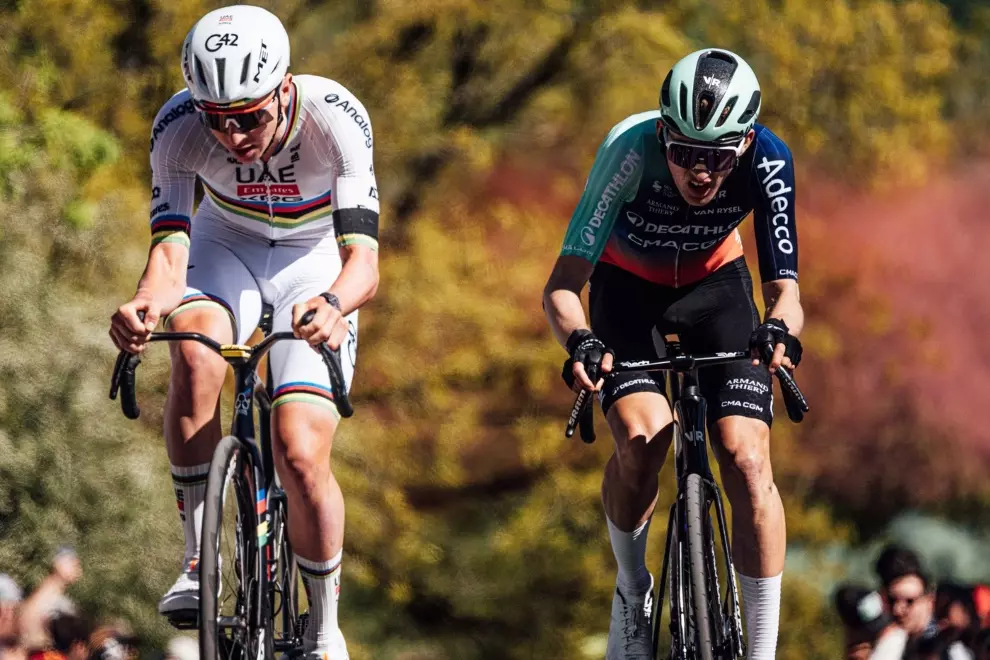
That word is increasingly being used in connection with the other spring talking point, 19-year-old French phenom Paul Seixas, who is now regarded as the Second Coming of Pogi to the point that UAE Team Emirates–XRG will be trying to acquire his services once his contract with Decathlon CMA CGM ends in 2027.
Already seen as the first French rider to win the Tour since 1985, the teenager officially became a French national icon this spring after, according to Eurosport Spain, French President Emmanuel Macron “offered his full support to the Decathlon team for the contract renewal and also spoke directly with the manager of the Lyon-born rider, who in turn is demanding a strong team around him.” In other words, he wants to keep Seixas French.
And Decathlon, eager to please the French president and Seixas, has started trying to meet the teenager’s demand. Again according to Eurosport Spain, they are close to signing one of Pogačar’s most valued domestiques, Pavel Sivakov, who is also French.
You see what I mean? Pogačar is still the best rider in the world and had a great spring, winning four of the five classics in which he rode, but we are talking about Seixas, who the Slovenian beat twice this spring, in the Strade Bianche and then in last Sunday’s Liège-Bastogne-Liège. In both races Pogačar’s winning margin over Seixas was similar, 1:00 in Strade Bianche and 45 seconds in Liège. But in the latter race, Seixas managed to stay on the world champion’s wheel for about 20km when he attacked, before succumbing to his infernal pace on the final categorized climb. That was big news.
At a post-race interview, as reported by France 24, Pogačar also spoke about his new rival. “Having Paul entering such a big field at such a good level already at 19, it brings motivation to everybody else now to keep trying to improve,” he said. “Because, again, he’s 19 now and normally your body physically is the best at 26 to 30 years old. So we’ll see. We keep working hard to still try to fight for the next years to win as much as we can until he destroys everybody… It’s just a matter of time when we lose to him.”
It’s not yet clear if Seixas will ride in this year’s Tour de France. He has no experience of a three-week race and there’s a definite risk in having him start with the hardest one. Asked after Liège about his ambitions, he said, “Now that I’ve finished second, my next ambition is to win a Monument. There are no certainties in life when it comes to the future: you’ve only achieved something once you’ve done it.” Does that sound like a teenager?
Pogi is still top dog
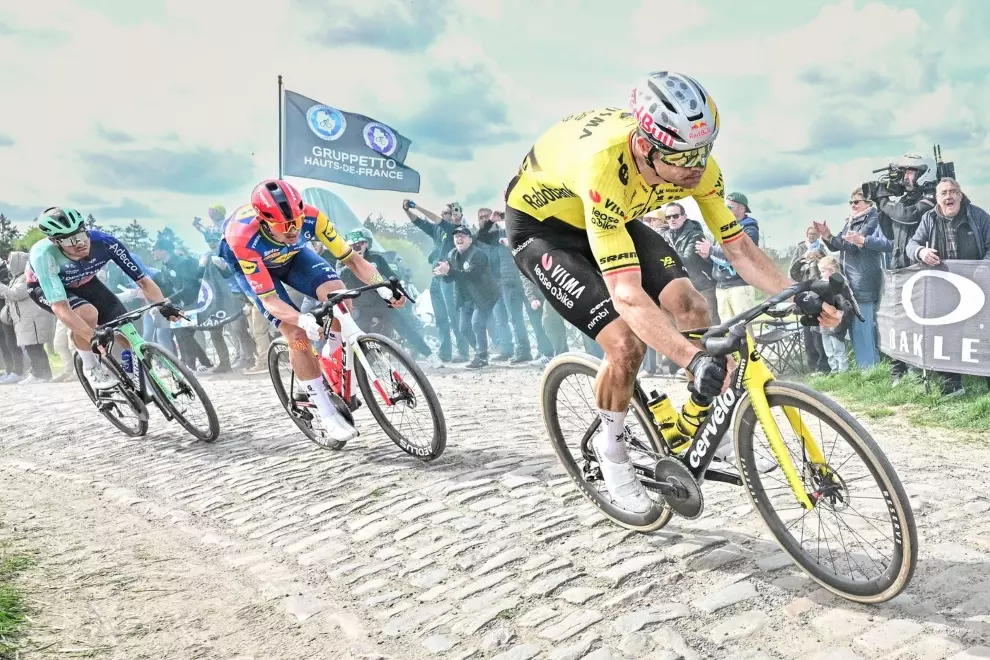
As for Pogačar, he came into this spring in what appears to be the best form of his life and was defeated only by a super-motivated Wout van Aert (Visma–Lease a Bike) in a Paris-Roubaix in which he had to change bikes three times and spent too much time riding on a service car bike because his team car was too far away. Other than that, he was nearly untouchable.
I say ‘nearly’ because he was definitely touched in Milan–San Remo and then proved by winning just what a great rider he is. He crashed about 33km from the finish line, just before the important Cipressa climb. When he got back on his bike, he was 35 seconds behind the peloton just as it was speeding up for the Cipressa ascent. With the help of teammates Florian Vermeersch and Felix Großschartner, he closed the gap in just 6 km, reaching the tail of the peloton just as the climb began. Two more teammates, Brandon McNulty and Isaac del Toro took him to the front of the peloton and led him up the climb.
When he attacked, only Mathieu van der Poel (Alpecin–Premier Tech) and Tom Pidcock (Pinarello Q36.50) were able to follow. He dropped van der Poel on the Oude Kwaremont climb and outsprinted Pidcock to the line. A remarkable victory, made even more remarkable by the fact that he had won with a damaged bike. His mechanic revealed after the race that the rear triangle (stays) of Pogačar’s bike was cracked during the impact.
In addition to the frame damage, the impact triggered the bike’s electronic shifting “crash mode” and caused the disc brake to rub against the braking surface. Pogačar managed to manually reset the derailleur while riding and ignored the mechanical drag to catch the peloton. And then he broke his own record for climbing the Cipressa in 8:48. In a word: Wow!
Wout thrills, Remco baffles, Mathieu rides hurt
While there were several thrilling races this spring, van Aert’s Paris-Roubaix victory may have been the best because it was Wout being Wout again after a long dry spell and because the “Hell of the North” was incredibly hellish, its unforgiving cobbles causing more mechanical issues than a demolition derby. For example, van der Poel had a puncture with 93km left to race that set him back 2 minutes. That he finished only 15 seconds adrift, in fourth place, tells you everything about his strength and determination. But this was van Aert’s day, and a stone must have fallen from his heart when he sprinted past Pogačar on the indoor track of the Vélodrome André-Pétrieux and crossed the line, as cycling fans all over the world rejoiced.
As for Evenepoel (Red Bull–BORA–hansgrohe), he didn’t have a bad spring at all, but it was mediocre for a superstar. Though he started the season early and well, winning three minor races in Spain before taking the Volta Comunitat Valenciana over João Almeida (UAE Team Emirates–XRG), he finished tenth in the UAE Tour and fifth in the Volta a Catalunya, well beaten by Jonas Vingegaard – though he appeared to be riding in support of teammate Lipowitz, who finished third.
He outsprinted Mattias Skjelmose (Lidl-Trek) to win the Amstel Gold Race, but finished third in the Tour of Flanders and Liège-Bastogne-Liège. That’s very good, of course, but I’m sure he wanted more and we had expected more. I had expected him to contest the finish at these races.
It’s far too early to call it a disappointing beginning for Evenepoel with his new team, because Red Bull–BORA–hansgrohe has won 14 races and he has won five of them. But something feels off about his performances against the riders he should be challenging for victories, by which I mean Pogačar, Vingegaard, and now also Seixas.
Van der Poel also went down in the Milan–San Remo crash that made Pogačar hit the pavement, and he was both the first to get away and the worst hurt. During the crash, another rider’s bike rammed into his hand, causing a “hole” in his fingernail and a deep laceration that was still bleeding at the end of the race. He said at the finish he couldn’t hold the handlebars properly during the final climb of the Poggio due to the pain. He finished eighth, 4 seconds behind Pogačar and was advised not to race for a while and let the hand heal. He didn’t do that.
In the Saxo Classic, he was uncharacteristically caught by a trio of riders after a long breakaway, but outwitted them for the victory. In the Tour of Flanders he couldn’t keep up with Pogačar when he attacked on the Oude Kwaremont, and finished 34 seconds behind the Slovenian. Though most riders would have been happy with the results, someone with van der Poel’s talents and ambition would not have called it a successful spring campaign.