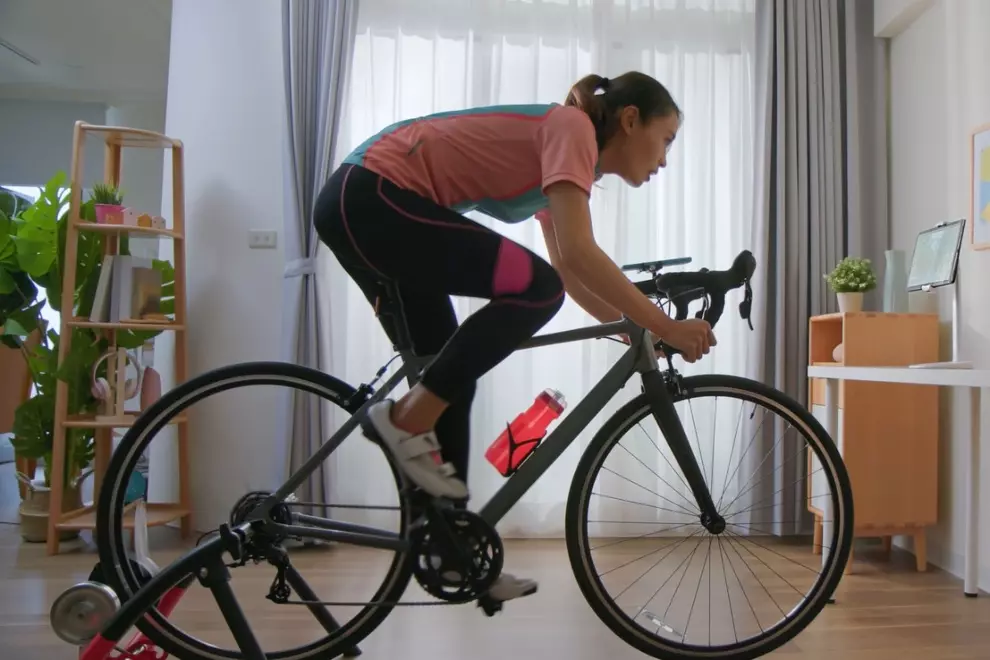
And to be fair, indoor riding has grown up. Thanks to Zwift and Rouvy, it’s no longer about staring at a wall while numbers blink at you like a dying calculator. Now you ride with others. You chase avatars. You race up French climbs in the morning and somehow end up in Sri Lanka by lunch. Zwift will even send you to an alien planet, which feels oddly reasonable after twenty minutes at threshold.
Naturally, there are races. Proper ones. You pin it, you suffer, you finish wrecked and pleased with yourself.
Then spring comes. The legs are there. The fitness checks out. The intent is good. And yet something is off. Not dramatically wrong, just subtly misaligned. Indoor racing doesn’t hurt your fitness. It quietly erodes a few real-world instincts, small enough to ignore at first, serious enough to stack up later.
Here’s how indoor races start hurting your outdoor performance if you’re not careful.
You ride without consequences
Indoor racing teaches you how to push power without paying for your decisions. You surge because you feel like it. You close gaps late. You drift through wheels. Nothing bad happens. Worst case, your avatar slows down, and you stare at the screen a bit harder. Indoors, mistakes are temporary. Outside, they compound.

Real racing is a long negotiation with consequences. Line choice matters. Surface matters. Timing matters. Miss one detail and you spend the next five minutes clawing back something you never should have lost. You don’t just produce watts, you spend them carefully. Indoors, every effort exists in a vacuum. There’s no penalty for impatience, no cost for sloppiness, no tax on bad judgment.
That’s the problem. You learn to ride as if output is the only variable that counts. Outdoors, power is just the entry fee. Everything else decides whether it was worth paying.
It’s mostly a road thing
Indoor racing doesn’t fail everyone equally. It has favourites. If you’re a road rider, especially one who enjoys long, seated efforts and the emotional comfort of steady numbers, you’re in luck. Indoor racing speaks your language. Smooth power. Stable cadence. Predictable effort. Sit down, suffer politely, repeat.
For MTB and XC riders, the relationship is more complicated. Off-road racing is disorderly by design. You’re constantly changing position. Standing, sitting, sprinting, braking, recovering, swearing at a root that definitely moved since the last lap. Power comes in bursts, not paragraphs. Cadence is a suggestion, not a rule.
Indoor racing can help your engine, no doubt. It makes you strong in a very specific way. But it doesn’t teach you how to deploy that strength when the terrain keeps interrupting your plans.
So, sure, you will build the horsepower, but when there’s no road to show it off, you need to adjust mid-race.
You don’t need tactics
Indoor racing is brutally honest about one thing: your brain is optional. You show up, the clock starts, and the only real instruction is “go hard now”. There’s no wind to hide from, no road furniture to exploit, no section where patience pays off. Everyone is exposed all the time, which turns racing into a steady exchange of watts instead of decisions.
Outside, tactics are survival. You drift back to shelter when the crosswind kicks up. You move early before the pinch point. You wait because the road, the group or the weather tells you waiting is smarter than showing off. Indoors, none of that exists. You can’t outthink the course because the course doesn’t think back.
So you race on instinct, not intelligence. You attack when you feel good. You follow when you feel threatened. It works indoors because there no punishment for it.
Outdoors, that approach gets read immediately. Just remember how Tadej Pogačar rode the Tour in 2022 and again in 2023, chasing everything like a man racing a spinner. Eventually, he cracked. Meanwhile, Visma waited, planned, and took everything that was offered. The moral of the story is that power tells who’s the strongest, tactics decide who is using the strength.
No genuine connection with other riders
Indoor racing puts you near other riders without ever really riding with them. You see names, avatars, and power numbers floating politely above heads. That’s the extent of the relationship. No eye contact. No elbow flick. No shared moment where you both pretend you’re fine while clearly you’re both about to throw up your lungs.
Outdoors, racing is social, whether you like it or not. A few words mid-climb can pull you out of your head. A glance tells you who’s bluffing. Someone skipping turns suddenly means something. Group dynamics shift constantly, quietly, and usually without warning. Indoors, none of that exists. Everyone rides their numbers. Everyone stares at their screen. Interaction gets reduced to math.
And then there are the bonuses. Draft boosts. Power-ups. Little gifts from the algorithm, handed out like party favours. Real racing doesn’t do that. No one hands you a helmet icon when you’re about to crack.
Racing people isn’t the same as racing profiles. One messes with your head. The other just updates your stats.
You don’t get the weather
Indoor racing is perfectly climate-controlled, which sounds harmless until you realise that the weather is part of the skill set. Wind teaches patience. Rain forces restraint. Cold changes how you pace, eat, and think. None of that shows up indoors. The conditions never argue with your plan.
Outside, the weather is a constant negotiation. You choose when to push because a headwind will punish impatience. You adjust lines because grip is a suggestion, not a promise. You suffer differently because your body reacts differently. Indoors, the effort is clean. Outdoors, effort is compromised by everything around it.
The problem isn’t comfort. It’s amnesia. You forget how much the weather shapes decision-making. You forget how to read it, respect it, and work with it. Then race day arrives, and the sky refuses to cooperate. And while fitness doesn’t disappear in bad weather, clear-headed judgment surely does.
There’s no real race prep
Indoor races are efficient. Too efficient. You log in, warm up halfway, race for forty minutes, collapse, and call it a day. It’s neat, contained, and oddly comforting. There’s no real need to plan beyond “have a towel” and “don’t forget to start recording”.
Outdoor racing doesn’t work like that. Races are longer, messier, and far less forgiving. You need to know when to eat, not just what to eat. You need to think about water before you’re thirsty, effort before you’re tired, and restraint before you’re desperate. Indoors, urgency is rewarded. Outdoors, it’s often punished.
Race prep isn’t glamorous, which is why indoor racing quietly erodes it. You stop practising patience. You stop rehearsing the boring parts that keep everything together later. Then you line up outside and realise strength isn’t the problem. It’s everything you forgot to prepare for.
Don’t stop indoor races, just don’t pretend they are enough
Indoor racing isn’t the enemy. Quitting it would be pointless and, frankly, unnecessary. It makes you fit. It keeps you sharp when the weather is actively hostile. It gives structure to winter when motivation is thin, and daylight is a rumour. All of that matters.
The problem starts when indoor racing becomes the only version of racing you practice. When it replaces outdoor riding instead of supporting it. When comfort turns into a habit. When you start believing that the way effort feels inside will translate cleanly once the road starts pushing back.
The fix isn’t heroic. You don’t need to seek misery or ride into storms out of principle. You just need to take the windows when they appear. Cold mornings. Ugly days. Imperfect conditions. Go outside and remind yourself how a real bike behaves when nothing is controlled.
Indoor races build fitness. Real riding keeps your instincts alive. Ignore that balance, and the road will re-educate you the hard way. It always does.