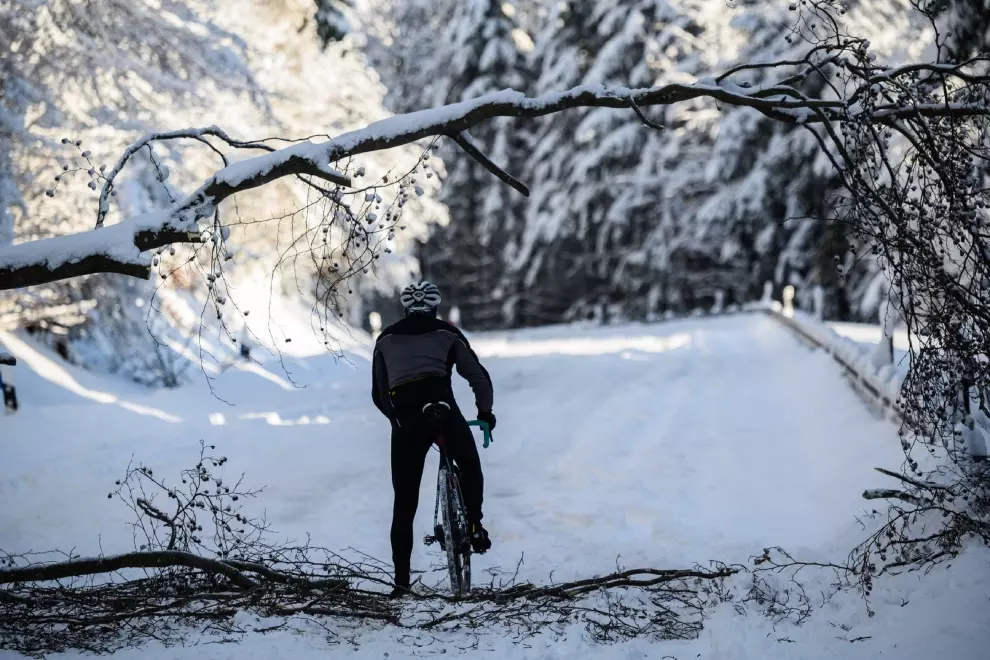
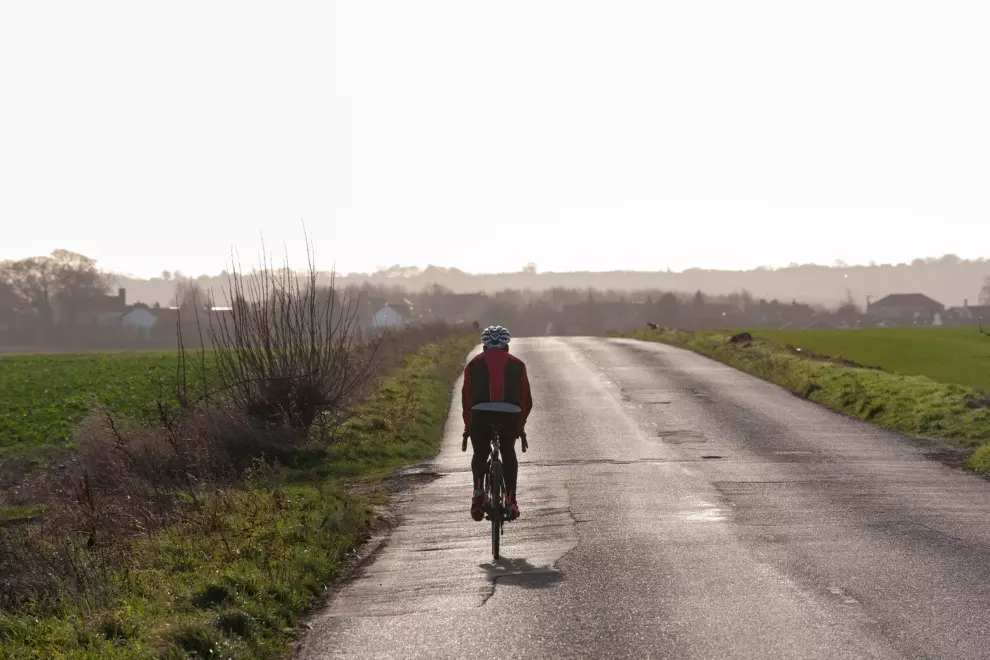
Real-world riding works differently. The effort is shaped by airflow, surface changes, small decisions, and forces that do not care about your workout plan. Power targets exist, but they are secondary to surviving the whole ordeal. I mean, you won’t run a red light trying to maintain zone 2, right? Right?!
At first glance, indoor and outdoor cycling may seem similar, but they are two entirely different sports. And while one can definitely help with the other, they are not interchangeable. Here is why.
Overheating and thermal stress
Indoor training often feels harder for a reason that has nothing to do with motivation or mental strength. Your body struggles to get rid of heat.
Outside, even at moderate speeds, airflow constantly removes heat from your skin. Indoors, that airflow disappears. Sweat still forms, but evaporation is slower, skin temperature rises, and the cardiovascular system has to work harder to maintain the same output. This is where cardiac drift shows up. Heart rate climbs even though power stays steady, and suddenly a perfectly reasonable endurance ride starts to feel like an extreme game show.
This difference matters because it changes how effort is experienced. Two rides at identical power can produce very different levels of strain depending on cooling. Indoors, heat accumulation can shorten time to fatigue, distort pacing, and make long steady efforts feel artificially demanding. You are not weaker inside. You are simply warmer.
The problem is not just discomfort. Excessive heat alters how reliably indoor training transfers to outdoor riding. If a significant part of the stress comes from poor cooling rather than muscular or aerobic load, the session trains heat tolerance more than riding efficiency. That can be useful in the right context, but it is not the same stimulus you face on the road.
So, use a proper fan or two. Aim airflow at the torso and face rather than the legs. Ventilate the room if possible, and drink more than you would outside for the same duration. These steps reduce heat strain and stabilise heart rate, making indoor efforts closer to their outdoor equivalents.
Cooling improves the situation. It does not recreate natural airflow, but it prevents overheating from becoming the dominant limiter instead of fitness.
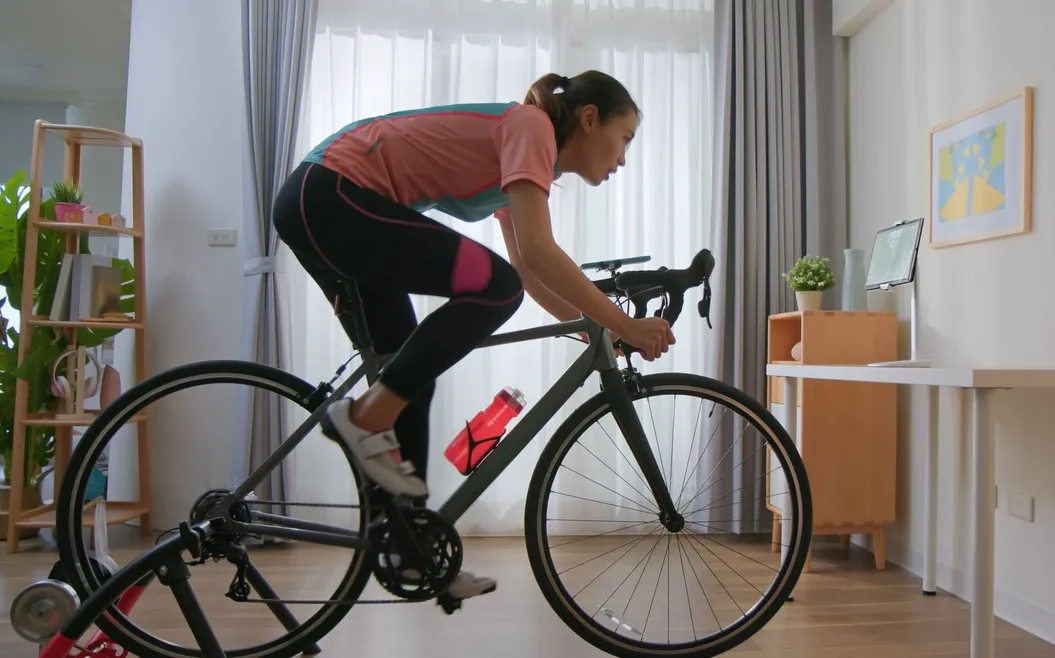
Inertia, momentum, and constant load
The beauty of riding outside is in the inertia, momentum, and those hundred micro-rests you get when you put on some extra effort. The road is rarely flat. It has its character with grumpy hills or cheerful descents. So, on the road, effort is rarely continued. You push a bit more on the downhill and have it easy on the small rise ahead. That’s a 4th-grader cycling tactic, but we still use it. You can’t get this indoors. The resistance is always there, waiting, demanding payment for every second of pedalling.
But inertia is not about rest. It effectively changes the entire dynamic of how you ride, how you apply force, and how you time your feeding and bottle sips. When you have the downhill on your side, you will try to drink water and eat while your legs aren’t spinning like a mental patient on a merry-go-round. You can break your rhythm without losing momentum or speed.
The issue is not that trainers are unrealistic. It is that they are predictable, and the real world rarely is. It constantly shifts the balance between force, cadence, and momentum. Indoor setups simplify that equation, and simplicity has consequences.
So, if you are trying to replicate outdoor riding, try to add some free-riding. Some high-end indoor trainers include this, but even if they don’t, simply stop pedalling for a little while when training your endurance. Also, your cadence can fluctuate naturally. You don’t have to be strictly at 92 RPM. Feel free to have outbursts, then a slower rhythm. But even though you can simulate a bit of the outdoor experience outside, you can’t really feel the momentum, the inertia, the turning technique, the micro-resting during turns, after a push, during a short but all-so-needed flat.
Handling, balance, and bike control
Indoor cycling can be very beneficial for your legs, but it largely neglects the rest of your muscle groups. Handling the bike, balancing it, and the constant movement required in real-life cycling activate much more than your quads. It involves your back and shoulder muscles, your abs and core, and your overall body. Even your neck muscles are activated when trying to push yourself to the limit. You can see it best looking when Jonathan Milan starts his sprint.
On the road, balance is always working in the background. Even when you think you are doing nothing, your body is making constant micro-adjustments to stay upright and smooth. Indoors, most of that disappears. The bike stays vertical on its own, corners stop existing, and traction becomes something you vaguely remember from last season.
This is why the first ride back outside after a long indoor stretch often feels sharper than expected. Standing feels clumsy. Corners feel faster. Nothing is actually wrong, but your legs and your bike have not spent much time together lately.
Indoor training does not damage handling. It simply ignores it. Balance, braking, and line choice are skills, and skills fade when they are not used. You can slow that process down a bit by standing more during indoor rides, moving around on the bike, changing hand positions, and, if you are brave or bored enough, spending some time on rollers, which have a remarkable talent for exposing sloppy balance within seconds.
Indoor riding will keep you fit. It will not remind you how hard you can push into a corner or how calm you stay when the surface changes. Those lessons tend to come back quickly outside, usually right after you have decided you are definitely still good at this.
Aerodynamics, drafting, and group dynamics
It’s tough to rely on aerodynamics, drafting, and group dynamics when you’re riding alone on an immovable object. Sure, modern apps allow you to actually feel the effects of drafting (somewhat), but with the lack of crosswinds and external factors, that’s mostly a number on the screen rather than feeling it through your legs.
Furthermore, no matter how aerodynamic your position is, you won’t get less resistance. You won’t feel a shove from your neighbour, and you won’t learn how to react to late braking in the group.
Outside, drafting is still about aerodynamics, but mostly it is about people. The draft moves constantly. Gaps open and close. Someone stands up without warning. Someone else slows down while reaching for a gel they absolutely did not need at that exact moment. You are always adjusting, often without realising it.
Sure, modern apps can help you learn how to hold position and follow pace changes, but they don’t teach distance. They don’t teach how close to get, how to stay calm riding three fingers from the rider in front at 50kph, not seeing what’s ahead. Indoors, there are no real consequences for getting it wrong.
That becomes obvious the first few times you ride in a group again after a long indoor block. The speed feels normal. The power feels manageable. What feels unfamiliar is the closeness. The noise. The small movements that suddenly matter a lot more than watts saved.
Unfortunately, there is nothing you can really do to mimic this indoors. So, mix your indoor sessions with outdoor rides with your friend. They don’t have to be long or hard. They have to be real, however.
Mental load and sensory deprivation
Indoor riding is a strange mental experiment. You pedal, the bike goes nowhere, and the scenery remains the wall in front or, at best, a window. You can always go for a mirror, but that would be awfully egocentric on your part. After a while, your legs are fine, your lungs are fine, and your brain starts checking the clock like it is waiting for a delayed flight.
Outside, the mental work is spread out. You read the road, watch traffic, adjust speed, lean into corners, and dodge the occasional surprise. None of it feels demanding, but it keeps your head busy enough that time behaves normally. Indoors, all of that disappears, and your attention has nowhere to go except straight into the effort. Five minutes feels long. Ten minutes feels like an accusation.
This is why indoor sessions can feel harder than they should. The workout is not brutal. The environment is just very, very committed to being the same. After a long indoor block, the first outdoor ride often feels easier than expected, not because you suddenly became fitter, but because your brain is finally entertained again.
You can make this better. Changing cadence, posture or effort mid-ride helps. Music helps. Screens help. And platforms like Zwift and Rouvy help a lot by giving you something to look at and react to, whether that is a virtual climb or a real road filmed by someone braver than you.
They do not turn indoor riding into outdoor riding. They just make the time pass at a speed that feels more socially acceptable, which, during a long winter, is already doing most of the work.
Indoor is not outside, and that’s fine
Indoor trainers are very good at what they do. They make you fitter, keep you consistent, and remove most excuses. What they do not do is replace riding outside.
That is not a failure. It is a reminder. Cycling is not only about producing power. It is about reacting, adjusting, and occasionally coasting at exactly the right moment while pretending it was all part of the plan.
Use indoor training to build the engine. Use outdoor rides to remember how to drive it. Confusing the two usually ends with great fitness, mild frustration, and the sudden realisation that the road still has a few lessons left for you.