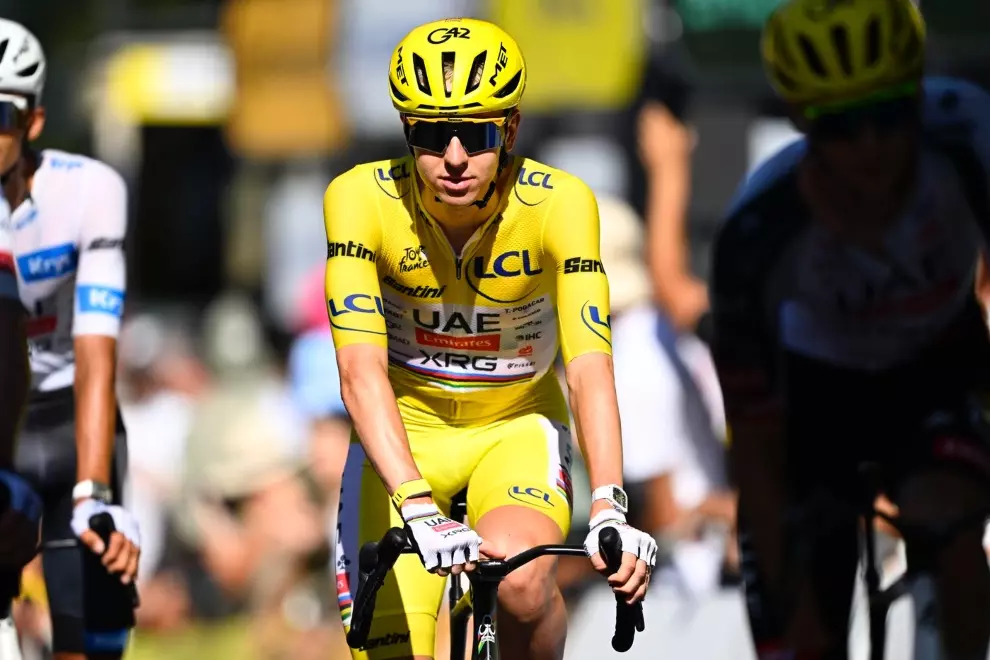
“The desire for next year would of course be the World Championships combined with the Tour and the Vuelta,” he said. “Even if I would rather go to the Giro, I will have to check off the Vuelta at some point. I think that will be the goal for next year.”
That is a lot of intense racing in a short time. The 2027 Tour starts in Edinburgh on July 2, with the first three stages held across Great Britain, and ends on July 25. The rest of the route will be officially presented on Thursday in Paris. The World Championship Road Race will be held on August 29, 2027, in Sallanches, France, and involves 5,700 metres of climbing over 265 km. The Vuelta starts just six days later. That makes for a lot of climbing and racing in three months.
But Pogačar has already begun training. “Last week I started the new season, and now it’s a slow build-up for the future,” he said. “I have now been training regularly for a week, which is a month earlier than in previous years.”
He also addressed the crash in the Vuelta, in which he suffered a fracture and dislocation of the left collarbone, a fracture of a cervical vertebra, and a serious concussion. First, he settled unequivocally the question of what had caused it. “It was a big stone,” he said. “Everything else is fake news.” There had been lots of rumours about the cause, including a camera flash and a TV camera battery.
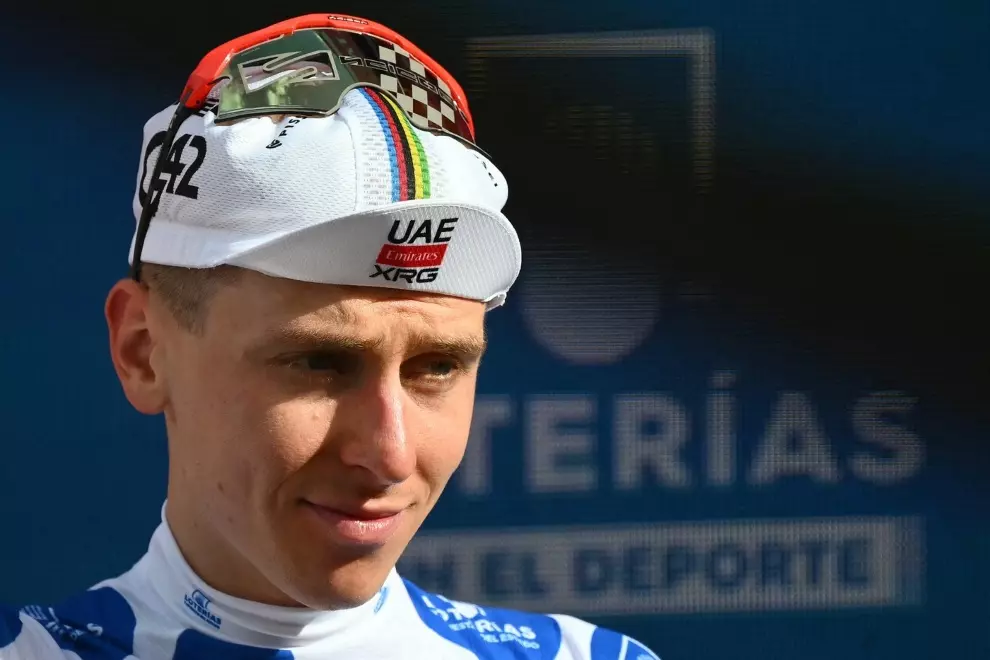
He went on to say that the crash was hard and the consequences were painful. “Because the injuries were quite serious, it took me quite a while to get on the bike – five weeks,” he said. “When my shoulder had healed and I no longer experienced dizziness […], I started training on the exercise bike and doing physiotherapy with the thought that I could go to the European Championships, which gave me additional motivation. But a little over two weeks before the European Championships, I realised that there was no point in racing. Because if I fell again, the consequences could be really serious and it wasn’t worth the risk.”
There had also been many rumours regarding his participation at the Euros, especially as his name had remained for a while on the list of riders participating. But UAE quickly shot down all suggestions that he would race again this year.
Pogačar spoke at the end of a charity event at the Volčji Potok Arboretum, 20 km northeast of the capital city, Ljubljana. He said that he will travel this week to the United Arab Emirates, home to his team and main sponsors, where he will have various obligations, such as cycling with his fans. “It’s also an opportunity to sit down with the team management and talk,” he said. “Since I’ve already finished the break between seasons, we’ll already be discussing specifically what we’ll do next year.” He said that a tentative racing program will be formulated at the gathering in Abu Dhabi before it is announced in December.
According to RTV Slovenia, there’s a possibility that he may begin his season at the Tour Down Under, where he made his WorldTour debut in 2019, finishing 13th. This would mean an early start to the season with a longer break before the summer and perhaps fewer spring classics. If that’s true, then the team is being cautious. And rightly so, for the effects of his injuries were cumulative – that is, the damage to the body was greater than the sum of the individual injuries.
It took Wout van Aert more than a year to recover his best form after injuring his knee in the 2024 Vuelta. His Visma–Lease a Bike teammate Jonas Vingegaard took two years to be at his best again after his horrific crash in the 2024 Itzulia Basque Country – and he has since crashed out of the 2025 Paris-Nice and this year’s Tour – which strikes me as unusual for a rider who earlier in his career hardly ever fell off his bike.
I assume that this caution will be part of the discussions between Pogačar and his team. Despite his apparently superior physical qualities, he’s (probably) not Superman and may take some time to recover his Greatest of All Time form. And a first serious crash can change a rider’s relaxed attitude to racing – at least for a while. That may be one reason Vingegaard has crashed more often after the Itzulia because that crash made him a little more tense, a little less natural on the bike.
Despite the lost time and racing, Pogačar ended the year as he began it, as the best rider in the sport. He won four one-day races – Strade Bianche, Milan-San Remo, the Tour of Flanders and Liège-Bastogne-Liège – losing only a thrilling Paris-Roubaix to Wout van Aert. He also won the Tour de Romandie, Tour de Suisse and Tour de France and was leading the Vuelta before crashing out.
Though the racing was more competitive, and therefore more dramatic, without Pogačar, I missed him. It will be a pleasure to be in awe of him again next year, while also complaining about the lack of suspense in the races he dominates. I can’t wait.