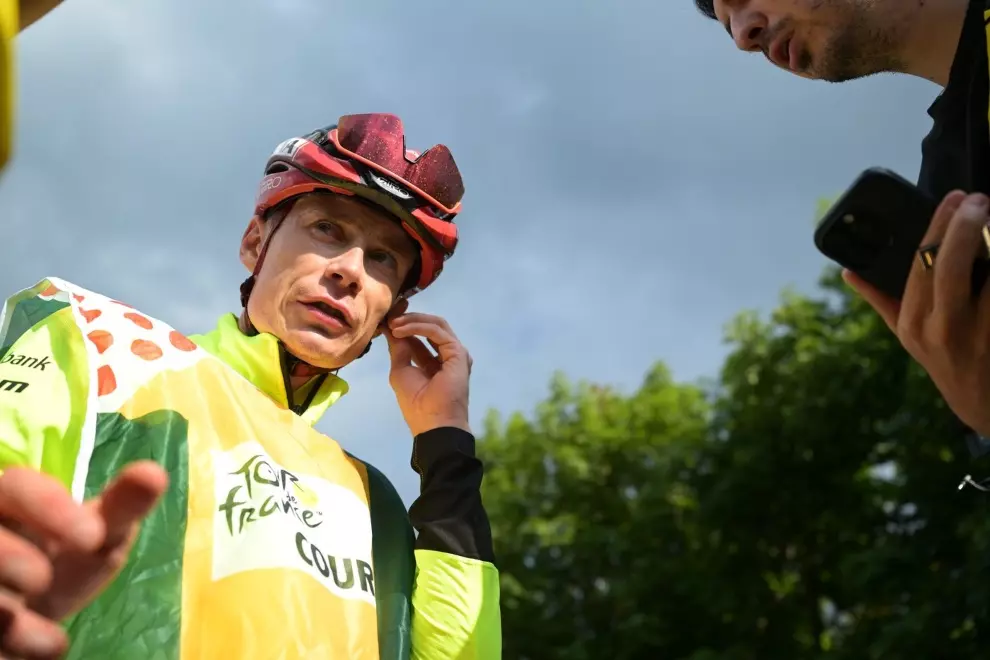
Two-time Tour winner Jonas Vingegaard abandoned the 2026 Tour de France after crashing on a harmless-looking curve with 22 km left to ride on Sunday’s stage 15, breaking his collarbone. The incident occurred as Visma–Lease a Bike had set up the stage to challenge race leader Tadej Pogačar (UAE Team Emirates–XRG) on the first big summit finish of the race, the Beyond Category (HC) climb to the Plateau de Solaison (11.3 km @ 9.1%).
In a statement, the team said, “[E]xaminations revealed that Vingegaard sustained a broken collarbone and multiple abrasions. Due to the severity of the fracture, he will undergo surgery in the coming days.”
Evenepoel springs a surprise
Vingegaard’s absence from the rest of the race appeared to deprive the GC competition of the little suspense it had left. But then Remco Evenepoel provided the second shock of the stage. When Pogačar took over the front of the small GC group and chased what remained of the breakaway, only his teammate Isaac del Toro and the Red Bull–BORA–hansgrohe leader could stay with him.
Zobrazit příspěvek na Instagramu
As it turned out, Pogačar was riding for the young Mexican to help him win the stage, take over the best young rider’s white jersey and, finally, to help him jump onto the GC podium. But – like the rest of us – he hadn’t expected the new Evenepoel. When del Toro attacked the first time in the final kilometre, Evenepoel stayed with him; when the Mexican attacked a second time, he surged past him and held off Pogačar to take the first Tour road victory (that is, non-time trial) of his career and become, at last, a real Tour de France contender.
“It’s amazing,” the ecstatic Evenepoel said afterwards. “I’m literally trembling from emotion. It’s been a hell of a day, a pretty hard start. I was actually feeling really bad at the beginning, but I got better and better through the day. You have to understand that I’m racing with the best rider ever and he was doing a hell of a climb to win the stage for Isaac. For me, it’s a big step forward that I can follow his pace because it’s a crazy hard pace and I always get so many hard [criticisms] that I cannot survive steep climbs. It means a lot.”
I plead guilty to doubting him – but I’m delighted to say that I was wrong and that, if this stage was not an outlier, Evenepoel has finally taken the big step he needed to become a Grand Tour superstar. Asked about that exciting finish, he said, “I was not expecting any attacks from Isaac anymore. But he went again with 400 [metres] to go, and this was for me the perfect way to make a sprint. I just tried to keep my momentum, ride as hard as possible to the finish line. To win this beautiful stage, it’s amazing.”
Then he was asked about Vingegaard. “It’s really bad news in the first place for himself, for his team and for the race,” he said. “It’s something you never wish on anybody.”
Evenepoel now sits second in the GC standings, exactly 5 minutes behind Pogačar, with del Toro now in third, at 5:58. Paul Seixas (Decathlon CMA CGM) was dropped on that final climb and finished fourth, 58 seconds behind the winner. He sits in fourth place in the GC, 6:23 adrift. He also lost the white jersey, which he had won the previous day [see below].
Did a doping control cause the crash?
But it is Vingegaard’s crash that will be a point of discussion for days or perhaps even weeks to come. Reuters and other sources reported that Vingegaard was awakened at 2 a.m. Sunday morning for an unannounced doping control. He said that the process took about 40 minutes before he could return to bed, heavily disrupting his recovery before a crucial Alpine mountain stage.
“The ITA (International Testing Agency) didn’t allow me to sleep much,” Vingegaard said before the start of the fateful stage. “I was sleeping very well, but somebody knocked on my door at 2 a.m., big surprise to me. Of course, it’s good that they test, but when it’s affecting performance and your sleep, I don’t think it’s so good.”
The question that will be asked, and must be asked, is how much, if anything, the lack of sleep contributed to his crash. Any athlete will tell you that fatigue leads to carelessness. No one can say that it had an effect on his alertness; but nobody could claim the contrary.
Pogačar was roused at 5 a.m. and never made it back to bed, preferring to drink coffee all morning. “I got four hours of sleep today,” Pogacar said before the start. “I couldn’t fall back to sleep. It was definitely not nice to wake up in the middle of sweet dreams. They come randomly in the mornings through the Tour, and today they chose nighttime.”
Fast, long, weird
Friday’s stage 13 was long, it was fast, and it was weird:
Long: at 205.8 km, it was the longest stage of this year’s Tour.
Fast: Despite 2,400 meters of climbing, the average speed was an astonishing 49.999 km/h.
Weird: At one point in the stage, and for quite some time, the breakaway contained 57 riders!
But 13 was lucky for Mauro Schmid (Jayco AlUla), who won the stage, and Tom Pidcock (Pinarello Q36.5), who moved from 10th place in the GC standings to fourth. Pogačar and the other GC riders let the gap to the breakaway grow out to 8:27 despite the presence of Pidcock up front. They were saving their legs for the weekend’s big mountain stages and did not believe that the British rider’s climbing was good enough to keep them from reclaiming the GC places they would lose to him.
Eventually, on the slopes of the Category 1 Ballon d’Alsace (8.9 km @ 6.9%), the mammoth breakaway broke up into smaller pieces, with a 10-rider group ending up at the front after the descent from that climb. Several riders tried to get away from the lead group, but were brought back until Schmid and Harol Tejada (XDS Astana) took off with 16 km left to ride. Their lead never surpassed 22 seconds, but it was enough to be able to take the time to jockey for position before the sprint and hold off the onrushing chasers.
Schmid’s winning margin over Tejada was minuscule, while Pidcock finished third, just 2 seconds adrift. The peloton finished 7:32 behind, which put Pidcock in fourth place in the GC standings, 4:15 behind Pogačar and only 9 seconds behind Evenepoel, then in third.
“I can’t believe it at the moment,” Schmid said after winning the first Tour stage of his career. “It was an incredibly hard day from the start. We were keen to be there in the breakaway. We’ve tried many times already, but so far, it didn’t go as planned. I felt really good from the start, but it was full gas from the first minute.”
Pogačar wins, Seixas climbs
As the old saying has it, “What goes up, must come down.” And that’s what happened to Pidcock on Saturday’s stage 14 and its 3,800 metres of climbing. The Briton again infiltrated a large breakaway (32 riders), perhaps in the hope of Pogačar again not caring about the win. But Pogačar did care; he cared very much. In fact, all the GC riders who Pidcock had passed in the GC standings cared, and, eventually, they caught him with 56 km left to ride. He eventually finished 18th and yoyoed in the GC from tenth to fourth and then to ninth in 24 hours.
Eventually, the peloton was chasing Richard Carapaz (EF Education–EasyPost) and the equally irrepressible Tobias Halland Johannessen (UnoX-Mobility) on the final, punishing climb, the Col du Haag (11 km @ 7.3%). They were caught 2.4 km from the summit, and 8.2 km from the finish. Less than a kilometre later, Pogačar – who had been biding his time – unleashed another winning attack that no one could follow and won his fourth stage of this Tour and the 25th of his career.
It was a good day for 19-year-old Seixas. He finished third in the stage, behind Pogačar and del Toro, which put him in the white jersey, if only for a day, and just 15 seconds behind Evenepoel and the podium.
It can’t be said too often that Seixas is still only 19 and the youngest Tour rider in 89 years. “It’s incredible, honestly; I’m living a dream,” he said after the stage. “For the moment, it’s better than I expected.”
Results 2026 Tour de France 2026 stage 15: Champagnole to Plateau de Solaison (183.9km)
1. Remco Evenepoel, Red Bull–BORA–hansgrohe 4:23:09
2. Tadej Pogačar, UAE Team Emirates–XRG ”
3. Isaac del Toro, UAE Team Emirates–XRG +0:06
4. Paul Seixas, Decathlon CMA CGM +0:58
5. Florian Lipowitz, Red Bull–BORA–hansgrohe ”
6. Lenny Martinez, Bahrain Victorious +1:57
7. Mattias Skjelmose, Lidl-Trek ”
8. Juan Ayuso, Lidl-Trek +2:00
9. Adam Yates, UAE Team Emirates–XRG ”
10. Quinn Simmons, Lidl-Trek +2:16
Tour de France 2026 General Classification After Stage 15
1. Tadej Pogačar, UAE Team Emirates–XRG 55:41:31
2. Remco Evenepoel, Red Bull–BORA–hansgrohe +5:00
3. Isaac del Toro, UAE Team Emirates–XRG +5:58
4. Paul Seixas, Decathlon CMA CGM +6:23
5. Florian Lipowitz, Red Bull–BORA–hansgrohe +6:48
6. Juan Ayuso, Lidl-Trek +7:28
7. Mattias Skjelmose, Lidl-Trek +9:38
8. Lenny Martinez, Bahrain Victorious +10:28
9. Tom Pidcock, Pinarello Q36.5 +11:19
10. Jordan Jegat, TotalEnergies +19:26