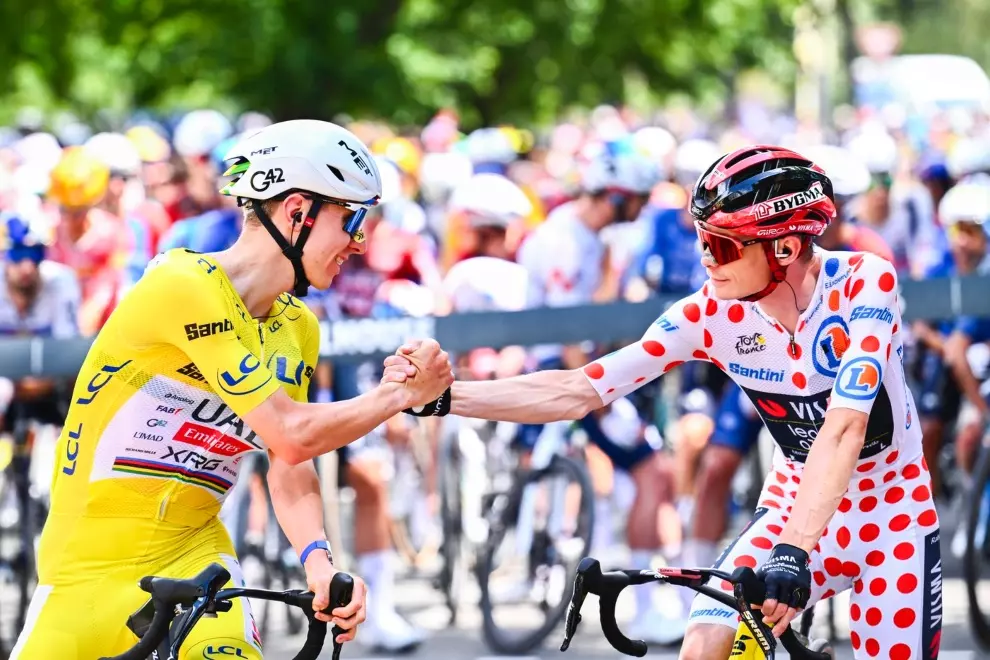
“It’s really, really sad to see that Jonas is out,” Pogačar said. “Since 2021, we were always battling out for the victory. Maybe at the beginning, we didn’t have the best relationship, but in the last two years, we became good, respected rivals, competitors, but I also think friends. The Tour will not be the same without him.”
The odd couple of the Tour
One of the reasons the Tour will not be the same is that Pogačar and Vingegaard have been the Tour de France since 2021, a show business duet every bit as iconic and inseparable as Sonny and Cher, Simon and Garfunkel, Batman and Robin. Yes, Pogačar came to dominate the relationship, but his domination in the Tour was always measured by how much he won or lost vis-à-vis Jonas Vingegaard.
And vice versa, of course. Vingegaard’s performances – or his chances of winning – were always defined by Pogačar. Other than each other, they had no rivals. When one of them won, the other finished second. Their talents and performances tied them together like Siamese twins. They were a couple, and they brought each other to the dance that is the Tour and danced almost always only with each other.
But they were an odd couple: the ebullient, fun-loving Pogačar, and the reserved family man that is Vingegaard. It’s easy to believe that, as the Slovenian said, their beginnings as a couple were difficult. Just compare how they celebrate their victories: Vingegaard kisses his wedding ring before crossing the line; Pogačar celebrates himself. That difference will surely be one reason they will be eternally linked in cycling history like the other legendary cycling rivalries – Fausto Coppi vs. Gino Bartali, Jacques Anquetil vs. Raymond Poulidor, Greg LeMond vs. Laurent Fignon.
As Alasdair Fotheringham wrote in Cyclingnews, “In fact, over the last five years, such consistent maintenance of his ‘best of the rest’ status has meant that Vingegaard has remained the link between the ‘first mortals’ behind Pogačar and the stratospheric level at which the four-time Tour winner operates.” In other words, Vingegaard was part human, part immortal, able to breathe both Pogačar’s rarified air and the more common air “the rest” inhale.
In his excellent article, Fotheringham quotes Red Bull–BORA–hansgrohe lead director Patxi Vila’s response to the question of whether it was possible for his two leaders to beat Pogačar. Vila said that the more immediate goal was beating Vingegaard. “If we win that battle,” he said, “then we’ll move onto another battle.” Put more dramatically, if Pogačar is the Greek god Zeus, Vingegaard is his half-mortal son and guardian of Olympus, Hercules.
Vingegaard’s ability has always defined Pogačar’s greatness, just as the Slovenian’s greatness underscored the Dane’s distance from immortality. Without Pogačar, Vingegaard would have been celebrated as one of the great riders in history. But without Vingegaard’s two Tour de France victories, Pogačar would have been called merely the best of a mediocre bunch. And who knows how much his rivalry with the Visma leader drove Pogačar to become the great rider he is? Would he have had the same motivation without a rival of Vingegaard’s ability? I doubt it.
A different Tour
Pogačar was right, of course: the race has been changed by Vingegaard’s absence. For one thing, it appears to have given Remco Evenepoel wings. When Vingegaard was in the race, the Red Bull rider suffered on the long climbs, making up lost time only on the flats and/or descents that followed them. But just two hours or so after Vingegaard abandoned the race, Evenepoel beat Pogačar on the hardest climb of the race so far, the Beyond Category (HC) ascent to the Plateau de Solaison (11.3 km @9.1%).
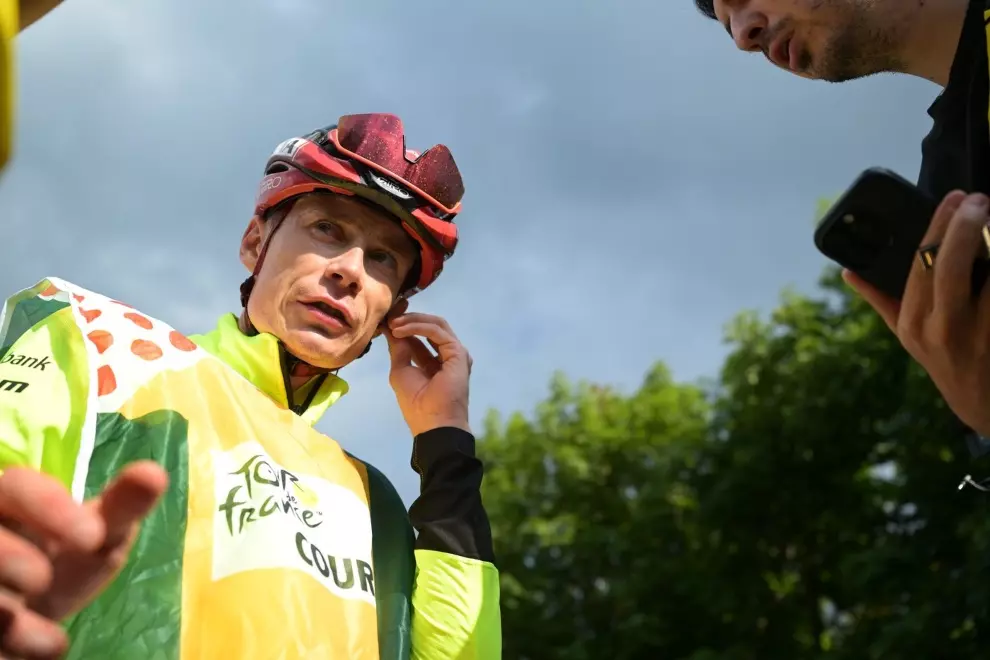
Coincidence? Or is Evenepoel just coming good in the race? Or was that a confirmation of Patxi Vila’s words, that with the first battle out of the way, the world time trial champion was able to move on to the next one? My first thought at seeing Remco ride with Pogačar on that climb was that he was filling a job vacancy and had simply been waiting for the opening in order to show what he’s got under the hood.
It’s too early to say if that was just a superior day for Evenepoel or if he will now replace Vingegaard as the main opposition to the Great One. Regardless, it will be a different rivalry and, yes, a different race – especially for Pogačar, who has always seen himself as battling Vingegaard. He must have been as shocked as I was to see Evenepoel on his tail on the Solaison climb.
Was that the reason he didn’t go all out on the sprint to the finish line because the satisfaction of beating Remco would not have been as great as beating Jonas again? After all, Evenepoel has never beaten him in the Tour GC, while Jonas beat him twice. If you don’t think that makes a difference to a competitor like Pogačar, think again. Another reason might have been that he wouldn’t have felt right celebrating a victory on the day Vingegaard crashed out. That might have been seen as disrespectful and, as we know, Pogačar is a good guy.
The race will not be the same without our hoping against hope that on this climb or on the next one Vingegaard may beat Pogačar. All cycling fans – except for the most die-hard Pogiephiles – would have rejoiced to see Vingegaard take a stage this year. I think Evenepoel’s victory was not as satisfying perhaps because he just doesn’t have the same history of perseverance and determination – and, yes, frustration – in the battle against the GOAT. Remember that Vingegaard rode in the 2024 Tour less than three months after a near-fatal crash in the Itzulia Basque Country – and finished second, for me his most remarkable race.
I think his recent failures to beat Pogačar prevented us from seeing just what a great rider Vingegaard is and how essential he has been to our enjoyment of the Tour de France. As the great Joni Mitchell wrote in her song “Big Yellow Taxi”: “Don’t it always seem to go that you don’t know what you’ve got ’til it’s gone?” I miss him already.