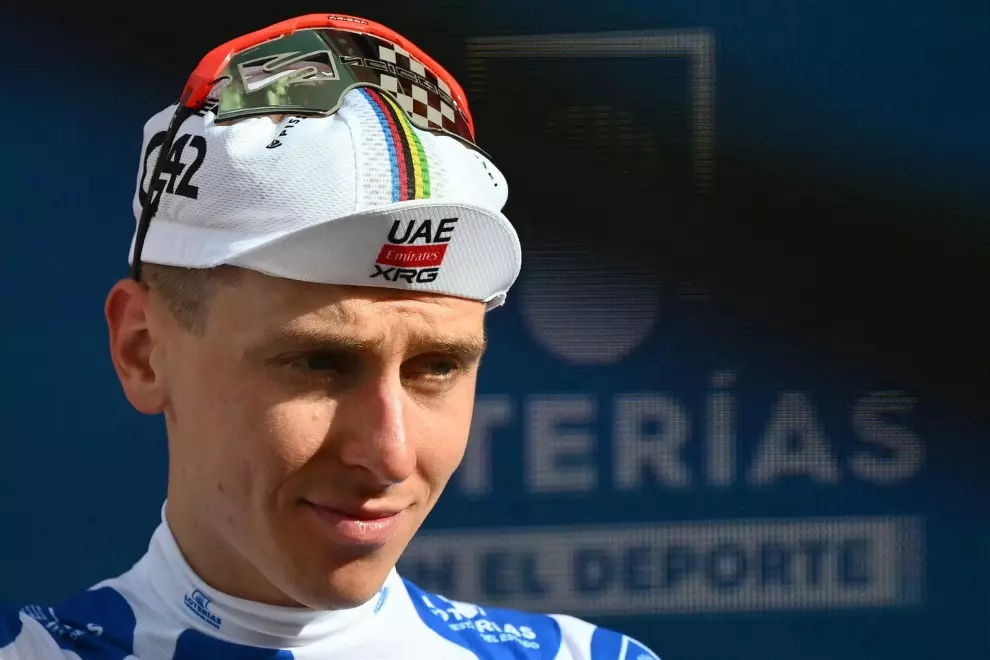
It is the first race Pogačar has abandoned since the 2023 Liège-Bastogne-Liège, the first-ever Grand Tour on which he has not finished on the podium, and the first Grand Tour he has ridden since 2023 without winning. In addition, according to TNT Sports, this is the first time in his career that he has not finished any of the 50 stage races he started. It is the end of a magnificent series of accomplishments.
A sad ending
What a shame it had to end like this. The five-time Tour de France winner was riding on the side of a wide road in the front half of the peloton when he apparently struck a loose rock on the new, otherwise pristine road surface. Dozens of riders had ridden over the same spot before him without incident. The contact made him veer sharply to the right into another rider and then pitch forward over his handlebars. Images showed him sitting on the roadside, dazed and unable to get up.
Later images revealed a nasty-looking wound on his right shoulder and bloody cuts on his face and forehead as well as numerous contusions. He tried to get back on his bike but was in too much pain; he then walked slowly but unaided to a waiting ambulance.
The first comprehensive medical report by UAE’s medical director, Dr Adrian Rotunno, was sobering. It read: “Unfortunately, Pogačar suffered a heavy crash during today’s stage and was unable to continue the race. He is stable, and following a thorough medical assessment at hospital, Tadej has been diagnosed with a concussion, a displaced left clavicle fracture, a stable C7 cervical fracture, and multiple abrasions.
“Fortunately, no other major injuries and no neurological fallout. He will require clavicle surgery, which will be delayed due to concussion precautions. Tadej remains under the care of our medical team, and we’ll provide further updates following the surgery.”
An uncertain future
Surgery will be carried out in Barcelona once the concussion has sufficiently improved. Following the procedure, the team and its medical staff will determine if Pogačar’s season is over or if he will be able to defend his world title in a month’s time in Montreal. But even if he is cleared to ride competitively, can he be even close to his best form in four weeks? The injuries he sustained were apparently ‘clean’ but severe.
According to expert online information, “When these three injuries occur together, their combined impact on the body is exponential rather than additive, heavily disrupting your neurological, structural, and metabolic systems.” Other sources say that achieving “full fitness” from these injuries is “a marathon that takes anywhere from 6 to 12+ months.” Fortunately, his cervical (or neck) fracture is stable, which will reduce the time required. And Pogačar is an extraordinary physical specimen, with uncommon powers of recuperation, so that no forecast is half as certain as his Vuelta victory was before the crash.
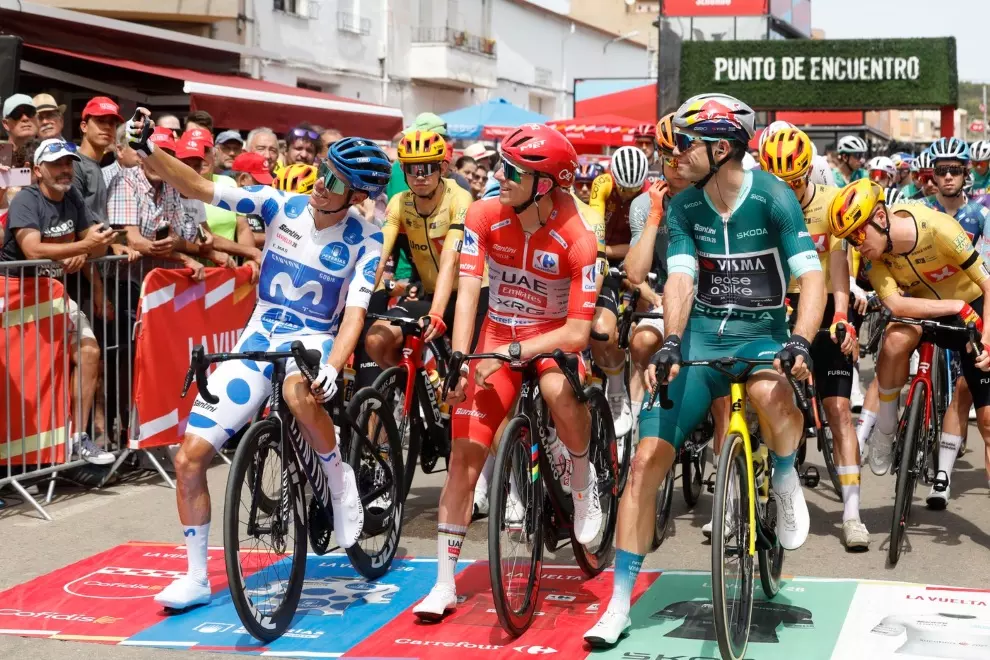
Oddly, a stage that looked to be the calmest and least dangerous of the entire three-week race – with only one minor climb and mostly wide and well-paved roads – was the arena for numerous crashes on Saturday. It began with a mass spill in the neutral zone, before the stage officially started, and ended with a mass crash 400 metres from the finish line as the bunch sprint got under way. In between, there were several crashes along the 161 km route from Puçol to Xeraco, including Pogačar’s. Three other riders abandoned the race after crashing on the stage.
The stage was also not particularly fast, as there was only a one-rider breakaway, Sinuhé Fernández (Burgos BH), whom no one was in a hurry to catch. And the GC teams were not invested in the stage because it was certain to end in a bunch sprint, so they had no reason to ride at a high pace to tire the legs of their rivals. The average speed was 42.536 km/h, which is nothing out of the ordinary for such a short and flat stage.
So, what can explain the many crashes when everything about the venue and the stakes of the stage promised an easy ride for the peloton? Perhaps the riders were tired from the exertions of the race so far, which has had them do a lot of climbing and fast riding in high temperatures. That could also explain why only one rider broke away from the bunch. Riding in a breakaway is tiring, and many of the riders probably wanted to use the stage for a rest, with a brutal stage coming on Sunday.
And let’s not forget that we’re nearing the end of a long, busy season, with many riders having already logged thousands of kilometres of climbing, sprinting, and occasionally crashing. Road racing has never been as fast as it is today; perhaps the bodies of many cyclists have not yet caught up to the efficiency of their material and the speeds they can produce. On the other hand, Sunday’s stage 9 was much faster and harder, yet there were few incidents on the road.
A totally new race
Pogačar’s abandonment of the race has transformed the Vuelta entirely. Such was his domination that all participating teams had to go back to the drawing board and make entirely new plans for the remaining two weeks of the Vuelta. Smoke must surely have risen from their team buses overnight as their sport directors mapped out new strategies. For one thing, home favourite Enric Mas and his Movistar team find themselves in the unaccustomed position of Grand Tour leader.
The last time Movistar led a Grand Tour race was during the 2019 Vuelta, when Nairo Quintana wore the red jersey through Stage 9. He ultimately surrendered the lead to Primož Roglič following the Stage 10 individual time trial. There’s another time trial in this edition of the Vuelta, 32.1 km on stage 18, and Roglič is here again. Déjà vu?
Mas and Movistar won’t have it easy for another reason. With Pogačar out of the race, the GC contenders won’t be so shy in attacking – and there are now at least six viable contenders for the title, which will be decided in the last three stages of the race.
On the other hand, Wout van Aert must now be considered the favourite to win the green jersey since there are very few, if any, bunch sprint possibilities left and it is unlikely that any one rider will dominate the stage victories as Pogačar would have. After stage 7, van Aert led Pogačar by a mere two points in the competition; after stage 9, he has a lead of nearly 60 points over teammate Mattew Brennan.
I confess that, despite the new suspense in the Vuelta, I missed seeing Pogačar power up the final climb of Sunday’s stage 9. Yes, there is much more suspense in the race now, but considerably less excitement. Mas and the others are excellent riders, but they will be haunted throughout this Vuelta by the world champion’s shadow. Because there is nothing more exciting in sports than watching a genius in full flight.