Anyone who wants to be surprised by Val di Sole should stop reading now. Roadies heading there to broaden their understanding of cycling culture, however, may prefer some advance warning. Consider this a short briefing on the things most likely to confuse them while every MTB fan nearby behaves as though nothing remotely unusual is happening.
Someone brought a chainsaw to cheer
If you’re visiting Val di Sole during the MTB Worlds, you’re likely to hear chainsaws revving from early in the morning. Don’t panic and don’t call the police. Firstly, they have ears too. More importantly, the aggressive audio assault won’t leave a massive bald spot in the surrounding forest. Nor is it emergency trail maintenance 35 minutes before practice starts.
The chain and guide bar have been removed. What remains is a fan making sure everyone in the valley knows they’re excited to watch the world’s best riders hurtle down what resembles a landslide with several roots and rocks mixed in, trying not to kill themselves at speeds suggesting this isn’t their primary objective.
Chainsaws have been part of downhill culture since forever, but in the last decade, ever since Stevie Smith’s tragic death, this tradition has developed a deeper meaning. Now, you can see a “Long Live Chainsaw” tribute along the trails, dedicated to the Canadian superstar, nicknamed “Chainsaw”.
If the chainsaws pause, cowbells, air horns, aluminium wheel rims beaten with metal rods, and anything else portable enough to carry uphill and hostile enough to human hearing will fill the silence.
Anyone seeking peace and quiet during the Worlds should wait until the downhill final ends. Even then, Val di Sole makes no promises.
The best seats have the highest crash probability
Road racing fans choose viewing spots based on scenery, tactical importance, and proximity to somewhere selling beer. Downhill fans use a different system. They find the section most likely to reject a rider and stand beside it.
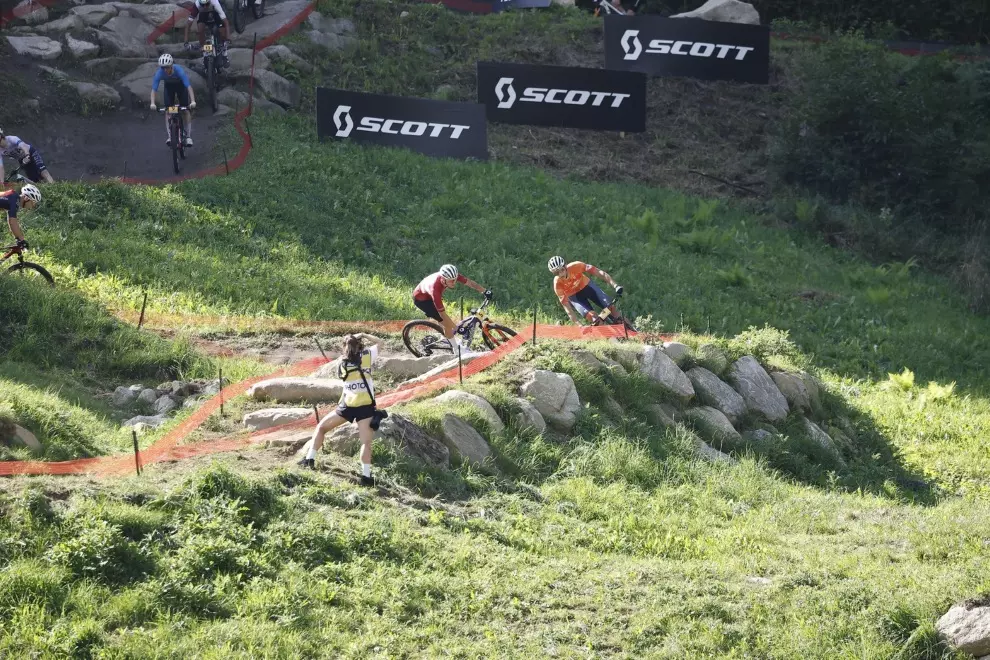
On Val di Sole’s Black Snake, crowds gather around the steepest chutes, ugliest root webs and corners where the bike often has different world views than its rider. Reaching these places may require scrambling up a slippery forest at an angle normally associated with roofing. Once there, spectators wedge themselves between a tree and a complete stranger, stand inches behind the tape and wait to see each rider for roughly two seconds. This is considered prime seating.
They aren’t hoping for a crash. Crashes ruin runs. They’re there to watch riders squeeze through the extremely narrow gap between perfect execution and an unscheduled flight into the undergrowth.
Road fans choose somewhere the race might unfold. Downhill fans choose somewhere it might come apart. Toilets, phone signal and personal safety are accepted casualties.
Safe decisions receive poor reviews
Road fans understand restraint. A rider refuses a doomed attack, hides in the bunch and saves energy for later. Sensible decisions win Grand Tours.
Downhill crowds are less impressed by sensible decisions. At the hardest sections, riders may have several lines available. One is faster, shorter and appears to have been designed during an argument. Another is slightly slower but offers considerably more room for remaining attached to the bicycle.
Take the safer line, and nobody will boo. The noise will simply collapse into the polite clanking of several disappointed cowbells. Send the difficult line, clear the roots and emerge upright, and the forest reacts as though someone has scored a winning goal.
This is mildly unfair. Riders are racing the clock, not seeking the approval of several hundred people who spent the morning climbing a muddy bank with industrial equipment. Losing a fraction of a second is sometimes preferable to puncturing, bending a wheel or becoming involved in helicopter-related paperwork.
The crowd understands this… on an intellectual level. Unfortunately, nobody carried a chainsaw uphill to reward sound risk management.
Practice is a spectator event
Warm-ups in road cycling are usually controlled affairs between a rider, their bike and some carefully measured suffering. Nobody chants, nobody heckles, and even the cameras tend to maintain a respectful distance. That’s rollers for you.
Downhill riders use trainers too. Gravity helps, but it hasn’t yet replaced quadriceps. Unfortunately, rollers solve only half the problem. Riders must also sharpen their reflexes, test their lines and learn the track at speed. They can only do that on the track itself, which fans begin populating from the first practice session. Consequently, downhill practice takes place before a full, raging crowd already chanting, heckling and offering unsolicited technical advice at industrial volume.
The spectators don’t treat it as a rehearsal. They arrive early, hang flags, occupy their preferred patch of mud and cheer despite there being no medals available. If someone clears a new gap or produces a miraculous save, the news spreads along the track and sections of the crowd begin migrating towards the relevant piece of geology.
Practice also lets fans see riders several times. They can compare lines, watch them build speed and decide who looks disturbingly comfortable aboard a bicycle travelling through a forest at motorway speeds.
To a roadie, it’s like thousands of people attending a Tour de France recon and losing their minds because Pogačar took a corner, went back and took it again, this time without touching the brakes.
The XCO spectators are racing too
For a roadie, a good viewing spot on the Tour is practically prime real estate. They defend it, thirsty, hungry; if they have to, they pee their pants, but it’s their spot.
XCO fans voluntarily surrender their territory every few minutes. Because the riders complete multiple laps, spectators can watch them at one section, sprint along the designated paths and catch them again somewhere else. First the climb, then the rock garden, then perhaps the finish, assuming nobody followed a man with a national flag who merely looked as though he knew a shortcut.
Every gap between rider appearances becomes an unofficial spectator race. Adults in jeans perform muddy hill intervals while carrying backpacks, cowbells and increasingly warm beer. The fastest disappear uphill. Everyone else arrives at the next section breathless, red-faced and just in time to discover that the leaders passed 15 seconds earlier.
None of this is compulsory. Spectators could remain in one place and watch every lap comfortably. Instead, they chase the race around the forest because seeing the same rider six times is apparently insufficient when seven remains theoretically possible.
So, don’t be surprised if the XCO audience looks just as tired as the riders by the finish. The riders, at least, knew they were entering a race.
Riding at night is part of the plan
Nowadays, road races are generally scheduled to finish before sunset. That suits TV viewers, the riders and anyone eager for dinner after spending an entire day defending one square metre of roadside, pressed against hundreds of strangers and slowly marinating beneath the hot sun.
At the MTB Worlds, however, racing in daylight is apparently a sign of weakness. If you’re in Val di Sole on Friday evening, you’ll notice that the crowd isn’t dispersing. It’s tightening. At 21:00, the 4X Pro Tour begins. One floodlit track, four riders and a four-way free-for-all best described as controlled carnage with an elimination bracket.
Four riders launch from the same gate, attack the same jumps and attempt to occupy the same piece of corner. Each race lasts less than a minute, leaving very little time for tactics and none whatsoever for regretting the first turn.
Four-cross isn’t awarding a rainbow jersey at the 2026 Worlds. It’s a side event. The spectators won’t behave as though this distinction matters. They crowd around the track, cheer every pass and collision, and give a series of elimination heats the atmosphere of a football terrace with considerably more airborne bicycles.
Roadies may recognise the elbows from a bunch sprint. The difference is that four-cross removes the lead-out trains, the finishing straight and most of the rules encouraging riders to remain politely separated.
You’ll adjust alarmingly quickly
Advance warning will only help for the first few hours. Eventually, a rider will clear something that appears physically unreasonable, the entire hillside will erupt, and your standards for normal behaviour will quietly rearrange themselves.
That’s how the MTB Worlds gets you. There’s no initiation and no membership card. By Sunday, the roadie who arrived hoping to broaden their understanding of cycling culture is hoarse, filthy and arguing with a stranger about line choice. Whatever dignity survived the Tour was abandoned somewhere halfway up a muddy hill.
By then, you won’t be wondering why somebody brought a chainsaw to a bike race. You’ll be wondering why the person beside them arrived empty-handed.