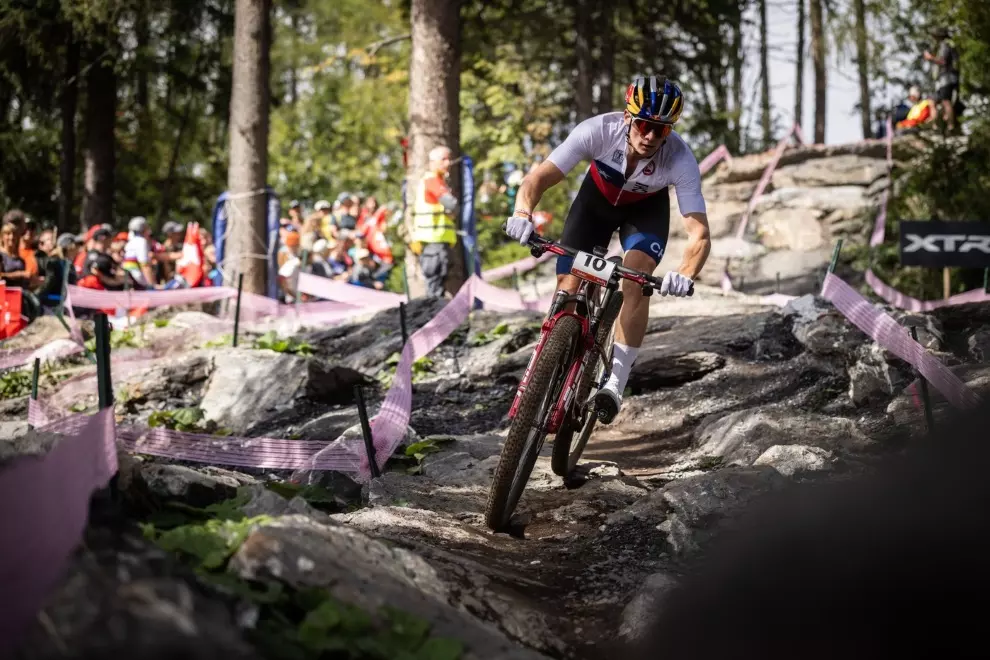
Still, even the most tarmac-dependent cycling fan should drag their eyes away from the road for the MTB Worlds. Not simply because the racing is spectacular, but because roadies already understand far more of it than they realise.
Short track is essentially a criterium with roots. XCO has more in common with a spring Classic than a mountain stage. Downhill is an individual time trial in which missing your line costs considerably more than three watts. Even the endless arguments about tyre pressure should make any Paris–Roubaix viewer feel immediately at home.
The terrain may look unfamiliar, but the racing really isn’t. Here are seven aspects of the MTB Worlds that every roadie already understands.
The faces are already familiar
If you’re wondering whom you should cheer at the Worlds, well, you already know some of the favourites. I mean, you have heard of Mathieu van der Poel, Tom Pidcock, and Puck Pieterse, haven’t you? So, you already know whom to cheer.
Besides, mentally filing them as road cyclists alone is rather unfair to their distinguished off-road careers. Pidcock may have won Strade Bianche, Amstel Gold and a Tour stage, but he also owns two Olympic XCO gold medals, one MTB XC rainbow jersey, and 2 European gold medals in the same discipline.
Puck dominated the polka dot classification in this year’s TDFF and wore the white jersey two years back. But she can also show off a World XC Championships gold, an XC World Cup win, European and national XC gold, along with 6 individual wins in the last 3 years.
Van der Poel has spent years chasing the major off-road rainbow jersey that still refuses to join his road and cyclocross collection. Yet, he can flaunt European and national XC gold medals and an XC World Cup.
The best part is that they still have the same style of riding. Mathieu van der Poel still attacks as if rabid dogs are chasing the group. Pidcock still goes downhill as if his bones are made of adamantium. Pieterse still turns the slightest hesitation into a several-metre gap.
So, the bikes may have more suspension, but the dangerous people sitting on them are reassuringly familiar.
Zobrazit příspěvek na Instagramu
Short track is essentially a criterium with roots
Any roadie who enjoys criteriums will understand short track before the first lap is over. It takes a mass start, a tiny circuit, repeated accelerations and the complete absence of recovery, then compresses everything into 20 to 30 minutes.
Positioning is everything. Enter a decisive section near the front, and you can choose your line. Arrive in 20th, and you inherit whatever line the panicking human blockage ahead of you leaves behind. One rider hesitates at a rock, everyone behind brakes, and the front five gain ten metres without producing a single additional watt.
The final laps should feel particularly familiar. Attacks become more violent, gaps become harder to close, and everyone suddenly wants the same half-metre of trail. The strongest rider doesn’t necessarily win. They still need to survive the corners, defend their position and reach the finishing straight without having spent the previous 20 minutes accelerating out of 37th place.
It’s essentially a criterium with a geological twist. The tactics are pretty much similar, the elbows are the same, and the only real difference is that road furniture was installed a few eons ago by tectonic plates.
XCO is a sprint classic on repeat
The name cross-country may trick roadies into expecting a miniature mountain stage. Put everyone on lightweight bikes, point them uphill and wait for the strongest climber to ride away while the rest quietly contemplate whether chess is not a better career option for them.
XCO laughs at this concept. Each 3.5-to-6-kilometre lap mixes short climbs, technical descents, forest roads, rock gardens and obstacles. There’s no 40-minute ascent on which everyone can settle into their preferred wattage. The rhythm changes every few minutes, and the race repeatedly stretches, fractures and regroups.
That makes it far closer to a Spring Classic. Every short climb can launch an attack. Every rock garden behaves like a cobbled sector. A five-second gap created in the wrong place can become permanent before the rider behind finds enough trail to close it. Meanwhile, a rider who gains time uphill can donate all of it back on the next descent.
The major difference is repetition. Paris–Roubaix subjects riders to the Arenberg once. XCO loops back and presents its worst sections again every 12 minutes. So, it’s like a Spring Classic but with the PTSD kicking in mid-race.
DH is an ITT on steroids
Downhill is essentially a race against the clock, something roadies know far too well and a phrase capable of making Filippo Ganna or Remco Evenepoel produce an inappropriate amount of saliva. It closely resembles an individual time trial. The angle, however, is considerably more… how to put it… suicidal.
Everything else feels reassuringly familiar. Riders set off individually, split times switch between green and red, and the current leader occupies the hot seat while each new starter attempts an eviction. On the road, however, missing the perfect line through a corner usually costs a few tenths. In downhill, it may cost a wheel, several layers of skin and a lengthy conversation with whoever insured the bike.
Before the final, riders walk the track, studying every rock, root and rut. They memorise braking points, test different lines and calculate how much speed the suspension can absorb before physics begins filing formal objections.
At full speed, the decisive gains rarely come from simply pedalling harder. Riders release the brakes earlier, stay off them longer and commit fully to lines that look irresponsible from every angle. One hesitation infects everything below it. Brake too hard before one obstacle, enter the next without enough speed, and a green split turns red before the commentator finishes shouting.
Yep, DH is nothing more than an ITT… on steroids.
The Team Relay is the Mixed Relay with more moving parts
The Team Relay is the event that puts national pride at the forefront. It’s much like the mixed relay in the Road Worlds, but with a bit more fluid mixture. The MTB version preserves the national aspect and the rainbow jersey at the end, but abandons any attempt to make the leaderboard immediately comprehensible. Each country normally fields one man and one woman from the Elite, Under-23 and Junior categories. Each rider completes one lap, but unlike the road relay, the team manager can arrange them in almost any order.
That order can make the early leaderboard spectacularly dishonest. One country may send its Elite man first and build a 40-second lead over a nation that started with its Junior woman. That looks impressive until you realise the leader has already deployed its nuclear option while its rival still has a world champion waiting in the exchange box.
Watching the opening laps without knowing the running orders is like declaring the Vuelta over because the breakaway gained seven minutes on Stage 3. The numbers are accurate. They’re simply withholding several crucial pieces of context.
By the final lap, the tactical fog clears, and the race becomes a straightforward pursuit. Until then, roadies should resist declaring a winner until they know which human weapons each nation still has in the box.
Tyre obsession is still the same
No roadie needs an introduction to tyre obsession. Every April, Paris–Roubaix transforms the cycling public into unpaid rubber consultants with very firm opinions about pressure, width and precisely which microscopic equipment decision ruined somebody’s race.
The MTB Worlds follow the same familiar ritual but add more variables. Riders must balance rolling resistance against grip, weight against puncture protection and low pressure against the possibility of introducing the rim to a rock at race speed. Then come tread pattern, rubber compound, casing and inserts, because apparently choosing how much air to put in a tyre wasn’t already exhausting enough.
Every advantage creates a corresponding way to lose. A lighter tyre accelerates faster until its sidewall meets something sharp. Lower pressure improves grip until the tyre squirms through a corner or folds against the rim. Aggressive tread bites into loose terrain but drags across hardpack like a dog being taken to the vet.
Naturally, each choice looks brilliant while it works. The moment someone punctures, thousands of viewers immediately identify the exact setup they should have used instead.
Roadies already know the ritual. MTB merely provides more options with which to prove everyone wrong.
The rainbow jersey makes everyone slightly unhinged
You know how Mario Kart is just a game until you and your pals decide to find out who’s the best once and for all? Now imagine offering the winner a distinctive shirt and the exclusive right to wear it whenever you play for the next 12 months. That’s no longer a friendly competition. It’s one blue shell short of a deathmatch.
The Road Worlds operate on pretty much the same principle, and so do the MTB Worlds. One race determines who gets the rainbow jersey and who must spend the next year staring at it from somebody else’s wheel. Unsurprisingly, this fogs the mind of every participant.
On the road, riders attack from distances normally associated with a several-day-long road trip, while usual teammates suddenly forget they’ve been pulling each other the entire year prior. In XCO, gaps that would usually be classified as cracks become the perfect overtaking opportunities. Lines get riskier, braking zones get shorter, and self-preservation is quietly subsiding, replaced by blind ambition… what a day… what a day.
Then there’s downhill. The speeds begin to suggest that Einstein left several important paragraphs out of his work.
Of course, the rainbow jersey doesn’t suspend the laws of physics. It merely blurs the lines between possible and impossible… at least until after the finish line.
Stop studying! There won’t be an exam
Roadies don’t need to understand suspension kinematics, memorise every course feature or develop a working knowledge of tyre inserts before watching the MTB Worlds. Cycling fandom has never required complete expertise. It requires a television, a favourite and the confidence to declare that a multiple world champion has approached the race completely incorrectly.
Give it ten minutes. Soon, the unfamiliar terminology fades away, the national jerseys acquire emotional significance, and somebody’s questionable line choice becomes an insult to you and your entire family. By the final lap, even the most committed road purist will be leaning towards the screen, shouting unsolicited technical advice at an athlete descending faster than they would drive.
Mountain biking isn’t another language. At its core, it’s still cycling, albeit with a few geological differences. Give the Worlds ten minutes and it will take root. Just not literally. The literal ones will wipe out at least ten riders before the weekend is over.