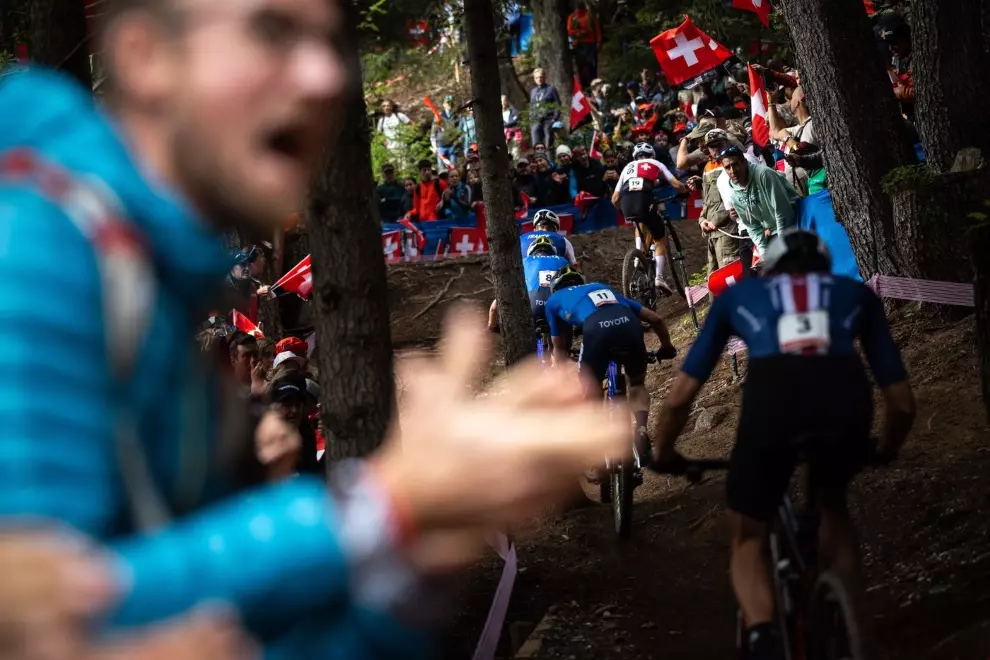
The MTB Worlds are just as Twin Peaks-y and demand just as much suspicion, possibly more, although the additional effort is rewarded with four times the entertainment and four disciplines to enjoy.
So, consider this your roadie’s guide to what actually matters when watching the MTB Worlds.
Cross-country short track (XCC)
XCC is the MTB discipline roadies may relate to most closely. It’s practically a 20- to 30-minute criterium, deprived of every form of comfort, including sitting in the bunch, finding a rhythm or, you know, riding on a stable surface. But if you want to enjoy the race without relying entirely on the frantic exclamations of the TV commentators, here are the three most important things to look out for.
Watch the fight for position
Road riders swarm before a narrowing because entering first prevents other people from making decisions on their behalf. XCC creates the same fight before almost every singletrack or technical pinch point, so watch who moves up on the approach rather than who looks strongest inside it. Arrive in 15th, and your race plan becomes a group project, with all the usual consequences.
Watch the descents for attacks
Roadies are trained to expect attacks when someone starts producing visibly unpleasant quantities of power. In XCC, riders can create gaps on descents by braking later, choosing a faster line and carrying more speed out of corners, so compare the order entering and leaving each technical section. If someone gains three bike lengths without pedalling, gravity has just taken a very decent pull on the front.
Watch what happens after a small mistake
On the road, one untidy corner may cost a wheel, a second or two, or merely a burst of words I can’t really write here, muttered under the rider’s breath. In XCC, a dab, a missed pedal, or a poor line choice can drop a rider several positions and trap them behind traffic, turning half a second into a lap-long recovery effort. Keep watching after the mistake because the trail charges compound interest.
Cross-country Olympic (XCO)
XCO is essentially a mutated XCC with more laps, longer climbs, rougher descents and enough time for every decision to show exactly how it affected the race. From a roadie’s point of view, it’s basically a mix between a one-day classic and a Grand Tour mountain stage. Only here, the same roots and rocks re-emerge every lap to test whether the rider learned anything from the previous encounter.
Since this is a longer race, there are three more things to add to the watchlist.
Don’t crown anyone on the first lap
The opening lap is XCO’s version of an early attack on a mountain stage: important, exciting and in no way a legally binding indication of the final result. Instead of staring at the current lead, watch whether the gap grows, stabilises or begins shrinking over the following laps. The first lap reveals ambition; the later ones reveal whether the lungs and legs will honour the contract an adrenaline-pumped brain signed in the opening minutes.
Watch when the trail starts looking harder
Road fans recognise fatigue through a falling cadence, rocking shoulders and increasingly frequent discussions with the team car. In XCO, it also appears through earlier braking, extra corrections, missed lines and awkward dabs, so compare how riders handle the same fixed-camera section from one lap to the next.
The trail is not enchanted, and the roots haven’t moved. This is not Harry Potter and the MTB Worlds. It’s the rider whose processing speed has slowed, leaving less time to react to what their eyes see. One mistake can happen to anyone. Several in quick succession tell you that a crash or a loss of positions may be waiting at the next overtaking opportunity.
Look out for mechanicals far from the technical zone
Road riders have a mechanic following behind them, while XCO mechanics and spare equipment wait in fixed feed and technical zones. When a wheel folds, a chain snaps or a derailleur resigns, check whether the rider is approaching the next zone or has just passed it. Fifty metres before means a repair; fifty metres after means an unscheduled lap-long jog with a bike on your back.
Zobrazit příspěvek na Instagramu
Cross-country team relay (XCR)
XCR is arguably the most interesting event at the Worlds. Six riders from each nation, one from each of the Men’s and Women’s Junior, Under-23 and Elite categories, complete one lap each before handing over to a teammate. Teams choose who goes when, creating battles road cycling rarely offers. A Junior woman can suddenly find herself racing against a hardened Elite man. It’s confusing, but it’s beautiful, especially when you know what to look for.
Watch the rider order, not just the leaderboard
The opening rider must deal with mass-start traffic, while those sent later may have clearer trail but much larger gaps to close. A nation that deploys an Elite rider first can lead one that opened with a Junior without necessarily being ahead in any useful sense, so keep track of which categories have ridden and which remain. The clock is accurate; it merely refuses to explain how the lead was acquired or whether it is sustainable.
Watch the Juniors for the next champion
Road Worlds politely separate Junior and Elite races, allowing the established champions to control their own problems. XCR makes the Junior laps count towards the same rainbow jersey, and these less-established, harder-to-predict riders can preserve an advantage, destroy one or win the entire relay for their nation.
Watch for the teenager who handles that responsibility suspiciously well. You may be seeing a future champion before the commentators have agreed on how to pronounce their name. In a few years, you can become the intolerable hipster who insists you rated them before everyone else jumped on the bandwagon.
Compare Junior and Elite lines on the descents
The repeated camera positions allow you to compare how riders from different categories handle exactly the same downhill features. Look at their braking points, line choices, corrections and exit speed. The more experienced riders will often make the same section look less dramatic and considerably less vocal. Fitness still matters, but descents expose how much technique and experience contribute because gravity has never shown much respect for FTP.
Downhill individual (DHI)
DH is by far the easiest discipline to understand. It’s essentially an individual time trial in which most of the pesky pedalling has been outsourced to gravity. Gravity supplies most of the acceleration but insists that every mistake be paid for immediately. The rest comes down to how much speed a rider can preserve through mud, rocks and a whole lot of roots.
And while the formula seems perfectly clear, several details can make or break a run, all of which are visible on TV if you know where to look.
Look at the splits, not how fast the rider looks
The fastest riders often look strangely calm because they brake once, make fewer corrections and preserve speed through the entire section. Treat the intermediate splits like those in a road time trial: green means the run is ahead, red means it isn’t, regardless of how dramatic it looked getting there. If a rider appears relaxed while turning every split green, they aren’t taking it easy; they’re simply refusing to waste effort entertaining you. How rude of them, isn’t it?
Look for the line that works best
Before each repeatedly televised technical section, mentally choose the line you would take, then compare it with what the riders actually do. The shortest route may require heavier braking, while a wider or higher line can preserve more exit speed, so watch where riders enter, where they leave and whether the following split approves their decision. By the fifth run, you will have designed the perfect descent from the sofa, where every braking point is precise, and all the roots are theoretical.
Look out for the crashes
Road fans already understand the shameful magnetism of a bunch crash. Downhill removes the bunch and arranges a direct disagreement between one rider and an immovable mountain, usually after a missed braking point, poor line choice or a wheel landing somewhere where geology had other plans. Study what caused it if you need a respectable excuse, but nobody will believe that’s the only reason you watched the replay.
Now you know what to shout about
Watching MTB becomes much more interesting once it stops looking like extremely fit people being repeatedly inconvenienced by a forest. You won’t become an expert over one weekend, but you will start seeing the decisions behind the mud.
By the second race, you’ll be criticising line choices from the sofa. By Sunday, you’ll have strong opinions about braking points and rider order despite never leaving the room. That isn’t expertise in the strictest sense, but it is how most cycling punditry begins.
At least now you’ll know what you’re shouting about.