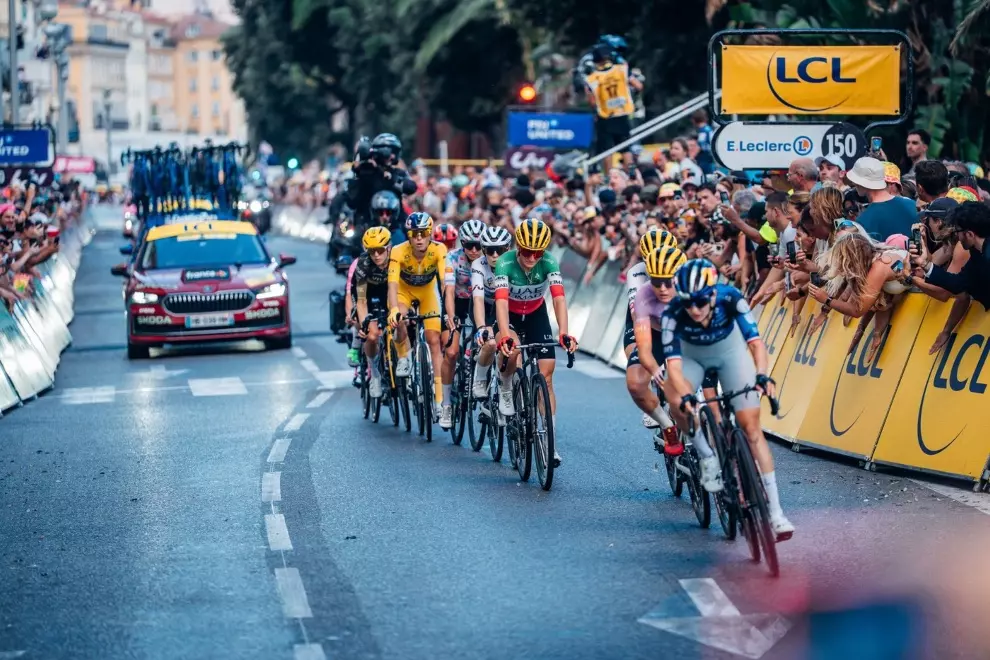
So, a loud bravo to the course designer and a louder hoorah for the riders, who were brave, fully committed, passionate, and talented enough to produce a classic Grand Tour that will be tough to beat for excitement.
That’s why it was a disgrace and an insult to these riders that only three of the nine stages were broadcast in their entirety on TV. There can be only one reason that the women’s Tour is not shown in its entirety and the men’s Tour is: ASO, which made the decision, still regards women as second-class citizens of the sport. If this race proved anything, it was that the TdFFaZ must be given the same treatment as the men’s Tour. Many people have already made that point, so I will just direct you to Adam Becket’s excellent argument in Cycling Weekly.
But there’s more to complain about. On Wednesday’s dramatic stage 5, which was televised from start to finish, TV viewers nevertheless missed the beginning of the breakaway, which had 19 riders in it and was about 40 seconds in front of the peloton while the TV showed the bunch and labelled it Tête de la course, the front of the race. This was fake news. When a camera motorcycle finally reached the break, with 85 km left to ride, we still had no idea how big the gap was to the bunch. It took another 7 km of riding for the second timing motorcycle to reach the peloton and inform us that the gap was 50 seconds.
I only knew of the break and its early gap because I was following two websites with live reports, and one of them had the information. Later, when the breakaway had broken up into several groups, we only received information about the front of the race and the group in which defending champion Pauline Ferrand-Prévot was riding. We had no idea – and neither did the TV commentators – what the gap was between the front of the race and the nearest chase group, which might have been useful to know. This almost never happens on the men’s race because the men have at least four timing motorcycles. Fortunately, a third timing motorcycle was brought to the race for the last two stages. But too little, too late.
Zobrazit příspěvek na Instagramu
This has been a pattern, and not only in the TdFFaZ. I have seen improperly affixed barriers fall into a women’s one-day race, causing a crash. And several times riders took the wrong turn because it was not properly sealed off or clearly marked – and on one occasion, the lead group of three riders followed a motorcycle onto the wrong road. The WorldTour’s women always provide first-class racing and first-class entertainment. So why are they still given second-class treatment?
Ferrand-Prévot defeated by her own success
Pauline Ferrand-Prévot is a victim of her success in last year’s TdFFaZ. Her dominant performance, especially on the Col de la Madeleine, apparently inspired many of her rivals to upgrade their training. She noticed it too, after falling well behind her rivals on the climbs. When she dropped out of the race due to illness before Saturday’s stage 8, she trailed Niewiadoma-Phinney by 14:37.
“You know, I think my level is quite good,” she said after losing more time on stage 6. “It’s just that the others are better, and I have to be realistic and honest.” She doubled down on her fitness by adding, “I think my level is great; yesterday I did my best 10-minute power in the last climb, so I think I’m not too bad. But it’s just that the level is much higher, you know?” This is why last year, many commentators saw her performance as ground-breaking and important for the future of women’s cycling.
To her credit, Niewiadoma-Phinney credited Vollering with having the same influence on her with this year’s victory. “I mean, honestly, having a competitor like Demi just motivates me to be stronger,” she told TNT Sports after the race. “I know the Tour is finished, but I feel like I just want to message my coach and say, ‘OK, this and this and this we need to change or work on.’” That’s how riders and the sport itself improve. The 2024 TdFFaZ winner will certainly not be the only rider to ask their coaches what they can do to ride like Demi.
Riders beyond the podium who impressed
Yes, the three podium finishers – and Marlen Reusser, who crashed off the podium on the final stage – put on a magnificent show, but they were not alone in elevating this year’s TdFFaZ to its stratospheric level. Beginning with Elisa Longo Borghini, who finished third in the GC, her first TdFFaZ podium finish, and her young UAE Team L’IMAD teammates Paula Blasi and Dominika Włodarczyk, who finished fifth and seventh, respectively. It’s not easy to ride for a top 10 spot and also support your team leader, especially if journalists are constantly complaining that Blasi, who had won the Vuelta España Femenina, the Amstel Gold Race, and other significant races this year, was being treated like a servant.
“You guys are making it up so big, bigger than it is. We are fine,” Longo Borghini said after stage 4. “Personally, I’m hurt by you journalists. I think you should consider how Blasi feels. It is not pleasant for her to sit at the dinner table knowing that these stories are being written. Be careful with what you write.”
That she, Blasi, and Włodarczyk made it into the top 10 is a testament to their talents. But I think that the 24-year-old Blasi, who is already a star with a Grand Tour victory, will probably head to another team as soon as she has an offer. Who knows how much better she would have fared if allowed to ride for herself. Still, well done to the team!
Other performances of note include: Puck Pieterse (Fenix–Premier Tech), who dominated the Queen of the Mountain competition; the great Lorena Wiebes (Team SD Worx–Protime), who won two stages and the green jersey competition; and CANYON//SRAM’s Antonia Niedermaier, who won the young rider’s white jersey ahead of Blasi.
A special mention also to Célia Gery and Franziska Koch of FDJ United–SUEZ, who buried themselves to set a blistering pace for Vollering when she needed it. The race winner has repeatedly expressed her gratitude to her teammates, and for very good reason. I wonder, just incidentally, if Gery will ever get the chance to ride for herself. She’s only 20, is the French road race champion, won a stage in this year’s Giro and came in second, to Blasi, in the Volta a Catalunya Feminina. She was the first ever Women’s Under-23 Road World Champion and looks to have a great future.
But…
A few more words about the Gery controversy
The controversy – of Niewiadoma-Phinney accusing Gery of unfair riding – did not end after the French rider was exonerated by the video replay (in my eyes at least) and by the race commissioners. Far from it. A visibly angry Demi Vollering said the next day, “I have a lot of respect for Kasia,” but that she had been disappointed by her accusation. Then she added: “I didn’t forget what she did when I was on the ground two years ago. So, if she’s speaking about fair play, then I think she’s not the one that can really say something about that.”
That reference was to the 2024 TdFFaZ, when Vollering crashed, and Niewiadoma-Phinney accelerated the pace, taking valuable time on the stage and eventually winning the race by 4 seconds. In post-race interviews, Niewiadoma emphasised that she was completely unaware Vollering had gone down. But the Dutch rider was apparently not convinced.
Vollering also said that Gery had had “a very, very rough night” before stage 9. The reason was, as sports director Lars Boom explained, that she had been subjected to intense online abuse, including death threats, as social media again permitted the worst elements to crawl out from under their rocks and spread their hatred. It is precisely the existence of such a “democratic” platform that should caution celebrities in all fields to think twice before accusing others of misbehaviour.
I understand that Niewiadoma-Phinney reacted in the heat of the contest, before she’d even caught her breath. But she was wrong in her accusation and wrong to repeatedly air it for the press. She and Vollering managed to patch things up during a lengthy private conversation they had on the road in stage 9 – and that’s how the incident should have been handled, behind the scenes, between the teams and with the race jury. Our world has changed, and not only for the better.