
And suddenly, nobody really knows what is happening anymore. Fans begin refreshing the live tracker every few seconds, even though it only updates every few kilometres. Journalists scramble for radio information. Screenshots from roadside spectators start appearing online. A blurry vertical clip filmed halfway up the climb shows one rider already alone. For the next half hour, one of the most important moments of the day unfolds mostly out of sight.
Women’s cycling fans know this feeling well because they have lived versions of it for years. When Lizzie Deignan attacked on the first cobbled sector of the inaugural Paris–Roubaix Femmes, much of the audience never actually saw the decisive move happen live. By the time television coverage caught up, Deignan was already disappearing alone up the road, beginning a solo ride that would become instantly legendary.
This is one of the strangest realities of modern women’s cycling: even now, some of the sport’s defining moments still happen beyond the cameras. And because of that, following women’s cycling often feels fundamentally different from following almost any other major professional sport.
Full-time fan, part-time sleuth
Modern sports coverage has trained us to experience competition almost entirely through broadcast. In men’s cycling, especially, fans have grown accustomed to consuming races as polished narratives.
In women’s cycling, on the other hand, sometimes the decisive split forms before the cameras even arrive. Take Kasia Niewiadoma and the dramatic 2024 Tour finale, for example. By the final climb of Alpe d’Huez, fans were calculating time gaps manually and refreshing live updates obsessively as the Tour de France Femmes came down to four seconds.
As a result, women’s cycling fans have developed a very different relationship with racing. They often have to piece races together. We have had to learn how to read races through fragments, with a static time gap suddenly dropping from 1:20 to 0:38 telling you what you need to know or a rider missing from a blurry overhead shot becoming the confirmation you need. Following women’s cycling online during incomplete coverage can feel less like watching television and more like participating in a giant collaborative reconstruction project.
Entire Reddit discussions become real-time investigations into who cracked, who attacked, and when exactly the race exploded. Even at the Tour de France Femmes, one of the defining moments of the 2024 race unfolded first as confusion, radio issues, split groups, missing teammates, and fans online trying to understand who even knew Vollering had crashed. It is messy and strangely intimate. And in some ways, it has created one of the most engaged fan cultures in professional sport.
Women’s cycling supporters are rarely passive consumers. Because everyone involved understands what is at stake when races are only partially visible.
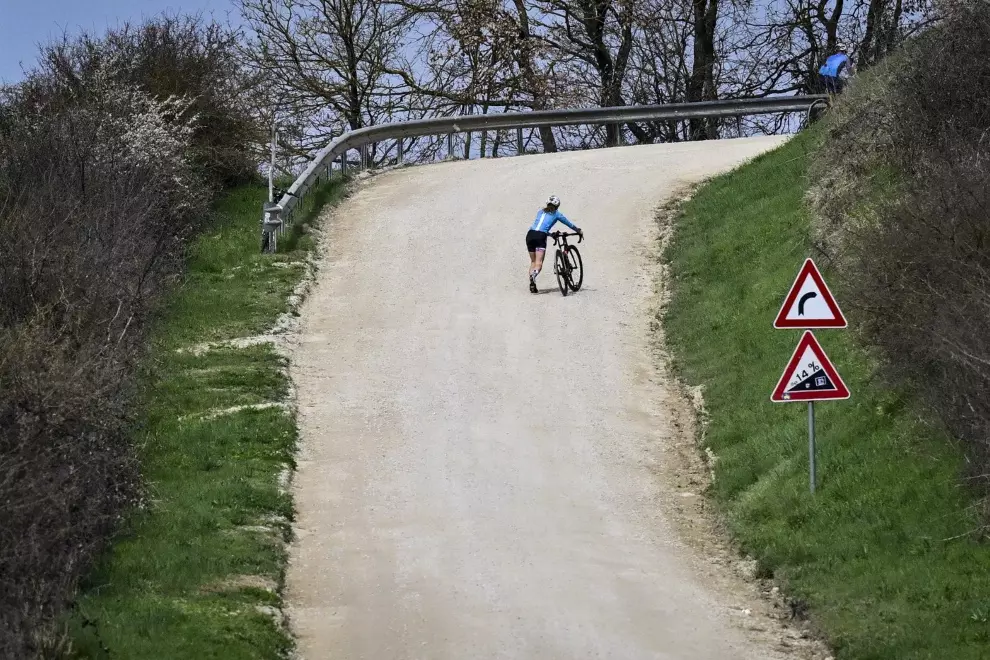
What gets lost when nobody sees it?
Yet despite the impressive dedication of established fans, it’s impossible to overstate the importance of live coverage. As we’ve discussed over the year, in sport, the camera ultimately decides what history remembers. That might be a perfectly timed domestique effort or a young rider’s first major attack. These are the moments that build careers, attract new fans, and result in sponsor coverage. Without that, future contracts and invitations are fewer and farther between.
Men’s cycling history is overflowing with visual references: grainy attacks replayed for decades, famous mountain accelerations frozen into collective sporting memory. Women’s cycling still has entire races that exist primarily through testimony. Lizzie Deignan’s legendary Roubaix Femmes in 2021 is mentioned whenever coverage gaps are discussed, because television viewers largely missed the moment her winning move actually unfolded. These moments become almost mythical precisely because they remain incomplete. But mythology is not the same thing as visibility.
Racing into the void
And riders know the difference. Imagine launching the defining attack of your career while being fully aware that much of the audience cannot actually see it live.
That reality still exists in women’s racing. Riders joke about it sometimes. Saving moves for television windows. Laughing about disappearing into the ‘coverage void.’ But beneath the humour sits something more complicated.
Professional athletes want their work to be witnessed.
Danish rider Cecilie Uttrup Ludwig has spoken openly about how different racing feels when people are truly watching. Reflecting on the atmosphere at the Tour of Flanders for Women, she described the crowds and energy as “one cycling party,” before admitting something many riders likely feel: “Sometimes I’m like, ‘I wish that people knew, I wish that our race was televised, I wish people knew how good our races are. Because I feel it’s as good as the men.’”
That longing sits underneath a lot of women’s racing. Especially in a sport as physically brutal as cycling, where so much effort already disappears into anonymity. Domestiques bury themselves for leaders and finish forty-third without their names ever appearing on screen. Riders spend hours surviving in crosswinds, closing gaps, carrying bottles, pacing climbs, and sacrificing their own results for teammates.
Even under perfect coverage, cycling naturally hides labour, and incomplete coverage hides even more.
For years at the Giro d’Italia Women, riders like Mavi García would launch huge long-range mountain attacks that fans could only follow through scattered time checks and post-stage reports. Entire tactical battles unfolded somewhere high in the mountains while viewers refreshed PCS updates and waited for finish-line photos to confirm what had actually happened. And that changes the emotional texture of racing itself.
Why the gaps still exist
To be fair, broadcasting cycling is expensive and logistically difficult, even for the biggest races in the world. Helicopters, motorbike cameras, relay aircraft, production trucks, signal dead zones in mountain terrain, every additional hour costs money. Race organisers have invoked these realities when defending shorter women’s broadcasts.
Paris-Roubaix organisers argued that combining the men’s and women’s races on the same day would ultimately increase total visibility, even while cutting the standalone women’s broadcast window. The backlash was immediate because fans understood exactly what would disappear in those missing kilometres: punctures, positioning fights, early attacks, and the tactical groundwork of the race itself.
And things are indeed changing. Compared to even five or six years ago, the transformation has been dramatic.
The contrast is especially visible at the very top of the sport. The Tour de France Femmes now receives wall-to-wall international production that would have been almost unimaginable a decade ago, helping establish stars and bring a larger fan base into the fold. But elsewhere on the calendar, particularly at smaller stage races or early race phases, fans still routinely rely on live tickers, social media updates, and post-race testimony to understand what actually happened.
A sport between eras
Part of what makes women’s cycling so fascinating right now is that it is on the precipice of a total breakthrough. There has been tremendous growth and development over the last decade, but there are still gaps to address. And inside that in-between space, a very particular culture has formed.
For years, loving women’s cycling has required imagination. For example, following the Giro Donne meant learning how to imagine mountain stages from time checks and finish-line photos alone. We’ve learned to follow races through static time checks and panicked tweets, building the shape of a race from fragments. And maybe that is partly why the connection feels so strong.
Because women’s cycling fans have never only been spectators, they have also been witnesses.
There is a temptation to treat this era as merely transitional, an awkward period on the way toward fuller coverage, bigger budgets, and seamless broadcasts from kilometre zero to the finish line. And hopefully that future comes. The sport deserves it. Riders deserve it. So do the people who have spent years trying to follow races by buffering livestreams and checking delayed times.
But something unique has emerged in the meantime. Women’s cycling has produced a culture of fans who pay attention in different ways. Fans who trade translated interviews and roadside clips because they instinctively understand that if they do not help tell the story, parts of it may disappear. The remarkable thing is not that fans learned to follow women’s cycling in fragments; it’s that the racing was compelling enough to make them want to.