As is by now only too well known, no French male cyclist has won the Tour since Bernard Hinault in 1985. But it’s not just about the Tour. While the Tour losing streak rankles most, French cyclists have racked up poor to mediocre results in virtually every aspect of road racing over the past four decades.
The last Frenchman to win any Grand Tour was Laurent Jalabert, who won the Vuelta a España in 1995; and the last French rider to win the Giro was Laurent Fignon in 1989. French riders have also had spotty records in winning Grand Tour points and mountain jerseys as well as in the one-day classics and Monuments.
The exciting “Class of 2026”
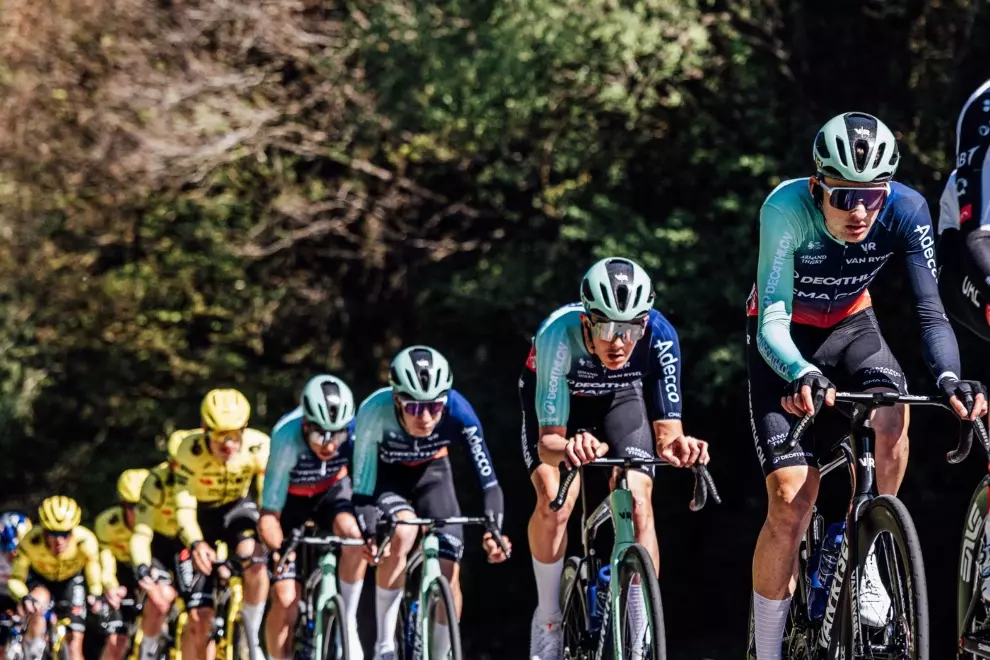
That is why excitement is now very high in the country because this generation of young riders, especially 19-year-old Paul Seixas (Decathlon CMA CGM) and 22-year-old Paul Magnier (Soudal Quick-Step), appears to be on the verge of changing the country’s fortunes and its reputation in the sport.
It’s still early days, but Seixas looks like a legitimate future contender for the Tour’s yellow jersey because of his already high level, all-around skills and his ability to go toe to toe with four-time Tour winner Tadej Pogačar, who is universally acknowledged to be the best rider in the world.
This year he has finished second in the Volta ao Algarve, Strade Bianche and Liège-Bastogne-Liège and won the Faun-Ardèche Classic, La Flèche Wallonne and three stages and all four jerseys (GC, points, mountain and youth) in the Itzulia Basque Country. He is scheduled to ride in his first Tour this year. He won’t win it, but a top 5 finish would be a great result and a podium place at the end would probably make the French stock market rise.
At 22, Magnier already has 28 wins to his name. But the two stages (out of the first three) he has so far won in this year’s Giro d’Italia demonstrated that he has the legs, the heart and the brains to become a superstar sprinter. The fact that he beat two of the sport’s best sprinters, Jonathan Milan (Lidl-Trek) and Dylan Groenewegen (Unibet Rose Rockets), to win these stages underlined his talent and his potential.
While Seixas and Magnier are the marquee names of what is beginning to look like a French cycling renaissance, other young riders are also demonstrating that the future of French cycling looks golden. Romain Grégoire (Groupama-FDJ), 23, is an explosive puncher, finishing in the top 5 of this year’s Amstel Gold Race and Liège–Bastogne–Liège. He could eventually become another Tom Pidcock (Pinarello Q36.5), strong in one-day races and a top 5 Grand Tour rider.
Kévin Vauquelin, 25, was signed by Netcompany INEOS after he won a stage in the 2024 Tour de France and finished second twice in La Flèche Wallonne (in 2024 and 2025). He can climb and is an excellent time trial rider. Though he hasn’t yet shown that he has the endurance to win a three-week race, he looks like a future one-week stage-race winner or even potential world champion à la Julian Alaphilippe.
Lenny Martinez (Groupama-FDJ), 22, is a pure climber and potential Tour stage winner, while Seixas teammate Léo Bisiaux, 21, earned his first professional road victory in stage 3 of the 2025 Vuelta a Burgos and finished second in this year’s Tour du Jura Cycliste behind teammate Matthew Riccitello.

Why the renaissance now?
Why is the French “Class of 2026” different from previous generations? Because the French approach to the sport has gone through a sea-change and, of course, because of money. The French system was criticized for decades for being old-fashioned by relying on “feeling” and traditional heavy racing schedules for juniors. No more.
For example, Seixas’ Decathlon CMA CGM and other French teams have caught up to the training standards of teams like Visma–Lease a Bike or UAE Team Emirates–XRG. They now use advanced aerodynamics, high-tech nutrition and data-driven power profiling from the age of 15.
The youth development structure has also changed. The French Cycling Federation (FFC) and elite amateur clubs have invested heavily in junior development. France now has stronger junior race calendars, more scientific coaching, earlier talent identification and better links between junior, U23, and WorldTour levels.
As a result, young riders are reaching elite training environments earlier without needing to leave France, , and French teams are no longer waiting for riders to turn 23 to make them professionals. By establishing world-class U19 and U23 development squads, they are preparing teenagers to jump into WorldTour races and be competitive as early. Therefore, they learn tactical racing and endurance very young.
In addition, France is increasingly copying the Belgian/Dutch model where juniors mix road, cyclocross, MTB and sometimes track instead of specializing in road racing early. Most of the young riders mentioned above raced in cyclocross and other off-road disciplines to improve their bike-handling and tactical skills. Seixas raced cyclocross extensively as a junior and won French junior cyclocross titles. His superior handling and descending skills are no doubt a result of that experience.
Magnier also raced cyclocross as a junior and is often compared to classics riders because of his bike handling and explosiveness, while Martinez comes from a family deeply tied to mountain biking. His father Miguel Martinez was an Olympic MTB champion, and Lenny grew up around MTB culture before specializing in road racing. And Léo Bisiaux was the junior men’s cyclocross world and European champion in 2023.
Finally, there’s the money
The infusion of cash from new players in the cycling landscape such as Decathlon, the world’s largest sports retailer, has fundamentally altered the landscape and brought in massive R&D resources. The company also brought in its proprietary Van Rysel bikes, considered some of the fastest in the peloton, thereby removing the “technical disadvantage” French riders previously complained about.
More importantly, when the company joined the team then known as AG2R Citroën in 2023, its annual budget jumped from an estimated €23 million to about €28-31 million in 2024. The entry of CMA CGM, a major global shipping, logistics, and transportation company, has pushed the budget for this year to about €40 million.
That made it possible to improve high-altitude camps and support staff. But it may not be enough to keep Seixas, whose contract runs out at the end of next year. Big-spending teams such as UAE Team Emirates–XRG, Red Bull–BORA–hansgrohe and Netcompany INEOS are reportedly very interested in signing “the next Pogačar”; so look for that budget to grow by at least another €8 million to pay the young man’s 2028 salary.
It will be a matter of national honor and pride if Seixas wins the Tour with a French team; French President Emmanuel Macron has reportedly already made his feelings clear on this issue. With all the other members of the “Class of 2026” riding with non-French teams – with Soudal Quick-Step, Magnier is on the best possible team for his talents – it would be a huge setback for the French cycling renaissance if the best pupil in the class went abroad for his graduation.