Cycling is an easy target. It’s fast, it’s visual, and it gives just enough room to make bad ideas look controlled for a few seconds. That’s all it takes. A short clip, a clean attempt, and suddenly something questionable starts to look like a skill instead of what it really is. The internet does the rest. One video gains traction, a few more follow, and before long, the same idea keeps showing up from different angles, each time a little more exaggerated, a little less controlled. Not because it works, but because it looks like it does.
That’s how some of the strangest, and frankly stupid, online cycling trends came to be.
(Passive-)aggressive lane takeover
There’s a specific genre of cycling videos where the rider becomes the self-appointed enforcer of the bike lane. Camera on, speed up, and wait for the inevitable obstacle. Usually a pedestrian, occasionally a tourist with a suitcase, moving at a pace that suggests long-term commitment rather than urgency.
We’ve all been there. You’re rolling well, you’ve found a rhythm, and suddenly the lane turns into a slow-moving puzzle. It’s frustrating. Nobody enjoys braking for something that shouldn’t be there in the first place. That’s where the trend kicks in. The frustration stops being a moment and turns into a performance. Louder horns, closer passes, exaggerated reactions. The goal shifts from getting through safely to making a point, ideally one that looks good on camera.
The problem is simple. The situation doesn’t improve just because it’s filmed. The pedestrian doesn’t become more aware. The space doesn’t magically open up. You’re still riding into a crowd that has nowhere to go, just with more speed and less patience. Poor city planning isn’t your fault. It also isn’t theirs. Most of the time, they’re not making a statement. They’re just in the wrong place at the wrong moment, same as you.
Turning that into a confrontation doesn’t fix anything. It just replaces control with noise, and patience with a clip that looks decisive but achieves nothing.
Riding no-hands in traffic
Watching the pros, it’s easy to get the wrong idea. They ride no-hands, take jackets on and off, grab food, adjust something mid-race, all while moving like it’s nothing. It looks effortless. It looks normal. What you forgot to notice, however, is a tiny little detail – they are professionals. They ride on closed roads, in controlled conditions, with a level of skill that doesn’t translate outside that environment. And even then, it occasionally goes wrong, quickly and without warning.
More importantly, they’re not doing it to prove they can. They’re doing it because they have to. There’s a reason behind it, and it’s usually practical. That’s not what you see online. What you see is no-hands riding in traffic, looking back at the camera, sometimes adding a second layer of brilliance by scrolling through a phone while doing it. Not because it’s needed, but because it looks calm, controlled, impressive.
It isn’t.
You’ve just removed your ability to react in the one place where reaction time is everything. No steering correction, no immediate braking, no margin if something changes in front of you. Call me a boomer, but showing off a skill that everyone with three rides under their belt can do with ease, ain’t cool. It’s just a dumb way to ruin your summer, break your bike, or worse.
Swerving (a.k.a suicide wheelies)
This one looks impressive for about three seconds, right up until your brain catches up with what’s actually happening. A rider pops a wheelie and heads straight into oncoming traffic. The goal is simple. Hold the line, keep going, and swerve at the last possible moment. Late enough to look dramatic. Early enough to avoid becoming a very solid argument for natural selection.
For a 12-year-old, it’s impressive. For the driver, it’s a completely different experience. They will have a very hard time deciding whether stopping was the best thing they could have done for the betterment of humanity, while fighting the urge to chase you and slap some sense into your empty head. They were never part of the “joke”. They’re just a moving object that your entire life now depends on.
That’s the part that gets edited out. The fact that none of this is actually under your control. The outcome hinges on whether the driver sees you, reacts correctly, and doesn’t decide you’ve earned a lesson you won’t forget. So the only real skill here isn’t the wheelie. It’s outsourcing responsibility and hoping it comes back intact.
Threading the needle
I have to be honest, these truly look cool on camera. Fast, precise, almost surgical. A rider slips through traffic, finds a gap that barely exists, and glides through it like it was planned that way all along.
Just make sure you watch the bloopers before you decide to try it out for yourself. Because that’s the part you don’t see. The attempts where the gap closes, the line shifts, the timing is off by half a second, and suddenly you’re not threading anything, you’re just very present in the worst possible place.
Threading the needle is when a rider goes around traffic through small gaps, essentially giving drivers heart attacks left and right. Between cars, past mirrors, across spaces that depend entirely on everything staying exactly where it is for just long enough.
The problem is that everything changes in a heartbeat. A sudden, unexpected move from anyone in the traffic, a small hole on the road, a poor judgment on your side, and you’re rolling around with hundreds of tyres that don’t really care whether you’re wearing a helmet or not. So, don’t pretend traffic is static. It’s not, and you can’t predict everything.
DIY urban downhill
Urban downhill is an incredible sport. Proper course, closed roads, barriers, people who know what they’re doing. It’s fast, chaotic, and somehow still controlled.
Remove the control, keep everything else, and you get the DIY version.
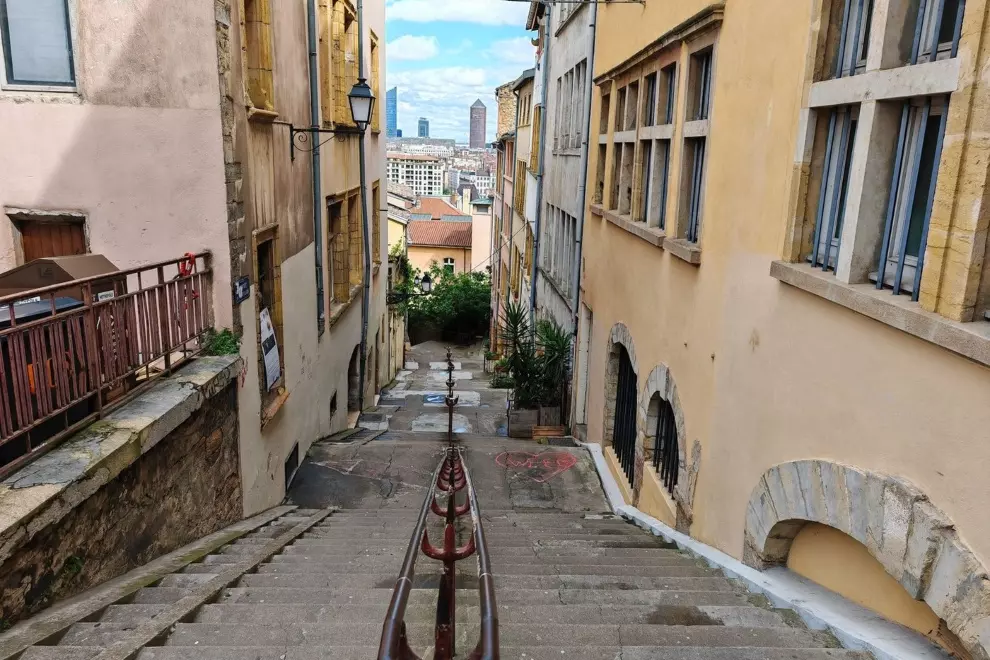
Same speed, same commitment, just with traffic still moving, pedestrians still existing, and zero indication that any of this is supposed to be happening. Stairs become your race line, crossings become blind guesses, and the finish line is wherever you manage to stop without introducing yourself to a car.
That’s the part that doesn’t translate well to video. In a real race, the road is yours. In a city, it isn’t. You’re just passing through it at a speed that assumes everyone else cares deeply about your well-being. They don’t. Not even a little.
Pedestrians use those stairs. Not as obstacles, just as people going somewhere. You won’t see them early, and you will stop late. That’s a bad combination, which ends up with either your injury or, worse, the pedestrian’s injury and a lawsuit. Then there’s the bike doing what bikes do under braking. Tyres scraping, edges wearing down, every run leaving a small reminder that this wasn’t designed for you in the first place. In many cities, that’s not just annoying. It’s illegal.
If you want speed, there are places built for it. Trails, tracks, courses where the only thing trying to take you out is the terrain, not someone stepping out of a doorway or a car appearing exactly where you planned to land.
Motorpacing
We’ve all done this as kids. Riding behind a bus, catching a bit of free speed, feeling like we were suddenly part of something bigger. The bus was doing 15, maybe 20 kph, but to us it felt like the peloton. Everyone told us to stop. Some drivers were more persuasive than others, occasionally stepping off the bus ready to explain things in a language that didn’t require words. At some point, you grow up and realise they were right.
What doesn’t make sense is seeing the same idea come back later, just scaled up. Same concept, different numbers. Now it’s not a slow bus on a quiet street. It’s a car moving at 60 or 80 kph, and the gap behind it is no longer playful. It’s the only thing keeping you out of trouble. That’s where the illusion starts. It looks controlled. Smooth cadence, steady line, everything working as it should. Until you think about what you’ve removed.
You don’t see the road ahead. You don’t choose the pace. You don’t control when things slow down, turn or stop. You’re borrowing speed from something you’re not connected to, with no way to influence what it does next. The distance looks manageable on camera. In reality, it’s measured in the reaction time you don’t have.
So the whole thing comes down to trust. Trust that the driver won’t brake suddenly. Trust that nothing appears in front of them. Trust that there are no bumps, debris, sand, potholes or glass on the road. It usually doesn’t happen, right until that one fateful moment when suddenly there is something wrong, and you have no time to react. In the best-case scenario, you will have severe injuries. Let’s not discuss the worst case.
Not everything needs to be a clip
There’s a difference between riding and performing, and it usually shows up in what gets left out. The better creators understand that. They don’t just show the clean moment. They show how it came together, what didn’t work, what had to be repeated, adjusted, sometimes abandoned. You’re not just watching something happen, you’re watching someone build toward it. That’s why it feels real.
These trends work the other way around. One clean attempt, no context, no margin, no indication of how many times it didn’t go that way. It looks simple because everything that makes it difficult has been removed. And that’s what makes it so easy to copy – not because it’s achievable, but because it looks like it is.
The ride stops being the point. It becomes something you pass through on the way to getting the clip. Control gets replaced by timing, decisions get replaced by reactions, and the only version that exists is the one where it worked.
It’s still cycling. It just isn’t the kind that lasts very long.