“Maybe things didn’t happen exactly the way I describe them, but this is how I remember it,” says Richard Gasperotti, who around that time decided to end a promising downhill racing career and move toward a new discipline: freeriding. “It must have been around 2001, when I was in Canada riding with the best. I became part of Flow Riders, the flying circus led by Dangerous Dan, who put together a team of bike stunt performers. We toured large Canadian stadiums, showing audiences what freeriding actually was. We had massive folding ramps and were sending big drops. It was new, pioneering, and people looked at us like real oddities.
“The same thing was happening in the forests of North Vancouver, in the legendary North Shore area. Trails with obstacles and wooden ladders were being built by Todd Fiander, known in the community as Digger. He also filmed everything, which is how the early Xtreme Northshore films were created. I was lucky enough to appear in one of them, and it helped put me on the map,” Richard recalls of the pioneering days, a quarter century ago, when freeriding was just beginning. On the North Shore, Gaspi became friends with Wade Simmons, who won the first Red Bull Rampage in 2001.
The extreme Josh Bender
While Canadians were developing technical riding on the North Shore, something entirely different was happening in the United States. A rider, unlike anyone the MTB world had ever seen, appeared. His name wasJosh Bender, originally from Alaska, where skiers and snowboarders tackled extreme slopes. “Josh was uncompromising and extreme. He had a special bike built with huge suspension and would send fifteen-metre drops on it. His success rate was maybe 20%. The rest of the time, he crashed violently, but that didn’t seem to bother anyone. We all watched him open-mouthed, unable to believe someone could have that kind of courage.
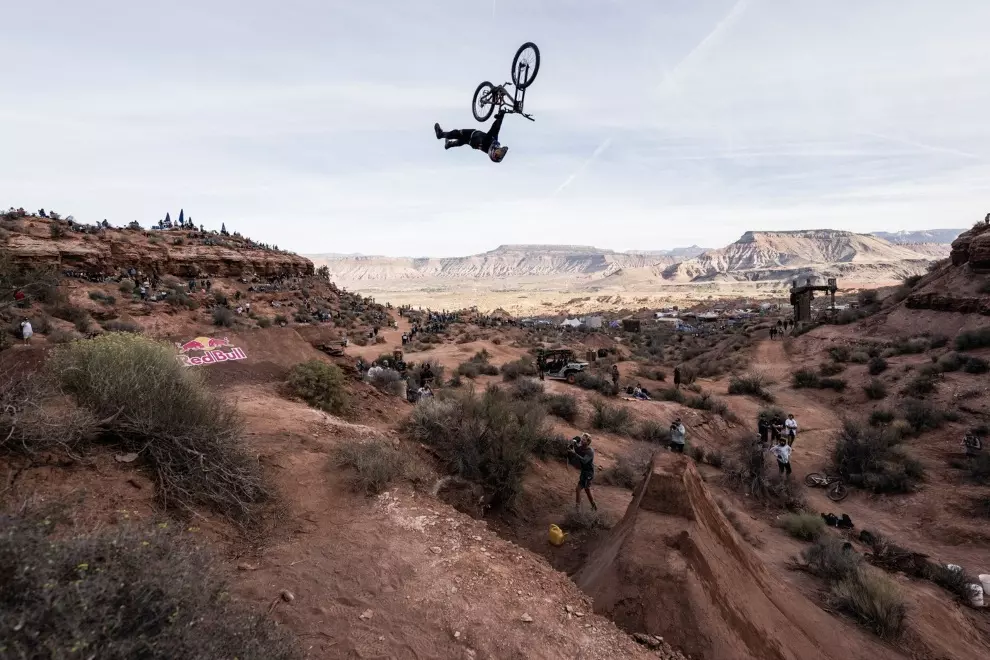
“Todd Barber, owner of h5events, noticed Bender, and together they created a concept for a competition that would forever change MTB history: Red Bull Rampage in Utah,” says Richard, who took part for the first time in 2002 as the very first European. The organisers found a spot among the orange cliffs of Zion, where riders could find lines unlike anywhere else in the world.
View this post on Instagram
The birth of Red Bull Rampage
The first Rampage editions looked very different from what we see today, when riders show up with full dig crews who spend days shaping features. “At the beginning, it was much closer to freeride skiing events,” Gaspi explains. “Organisers marked off a section of the mountain with flags, and that’s where everything happened. They gave us these shovel-rake tools, and we just cleared the biggest rocks off our chosen line – and went for it.”
Collective, Roam, and other influential videos
According to Richard, the turning point came around 2003, when riders like Darren Berrecloth emerged and pushed the sport forward. He could ride steep, technical slopes as well as anyone, but added tricks from BMX. While others could take a hand off the bars in the air, Darren could throw a 360. “It was like something from a snowboard video. He took off, spun it, and landed it smoothly,” Gasperotti remembers. It was also the era when VHS tapes were replaced by DVDs. Riders consumed new videos like Collective and Roam, where Berrecloth and many others kept pushing the sport’s boundaries.
After Rampage was cancelled, new events stepped in
When Rampage ended in 2004, many people didn’t know what would come next. In Whistler, Red Bull Joyride appeared; in Australia, Red Bull Ride. Europe followed with events like Adidas Slopestyle in Saalbach, where the same names reappeared. But everyone wondered whether the original Rampage would return – which it finally did in 2008. Familiar faces showed up, but also many new ones. “They were dirt jumpers and BMX riders with a whole new range of tricks – that was the moment freeriding merged with slopestyle, similar to what had happened in snowboarding.”
Safer training
The younger generation had several advantages: they had grown up watching North Shore videos and the early Rampages, and at home, they tried to push those limits further. New tools helped them – foam pits and airbags where they could safely practice difficult tricks without fear of injury. “When I tried a backflip on a mountain bike for the first time, it was on dirt. And if I didn’t land it, it hurt. We didn’t have anything like airbags,” Richard recalls.
A new mental approach
Along with new equipment and training tools came new methods. Older riders became coaches and passed down their knowledge. Mental training became a key part of preparation. “It was completely different from what we experienced. We’d finish riding and go for a beer. The new generation would go see their therapist,” says Gaspi. “A modern Rampage rider is an athlete on the level of an Olympian – physically and mentally prepared, focused on their mission. Riders from five or seven years ago wouldn’t be able to complete today’s competition. And even with all this preparation, they still run into limits. Dangerous limits,” Gasperotti says.
How far can we go?
Freeriding today is at its peak. All fourteen Rampage riders carefully monitor the wind at the start, because even a slight gust can fatally affect their run. The jumps are so extreme that the smallest breeze can break the delicate balance and cause disaster.
“Riders have to put themselves into a mental state where they simply believe they can do what they set out to do – whether it’s realistically possible or not. It’s an all-or-nothing mindset. The chance of landing a trick is basically fifty-fifty,” Gasperotti explains.
Spectators this year saw Spanish rider Adolf Silva attempt the world’s first double backflip off a massive drop. He didn’t land it – and today he uses a wheelchair. “No one knows how far this can go. Many people asked whether the organisers could have prevented it, but it’s always up to each rider to decide where their personal limits lie,” Richard believes.
“In our day, a ten-meter drop was considered extreme. When I landed one, everyone patted me on the back and said, ‘Gaspi, that was like jumping off a fourth-floor balcony.’ But today, riders at Rampage drop sixteen meters. It still requires absolute concentration and photographic memory: you memorise every detail of the takeoff and landing. I would mark stones on the lip, visualise where I would land, and before I hit it for the first time, no one was allowed to speak to me,” he recalls.
“Today, riders have twenty-metre landings built to increase their chances of riding away safely – but they still have to hit them perfectly. Will the sport ever reach its limit? Maybe new trends will appear. As an e-biker, I have another idea stuck in my head: whatever you ride up, you should also have to ride down,” Richard says. “We’ll see.”