If your answer is something like “abs,” you’re in good company. Maybe you throw in the obliques, maybe the lower back. But for most cyclists, there’s one crucial muscle that rarely makes the list, even though it works tirelessly every second you’re alive. We’re talking about the diaphragm.
Most of us know the diaphragm as the primary muscle responsible for breathing, but it plays a significantly larger role in cycling performance than it is often given credit for. From posture and power output to fatigue resistance, this humble dome-shaped muscle sits at the crossroads of some of your most essential athletic functions. And the better it works, the better you ride.
Meet your inner core
To understand how the diaphragm fits into the bigger picture, it helps to take a step back and examine how your core actually functions. Picture a soda can. The top is your diaphragm. The bottom is your pelvic floor. The sides are your deep abdominals and multifidus (a deep spinal muscle). When all of these elements are working together, they create pressure and stability from the inside out, keeping your spine supported, your pelvis aligned, and your limbs free to move efficiently.
When that internal pressure system isn’t functioning well—say, from poor breathing habits or a weak diaphragm—everything from posture to power transfer can start to fall apart. You might not notice it right away, but over the course of a long ride, the little things add up. A subtle shift in spinal alignment, a small energy leak from your hips, a creeping tension in your neck or traps. Eventually, it affects your form, your performance, and how long you can stay comfortable and efficient on the bike.
What breathing has to do with riding strong
Think about a hard effort—a climb, a sprint, or even a long, steady push into a headwind. Your legs are working, your heart’s pounding, and your breathing is picking up. Ideally, your breath is deep and rhythmic, driven from your lower ribs and belly. But for a lot of us, breathing becomes shallow and chesty as intensity increases.
The problem with this kind of breathing is that it bypasses the diaphragm. Instead of engaging your core and stabilising your spine with each inhale, you’re lifting your shoulders, tightening your neck, and recruiting accessory muscles that weren’t meant to work that hard for that long. Over time, that compensation creates fatigue, not just in your upper body, but in your whole system.
And it’s not just about where you’re breathing from. How well your diaphragm functions can also influence how efficiently oxygen gets delivered to your working muscles. If the diaphragm is weak or out of sync with the rest of your core, it can compromise your breathing rhythm and your ability to exchange air effectively. That means higher heart rate, higher perceived exertion, and—ironically—less endurance.
Posture, power, and fatigue: A three-way street
Posture is one of those things that often slips under the radar until it becomes a problem. On the bike, poor posture can look like slouching through your lower back, rounding your shoulders, or craning your neck forward. It feels like that annoying ache between your shoulder blades, the tension in your traps, or the low-grade fatigue that builds up over hours in the saddle.
What many cyclists don’t realise is that dysfunctional breathing can be a root cause of postural breakdowns. When your diaphragm isn’t pulling its weight, your body loses a key player in spinal support. That puts more stress on the superficial muscles, which then fatigue faster, pulling you out of alignment and setting off a chain reaction: posture goes, power goes, fatigue sets in.
It’s a vicious cycle. But the good news is, it works in reverse, too. Improve your breathing mechanics, and you support your posture. Improve your posture, and you free up more energy for your legs. The whole system becomes more efficient, and that can translate to more watts, longer endurance, and a lot less tension.
So… how do you actually train the diaphragm?
Here’s the part you can control. Just like your glutes or your hamstrings, the diaphragm is a muscle that can be trained. And the training doesn’t need to be complicated, time-consuming, or high-tech.
The easiest place to start? Lie down and pay attention.
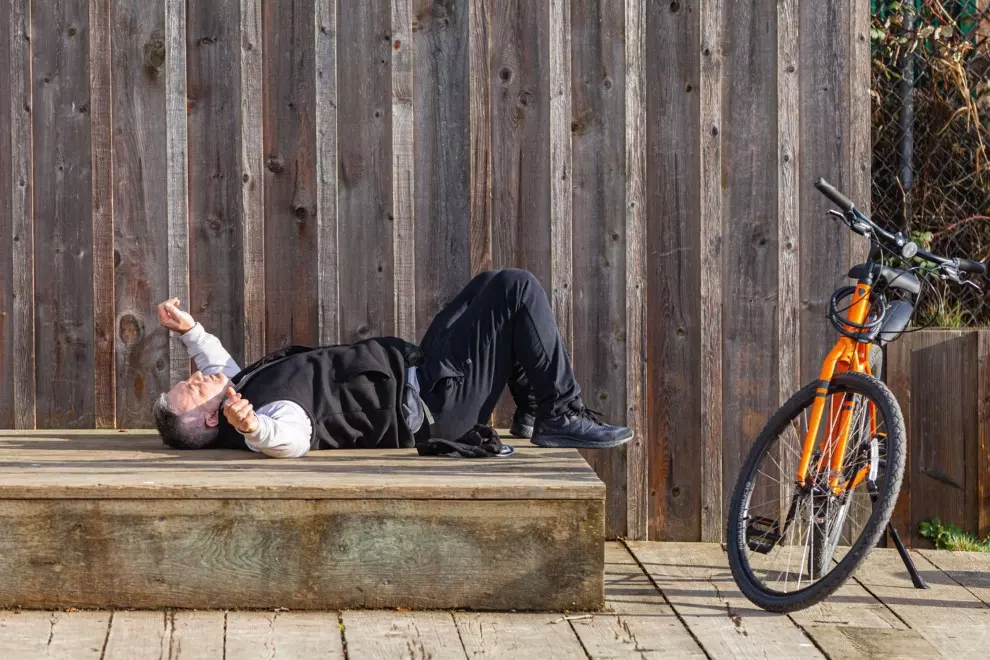
Try this: Lie on your back with your knees bent and your feet on the floor. Place one hand on your chest and one on your belly. Now breathe in through your nose and notice where the air goes. Ideally, your belly expands and your lower ribs widen, not your chest. Then exhale slowly through pursed lips, like you’re blowing out a candle. Feel your belly gently fall and your ribs move inward.
If this feels unfamiliar or difficult, don’t worry. You’re not alone. It might take some practice to reconnect with your diaphragm, especially if you’ve been defaulting to shallow chest breathing for years.
Once you’re comfortable lying down, you can start to explore diaphragmatic breathing in other positions, like lying face down (known as crocodile breathing), seated upright, or even on the bike during easy rides. One helpful exercise is called box breathing: inhale for four counts, hold for four, exhale for four, hold again for four. It’s simple, calming, and an effective way to link breath with rhythm and control.
When you’re ready to take it a step further, you can combine breath with movement. Exercises like the dead bug or bird-dog, performed with intentional exhalation and spinal alignment, can help integrate diaphragm engagement with core control. You can even bring it into your strength training or mobility work. The key is awareness—breathing well on purpose, rather than letting old habits take over.
What you’ll notice on the bike
The first thing most cyclists notice when they start working with their diaphragm is a drop in tension. Neck and shoulder tightness starts to ease. You feel more grounded through your core. Over time, your breathing becomes more efficient under pressure—climbs don’t feel quite so frantic, and long rides don’t leave you quite so wrecked.
Posture starts to hold up better, too. That mid-ride slouch? Less dramatic. The low-back fatigue that creeps in after three hours? Not as intense. Even your recovery might improve, thanks to better oxygen exchange and nervous system regulation.
And while it’s unlikely that diaphragmatic breathing alone will suddenly make you faster, it will help you ride more efficiently. And in a sport where energy conservation is everything, that might be the edge you’re looking for.
Never underestimate the power of your breath!
In the world of cycling, we spend a lot of time chasing marginal gains. Aero socks, ceramic pulleys, and perfect tire pressure. But sometimes the biggest improvements come from the simplest places—like learning to breathe better.
So the next time you’re on the bike, check in with your breath. Is it deep, grounded, and rhythmic—or shallow and tight? Is your core helping support your ride, or just along for the ride?
Your diaphragm might not look as flashy as your quads or glutes, but it’s doing work that matters. Show it a little attention, and you might just ride stronger, longer, and more comfortably than you thought possible.