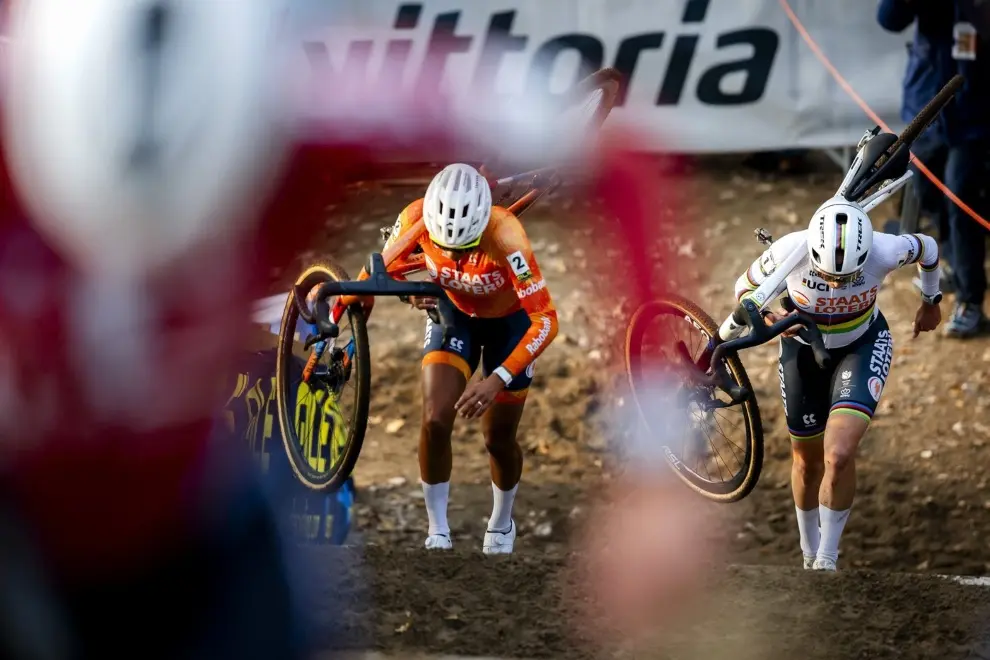
This is a reasonable moment to question several decisions.
You bought the bicycle to avoid running. You entered a cycling race to ride it. Yet here you are, carrying the thing like an expensive piece of furniture while a spectator enthusiastically rings a cowbell.
Welcome to cyclocross. There is an explanation. Whether you find it convincing will depend partly on how much mud is currently inside your shoe.
The basic idea is simple: race several laps of a short circuit combining surfaces such as grass, dirt, gravel, sand and tarmac. Add tight corners, steep banks and occasional obstacles that require you to dismount. Races typically last around 30 to 60 minutes, depending on the category. A surprisingly compact appointment in which to discover quite so many personal weaknesses.
Picture your first race at a local event. You arrive early, look across the course and feel reassured. It is a field. You have ridden through fields. There are some corners, but your bicycle is equipped to turn.
Then you ride a practice lap.
The innocent-looking bank requires a decision about whether to ride or run. The grassy corner offers less grip than its appearance suggested. A short sandy section introduces the possibility that your front wheel has ambitions unrelated to yours.
This is why arriving in time to inspect the course is worth more than spending the previous evening watching professionals leap over barriers online. Their version looks effortless because they have practised. Your version does not yet need to leave the ground.
Before any of that, check what the organiser allows you to ride. Some grassroots events accept mountain bikes and gravel bikes alongside dedicated cyclocross machines. Entry requirements and equipment rules vary, so ask before assuming your existing bike is eligible—or deciding you urgently need another one. British Cycling explicitly encourages newcomers to explore local events on a mountain bike where permitted.
There will be plenty of opportunities to become unreasonable about equipment later.

For now, being comfortable getting off and back on is more useful than owning something photographed against a Belgian barn.
Practise dismounting slowly on a quiet patch of grass. Learn to clear the bike safely and remount without treating the saddle as a landing target. If you use clipless pedals, make sure unclipping is familiar before adding slippery ground and other riders.
At an obstacle, a controlled stop and step over will do. Nobody awards bonus points for attempting a flying dismount and arriving separately from your bicycle.
And yes, sometimes running is the sensible choice. A steep, slippery bank or deep mud can be quicker to negotiate on foot. Cyclocross asks you to recognise when pedalling has stopped helping. Continuing to spin the rear wheel while remaining in approximately the same postcode is usually a clue.
Then the race starts, and your carefully considered plan to ease into it encounters everyone else’s enthusiasm.
Let them go if you need to. Your first lap is already providing plenty to think about. There is little benefit in reaching the first technical section too breathless to remember what your hands do.
Soon, someone will probably overtake you. Perhaps several people. One may do it while taking a line you had not realised existed.
This is useful information, even if it feels personally targeted.
Watch how experienced riders approach corners, where they slow down and how they keep moving through awkward sections. Cyclocross rewards handling as well as fitness: preserving momentum means less work getting back up to speed. You can be impressively fit and still spend an afternoon repeatedly accelerating out of your own mistakes.
If faster riders catch you, stay predictable and give them space where it is safe. A sudden sideways leap into the undergrowth rarely improves traffic flow. Listen to the briefing, too: organisers will explain the finish procedure and what happens if you are lapped.
Meanwhile, the course begins to feel familiar. You know which bank is worth running. You get through the corner that caused trouble earlier. You stop braking quite so much before the section that only looks alarming.
Your position might not have changed. Your riding has.
That is one of cyclocross’s great attractions for a beginner. Progress can happen within a single race, and it can be very specific: one corner, one remount, one stretch ridden cleanly. There is always something to work on besides the uncomfortable fact that someone ahead is faster.
The short circuit also makes this a spectator-friendly form of suffering. Friends and family can see you repeatedly, rather than watching you disappear down a road and waiting three hours for an update.
Choose your supporters carefully. They will have multiple opportunities to revisit whatever happened on lap two.
At the finish, get into something warm and dry, find your drink and assess the damage to your appearance. Bring a towel and a bag for muddy kit. Your future self, particularly the version cleaning the car, deserves this small kindness.
You may have finished well down the field. You may have run more than expected. You may also be oddly pleased with a corner nobody else noticed.
And somewhere between peeling off your socks and explaining why there is grass in your helmet, you will start thinking about the next race.
You could definitely take that corner faster.
Which is how they get you.