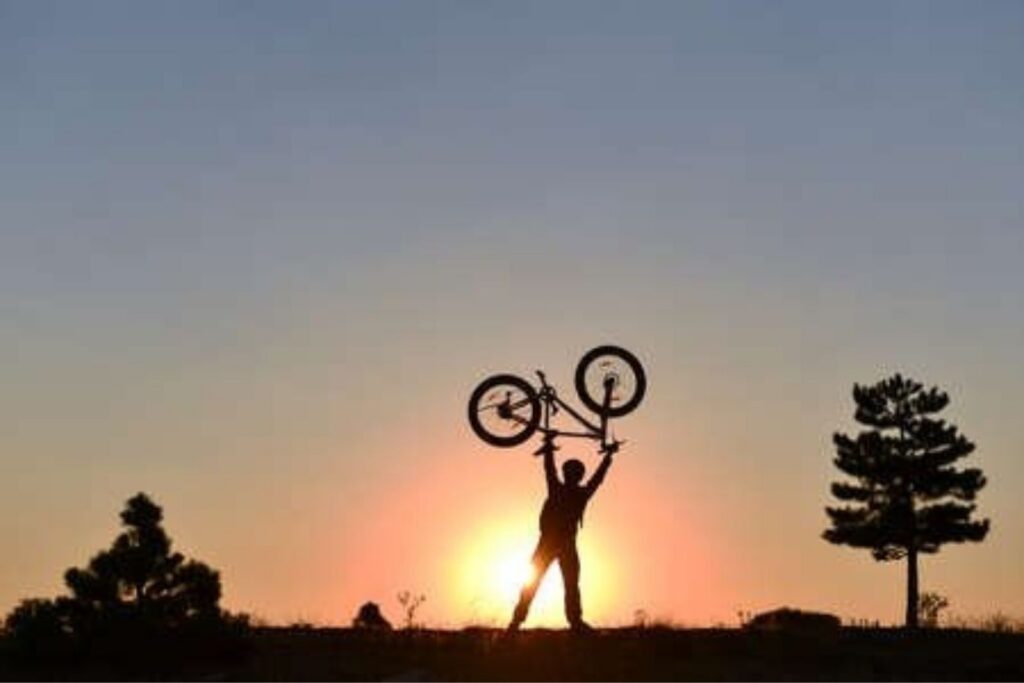
Oh, wait… did you think you’re the cool dude everyone looks up to and secretly dreams of being? Yeah, not really. You’re a grown adult in a skintight Lycra suit who, the moment nobody’s watching, starts doing things that would earn anyone else a one-way ticket to the psychiatric ward. Sure, I might be exaggerating a bit, but just look at the things every single one of us does when nobody’s watching and tell me that’s normal. I dare you.
Talking to your bike
Don’t pretend you don’t do it. We all do. Sometimes we proclaim our love, other times we pick a fight, but we’re always talking to our two-wheeled friend. I mean, who else are you going to talk to? The squirrels in the forest? Or the guy riding next to you? Don’t be silly. He’s talking to his bike, and we were raised better than to interrupt someone else’s conversation.
So, whether we’re asking an increasingly frustrated “What’s up with you now?” when we hear a noise that definitely shouldn’t be coming from the drivetrain, or excitedly exclaiming “Good job!” after miraculously surviving an unexpected pothole or a particularly nasty root, we’re always conversing. There’s also the occasional “Nice one!” when your bike somehow regains traction a split second before your sleeve becomes a sledge across the dirt.
And to be honest, I couldn’t think of a better person to talk to during those rides. Still, that doesn’t mean it’s sane or publicly acceptable. But who cares? I don’t see the general public riding around in 7°C wearing what can only be described as a glorified second skin, so why would I care what they think?
Bargaining with a climb
If you’ve never bargained with a climb, you’ve never actually given it your all. It’s much like the shamans who see visions and gods after fasting for two weeks. Sure they do. When you’re that close to the other side, you can probably peek behind the curtain.
But while these guys are looking for enlightenment, we’re just trying to get our adrenaline dose. Whether it’s a KOM or a mere PR, the dopamine hit you get from seeing that crown or gold medal on Strava definitely makes the whole thing worth it. But before that, you need to get to the top.
On the way there, if you’re giving it your all, you’ll be in constant negotiations with the slope. Whether you’re asking for some shade, a gentler gradient, a short descent to recover or for the summit to finally be behind that corner over there, it doesn’t really matter. The climb holds all the cards, and to be honest, I’ve never seen it give in. No matter what you promise or how much you beg, the climb never becomes easier or shorter. Still, that stops absolutely no one from vocally, sometimes at considerably higher decibels than socially acceptable, pleading their case, offering their food, water, and firstborn child in the process.
Racing complete strangers who have no idea
Some will call it toxic, others will call it competitive, but it’s actually instinct. We’re programmed to chase. We don’t ride bikes because we want to get somewhere slower… or second. Plus, having someone in front of us is like waving a bone in front of a pack of starving dogs. As I said, It’s instinct.
You may be on a nice recovery ride, enjoying a quiet conversation with your bike, when your eyes meet those of someone who’s just overtaken you. Blink, and you’ll miss it, but I’m pretty sure that was a challenge. And, well, we’re hardly the type to turn down a challenge or at least a chance to get the first pick of the pastries at the coffee shop.
So, let the games begin. You close the gap, tuck in behind them, and 200 metres before the café, you explode. 2,000 watts are nothing when your honour is at stake. So you give it your all. The veins on your neck look as if they’re carrying half of Europe’s natural gas through them, and your face can only be described as a Picasso painting. I know, no one has ever dared compare your otherwise gorgeous face to cubism, but here we are.
And there you are – only the damn challenger is missing. Oh, yeah, he wasn’t racing. He actually turned left at that crossroads 50 metres ago. God damn it. We’ve misread the situation again. OK, no more sprints. Just a normal ride… until the next rider passes you smugly on the left. Well, we know what happens next.

Practising imaginary victory celebrations
Our rides are not the Tour de France, no matter how imaginative our Strava headlines might be. We’re not racing for the yellow or the polka-dot jersey. But that doesn’t mean we can’t dream. I mean, would it really be such a stretch of the imagination for Visma to invite a 38-year-old marketing expert with a respectable FTP and absolutely zero racing experience to join their team for the Tour? I’d say stranger things have happened, but I’m not entirely sure that’s true. So, let’s just say, never say never.
And just in case Visma decides to call me under their banners, I must be ready. No, not by improving my FTP through structured training and a well-regulated diet. I’m a dreamer, not insane. I’m preparing for the celebrations. And let’s be honest, I’m not alone.
Just like all the other amateur riders who are well past their prime and will never get the chance to duke it out with the big names, we practise our finish-line celebrations. And the finish can be anywhere. That tree on the left, the guy at the bus stop, the pothole in the middle of the street. Truly anything. So, we launch a nice big sprint, take a theatrical look behind us, zip up our jersey to display the sponsors’ logos, sit up and raise both hands. Those of us with far more skill but less imagination might even attempt Del Toro’s famous bow.
Naturally, you have to try a few different celebrations. There’s the understated fist pump, the triumphant roar, the emotional point towards the sky and, of course, the arms-wide-open pose that makes for such a wonderful finish-line photograph. The photographer isn’t there, unfortunately, but that’s hardly your problem.
Then, just as you’re perfecting your third victory salute, you notice a car approaching in the opposite direction. Both hands immediately return to the handlebars, your face assumes the expression of a perfectly normal adult, and you continue riding as though you haven’t just won four Grand Tours in the space of three kilometres.
Providing live commentary on your own ride
There’s something deeply satisfying about having a professional commentator narrate your every move. Unfortunately, Eurosport has yet to recognise the commercial potential of broadcasting a slightly overweight amateur riding through the countryside on a Sunday morning. So, naturally, we have to do the job ourselves.
And we’re surprisingly good at it. One moment you’re riding along, minding your own business, and the next you’re describing your performance in the third person, preferably with a British accent and the kind of excitement usually reserved for the final kilometres of Paris-Roubaix. “He’s out of the saddle! He’s attacking! What an incredible acceleration!” You’re doing 23 km/h on a 3% gradient, but that’s irrelevant. The audience deserves a spectacle.
Of course, every respectable broadcast needs some tactical analysis. You explain why you’ve selected a particular gear, question your decision to attack so early, and provide expert commentary on your increasingly questionable physical condition. Occasionally, you even disagree with yourself. The commentator thinks you should push harder, while the expert analyst, who happens to be the same oxygen-deprived dude, insists that saving energy would be the more sensible option.
And eventually, it all ends with the same four words every cyclist dreads saying, straight from Pogi’s infamous radio message on the Col de la Loze: “I’m gone, I’m dead.” And to be honest, that’s probably exactly how any ride of ours worth commentating on would end. So, let’s just enjoy doing it ourselves.
Deliberately riding through things you’re supposed to avoid
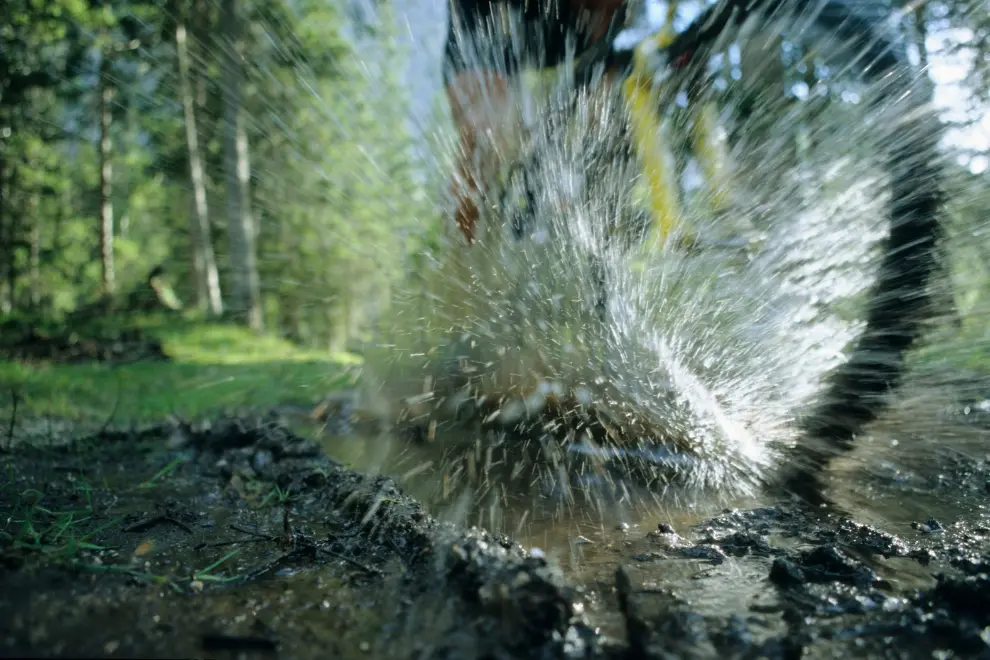
You can spend thousands on a bike, hundreds on protective equipment and years improving your riding technique, but none of that will stop you from behaving like an unsupervised eight-year-old the moment you encounter a particularly inviting puddle.
There’s a perfectly dry line around it. You can see it. You know it’s there. Yet something deep inside your brain insists that riding straight through the middle is the only reasonable course of action. And if the splash doesn’t reach your knees, you’ve somehow failed. Naturally, you’ll complain about having to clean the bike afterwards, as though the entire incident was unavoidable.
The same goes for every little bump, pile of leaves or suspiciously shaped mound of dirt. You could simply ride past, but where’s the entertainment in that? Instead, you launch yourself off a tiny roadside bump with the enthusiasm of someone competing at Red Bull Rampage, getting approximately twelve centimetres of air and landing with the self-satisfaction of a man who’s just rewritten the laws of physics.
Is it wise? Of course not. But you’re not reading a book, for God’s sake. You’re riding a bike. You left wiseness at the bike stand. So, be a kid for a moment or five. If growing up means deliberately avoiding every opportunity to have a little harmless fun, perhaps we should all remain eight years old for a bit longer.
Normality is overrated
Sure, some of these habits might raise a few eyebrows, and others might convince a passing stranger that you require professional supervision. But that’s the beauty of riding alone. For a few hours, you can abandon the exhausting business of being a respectable adult and your wonderfully ridiculous self without anyone judging you. Well… almost anyone. There’s always that one hiker who catches you celebrating an imaginary Tour de France victory. But who cares? You’ll probably never see them again. And if you do, they might just ask for an autograph.