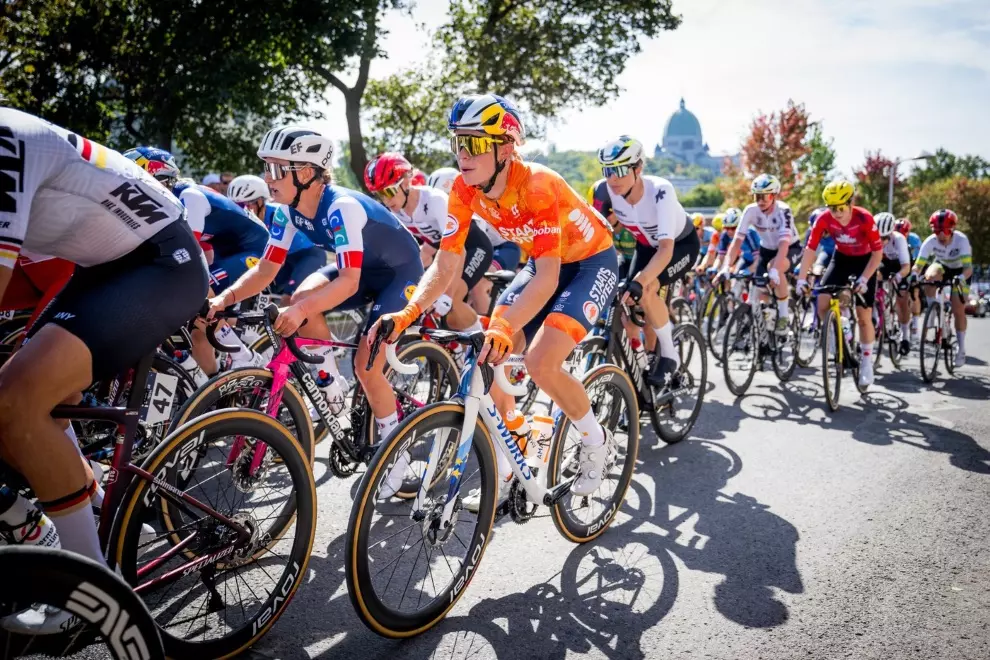
And then there was Demi Vollering. After years of near misses, the Dutch star finally pulled on the World Championship rainbow jersey on Saturday, winning a spectacular 180.1-kilometre elite road race in a two-up sprint against Kasia Niewiadoma-Phinney. But Vollering’s victory was only the final chapter in a week that offered plenty of reasons to believe women’s cycling is entering an especially fascinating period.
Reusser starts with a statement
The championships opened with Marlen Reusser doing what she has become rather good at: winning the individual time trial. The Swiss rider defended her world title over Montréal’s 39.2-kilometre course, but this was no straightforward procession. Reusser actually trailed Zoe Bäckstedt at the first time check, with the British rider, making her elite World Championship debut, setting an exceptionally fast early pace.
Reusser turned the race around in the second half, ultimately finishing in 50:24.44, more than 40 seconds clear of Bäckstedt. Germany’s Franziska Koch took bronze, while Elisa Longo Borghini and Cédrine Kerbaol rounded out the top five. Reusser’s victory was particularly fitting given that she celebrated her 35th birthday on race day.
It was also a revealing result for the next generation. Bäckstedt, already a junior and U23 world champion in the discipline, immediately translated that success to the senior level with silver. She had chosen to race the elite time trial rather than defend her U23 title, and the decision paid off spectacularly.
Meanwhile, Demi Vollering finished eighth. It was a rare reminder that being the strongest rider in a road race and being the fastest against the clock are rather different propositions. Of course, Vollering would have another opportunity to demonstrate which discipline suited her better later in the week.
Zobrazit příspěvek na Instagramu
The next generation takes centre stage
The U23 events offered perhaps the clearest glimpse of where women’s cycling is heading. Australia’s Felicity Wilson-Haffenden won the U23 time trial, completing the 20.3km course 28 seconds faster than the Netherlands’ Nienke Vinke. Slovakia’s Viktória Chladoňová took bronze. For Wilson-Haffenden, it was a particularly satisfying result after narrowly missing the podium in the same event in Kigali the previous year.
Three days later, Chladoňová went one better and claimed the rainbow jersey in the U23 road race. That race became one of the most entertaining battles of the championships, particularly for the home crowd. Canada’s Isabella Holmgren attacked repeatedly on the Mont Royal circuit, eventually getting clear with Chladoňová and Belgium’s Fleur Moors. When Moors was dropped, the race became a duel between Holmgren and Chladoňová.
Holmgren had the home roads, the crowd and the climbing legs. Chladoňová had patience. The Slovak rider resisted Holmgren’s attempts to get clear and waited until the final sprint, coming around her with 125 metres remaining to take gold. Holmgren settled for silver, while Moors took bronze.
For Chladoňová, it was redemption as much as victory. She had finished second in both the U23 road race and time trial at the 2025 Worlds. This time, after 134 kilometres and ten laps of a course featuring the punishing Voie Camillien-Houde, she got the result she had been chasing.
And Montréal gave us another reason to remember the Holmgren name. Isabella’s twin sister Ava was instrumental in driving the race apart, with her attacks helping set up Isabella’s move. The Holmgren sisters are only 21, and their presence at the sharp end of a home World Championship felt less like a novelty than a preview.
Okrucińska and Neira put Poland and Spain on the map
The junior women’s events produced two more compelling stories. Maria Okrucińska won Poland’s first-ever junior women’s individual time-trial rainbow jersey, beating Belgium’s Yana Decruyenaere and Great Britain’s Aalia Clay over the 11-kilometre course. It was a performance built around consistency: Okrucińska was already at the top of the standings at the early checkpoints and never surrendered control.
Three days later, Spain’s Alejandra Neira won the junior women’s road race after an 80.4km battle that gradually whittled the field down. The final kilometres were particularly chaotic. A late escape was reeled in, crashes disrupted the chase, and five riders ultimately arrived to contest the medals. Neira waited until the final 150 metres before launching her sprint, beating Italy’s Matilde Rossignoli to gold, with Switzerland’s Anja Grossmann taking bronze.
It is easy to look at junior and U23 results as simply a list of names to remember. But the Montréal championships offered something more interesting: a glimpse of how quickly riders are moving through the development system and into major senior races.
Bäckstedt’s elite silver, Chladoňová’s U23 title and the performances of Holmgren and Wilson-Haffenden all suggest that the gap between “rising star” and established professional is becoming increasingly short.
Then came Vollering
At 180.1 kilometres, the elite road race was the longest women’s World Championship road race ever contested. The race began in Brossard before moving into Montréal, where the riders faced eight laps of the demanding Mont Royal circuit. The defining climb, Voie Camillien-Houde, measured around 2.3 kilometres at an average gradient of 6.2%.
The race was also marked by tragedy and disruption. With around 95 kilometres remaining, a large crash brought down more than 15 riders on a fast section of the circuit. Among those caught up were defending world champion Magdeleine Vallières Mill of Canada and Spain’s Paula Blasi, both of whom ultimately abandoned. Sweden’s Caroline Andersson and Australia’s Lauretta Hanson were taken to hospital; subsequent updates said Andersson had suffered a broken collarbone requiring surgery, while Hanson reported broken ribs. Vallières Mill was later reported to have no fractures.
For the Canadian crowd, losing the defending champion was a particularly cruel twist. Vallières Mill had been hoping to defend her title on home roads, but the race was about to become a completely different contest.
The Netherlands took control, while attacks came and went. Maeva Squiban of France made a particularly strong move with 52 kilometres remaining, but the decisive phase began when Vollering finally made her move.
With roughly 40 kilometres to go, the Dutchwoman attacked on the climb and established a significant advantage. For a while, it looked like the sort of move Vollering has made so many times before: incredibly powerful, incredibly committed, and potentially just a little too far from home.
This time, however, she was caught. With just over 15 kilometres remaining, Kasia Niewiadoma-Phinney and Elisa Longo Borghini helped close the gap, bringing Vollering back into the fight. Juliette Berthet also joined the leading group, creating a tense four-rider finale.
Then Longo Borghini attacked.
Her move at the beginning of the final lap opened a gap of around ten seconds and briefly threatened to steal the race from everyone. It was a typically aggressive move from the Italian, who was unwilling to wait for the final climb and sprint.
But Vollering chased her down. On the final ascent, Vollering and Niewiadoma-Phinney distanced Longo Borghini and turned the World Championship into something much more personal: one final duel between two riders who have spent years testing one another at the biggest races in the sport.
Niewiadoma attacked. Vollering responded. The Pole tried again. Vollering stayed with her.
And then, after 4:45:09 of racing, it came down to a sprint.
Vollering led into the final metres and had enough left to beat Niewiadoma-Phinney by a fraction of a second. Longo Borghini held on for bronze, just four seconds back, with Reusser fourth and Berthet fifth. Puck Pieterse finished sixth, while Célia Gery, Dominika Włodarczyk, Squiban and Koch completed the top ten.
For Vollering, the significance goes well beyond a single rainbow jersey.
She arrived in Montréal having already won the Tour de France Femmes, the Giro d’Italia Women, Liège-Bastogne-Liège and the Tour of Flanders this season. Now she can add the World Championship road race to that list — finally.
For years, the rainbow jersey has been one of the conspicuous omissions from her palmarès. In Montréal, she attacked, got caught, attacked again and then trusted herself in the sprint.
A changing hierarchy
After an action-packed week, perhaps the most interesting thing about these championships is how many different generations are appearing at the front of the same story.
Reusser, at 35, remains the benchmark against the clock. Longo Borghini, 34, can still attack the world’s best deep into a brutally long race. Vollering, 29, has reached the most dominant phase of her career.
And behind them are Bäckstedt, Chladoňová, Holmgren, Wilson-Haffenden, Neira and Okrucińska, riders who are already winning rainbow jerseys or standing on senior World Championship podiums.
The women’s peloton is producing riders who are arriving earlier, racing more aggressively and making themselves relevant at the biggest events almost immediately. In Montréal, we saw clearly that the next era of women’s cycling is already racing up Mont Royal, fighting for the rainbow stripes.