Remco for the world title double?
The run-up to Sunday’s Elite Men’s World Championship Road Race was overshadowed by Mathieu van der Poel’s 176 km start-to-finish solo to win the final stage of the Škoda Tour de Luxembourg last Sunday. Talk about a great warm-up! That by itself should have made him the favourite for Sunday. But he had already played down his chances before that jaw-dropping performance.
“I think it will still be a little too difficult for me,” he said after winning the first stage of the Luxembourg race. “If you saw which riders were at the front on Sunday [at the GP de Montréal].” That race, which was held over a similar circuit as Sunday’s title race, was won by Mexico’s Isaac del Toro after a two-man sprint with France’s now-20-year-old Paul Seixas. Both are superior climbers.
But after doing a recon of Sunday’s course, van der Poel changed his mind. “It was more or less in line with what I expected,” he told journalists on Thursday. “As I said before, it’s simply a difficult circuit. Probably just on the limit, but not impossible.”
No, that’s not what he said before. Then he added: “I don’t think I’m one of the biggest favourites, but I still have a chance of winning the race if everything goes well.” He emphasized the taxing 600-metreclimb (at 4.6%) to the finish, saying: “[E]specially from around the last 500 metres before the finish all the way to the top. It’s a really difficult climb. But a lot will depend on how the race develops.”
I think he is one of the big favourites and will likely set off on his own from distance. But surely not at the start. The course is 273.4 km long, and this is a much higher level of competition than at the Tour de Luxembourg, and there is much more – and much steeper – climbing. The men climb the Voie Camillien-Houde (1.7 km @ 7.3%) 12 times, which – including the final climb – makes for 3,800 metresof altitude gain; that’s a lot of climbing on such a long race.
That is why after the GP de Montréal, in which he finished fifth, Remco Evenepoel told Wielerflits, “With the way the longer climb [the Voie Camillien-Houde] is ridden, it is really difficult for the heavier guys. If you look at the average weight of the [Montréal] top 10, we are perhaps at 63 or 65 kilograms. Those aren’t heavy men, but riders like Wout [van Aert] and Mathieu [van der Poel] can survive this on super days.” Van Aert and van der Poel tip the scales at 75 kg and 78 kg, respectively.
And, as Evenepoel pointed out, there’s a lot more flat terrain in the World Championship race than there was in the GP. “It is also a difference that we will first ride 100 kilometres on flat terrain,” he noted. “We can ease into it a bit then. Here [at the GP de Montréal] it was full throttle right from the start. And the race is much longer, so it will be less explosive towards the end and come down more to endurance.”
If endurance is indeed the key, advantage to van der Poel. The man is a physical marvel. But it depends on what his legs are like when he hits that final climb and who is chasing him.
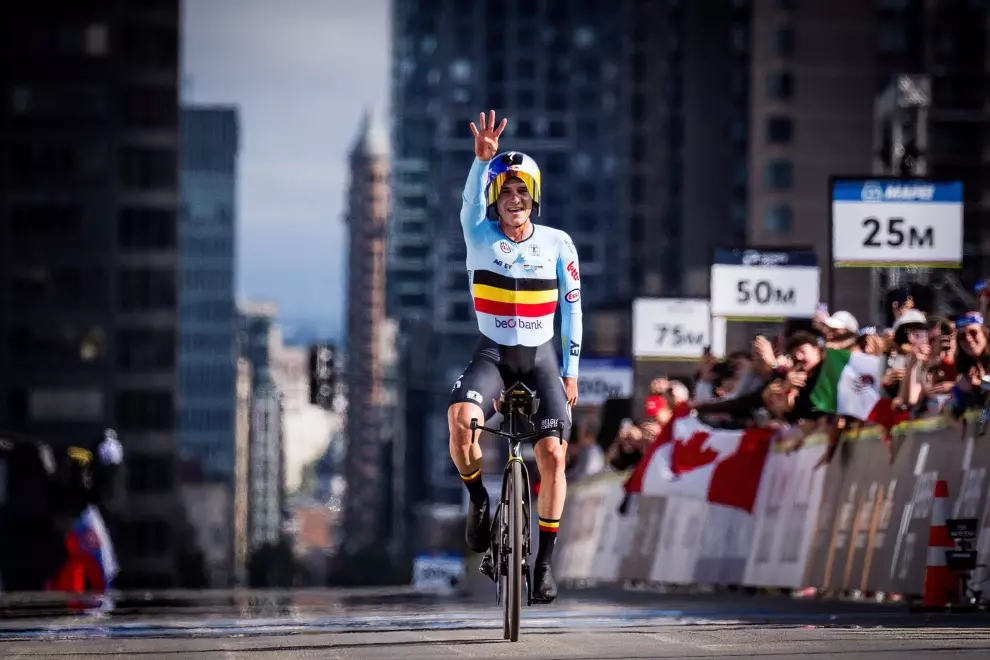
Evenepoel would love to become the first male rider to win the time trial and road race world titles in the same year. On Thursday, 17-year-old academy rider Benjamín Noval of Spain completed the ITT-road race junior world championship double with a long solo. The last junior-level rider to win the double? Remco Evenepoel, of course, in 2018.
So, who will win the Elite race? I have no idea. There are a number of riders with good chances to win. In addition to those already cited, there’s del Toro, Seixas, Britain’s Tom Pidcock, Denmark’s Mads Pedersen, Germany’s Florian Lipowitz, Spain’s Juan Ayuso, and, of course, Evenepoel’s Dutch teammate Wout van Aert.
I like Evenepoel for the win, just because being the first Elite Man to do the double is powerful motivation – and especially if van Aert rides in support. I expect him to take off on the final ascent of the Voie Camillien-Houde and then time-trial the remaining 12 km.
Seixas will be world champion one day, but not on Sunday. Though he just turned 20, he still lacks the necessary experience. Pedersen, del Toro, and van der Poel should be in the mix for the podium. But this is one race I would not put money on.
Lessons learned?
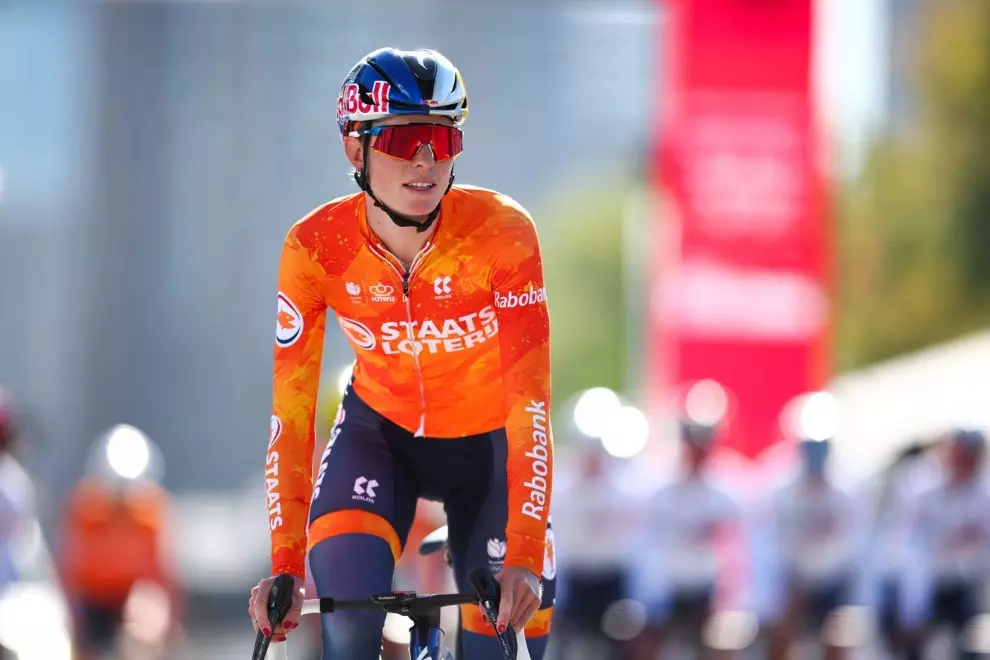
Saturday’s Elite Women’s Road Race World Championship should play out between three riders: Demi Vollering of the Netherlands, winner this year of the Giro d’Italia Women and the Tour de France Femmes avec Zwift (TdFFaZ); the two-time time trial world champion, Switzerland’s Marlen Reusser, who led the TdFFaZ for much of the race; and Kasia Niewiadoma-Phinney of Poland, winner of the 2024 TdFFaZ and second in this year’s TdFFaZ.
I say “should” because there are often surprises in this race, none greater than last year, when all the favourites, riding together, refused to chase the breakaway because they were afraid it would leave them without a chance against their rivals at the end. So they all lost, and the unheralded Canadian Magdeleine Vallieres stole the race. Vollering, Reusser, and Niewiadoma-Phinney finished 7th, 9th, and 10th, respectively, 1:34 behind the plucky (and lucky) Canadian.
You’d think that they learned their lesson in that race, but don’t bet on it. Remember how Vollering refused to chase Niewiadoma-Phinney on the Mont Ventoux in this year’s TdFFaZ for fear of pulling Reusser up the climb with her and handing her the glory. Still, I think Vollering will win because she is the best rider in the race and has doubtless become a little smarter as a result of her past errors.
The problem for her is that the Voie Camillien-Houde, which the women climb eight times on the 180 km course, are not long enough for her to exploit her superior climbing ability. They are steep, yes; but perhaps too short. A lot will depend on the ability of her Dutch teammates – Riejanne Markus, Puck Pieterse, Femke de Vries et al. – to maintain a hellish pace and weaken the legs of her rivals.
All things being equal, this year no one can stay with Vollering on Grand Tour climbs when she wants to win. If all the favourites reach the summit of the final climb together, probably as a small breakaway group, they must race the lumpy final 12 km together, which might favour the best time trial rider, which would be Reusser. The key will then be the final 600 uphill metres.
On Thursday, 19-year-old Viktória Chladoňová of Slovakia won the women’s U23 championship because she had fresher legs than Canada’s Isabella Holmgren and wore her down in the sprint to the line. Everyone racing on Saturday will have seen that race and learned something. If it comes to a sprint among the three favourites, Vollering should win. However, remembering the disaster of last year, she may want to be out in front all by herself. I think she will take off to try to solo for the win, perhaps on the last ascent of the Voie Camillien-Houde.
An interesting outsider for the win is Spain’s Paula Blasi, who won this year’s Amstel Gold Race Ladies Edition ahead of Niewadoma and Vollering. Another serious contender is Italy’s Elisa Longo Borghini, who on Tuesday won the Mixed Relay Time Trial World Championship with Filippo Ganna and four other riders, and will be feeling confident. She also finished a solid fourth in the ITT WorldChampionship behind Reusser, so either she is perfectly tuned for the road race or is carrying tired legs.
Whoever wins, both races should be exciting from start to finish.