Shared bikes vs public transport
For trips under 20 minutes, shared bikes often match or beat public transport. Here’s how some of my regular routes compare:
- Train station: 19 minutes (bike) vs. 21 minutes (tram)
- Dentist: 13 minutes (bike) vs. 14 minutes (tram)
- Movie theatre: 12 minutes (bike) vs. 17 minutes (tram)
- Bouldering gym: 18 minutes (bike) vs. 33 minutes (tram)
- Work: 22 minutes (bike) vs. 14 minutes (tram)
You might think I’ve cherry-picked destinations that favour shared bikes – and you’d be right. But these are the places I go most often. For short trips, I now instinctively consider shared bikes, and they’re frequently faster.
Of course, longer trips (over 30 minutes) are a different story. I won’t pretend that a shared bike is the best choice for everything. Riding one through a busy city for an extended time isn’t fun, and public transport often wins for speed and comfort over longer distances.
Door-to-door speed matters more than top speed
The real advantage of shared bikes is their door-to-door efficiency. With public transport, you have to walk to and from stops and often wait for connections. With shared bikes, you ride all the way.
For this to work, a city needs two things:
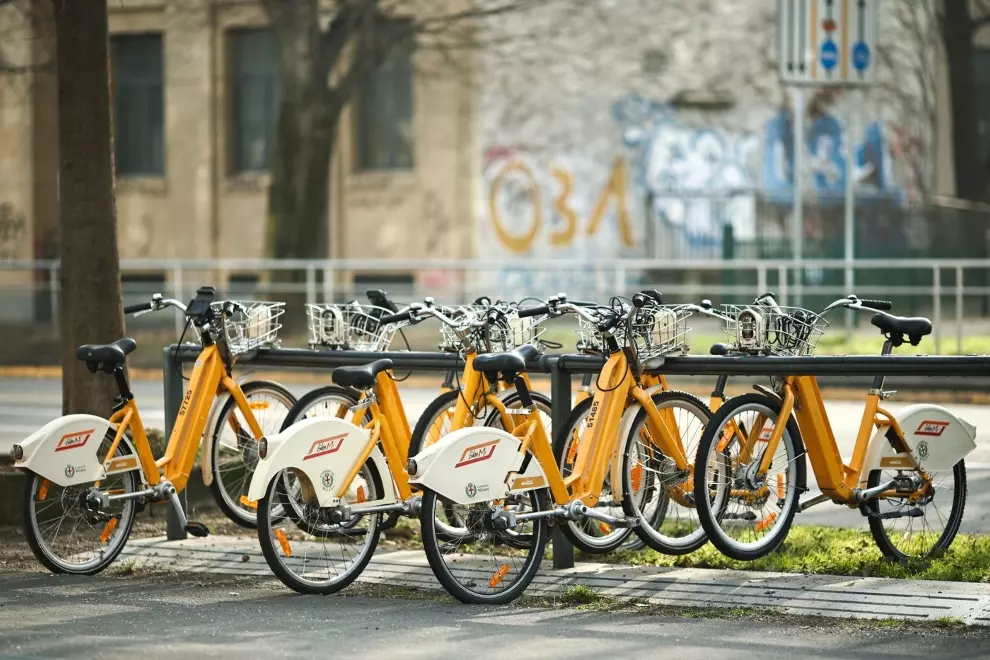
- Dense bike availability: Prague’s wider centre has stations everywhere. I have two within a minute’s walk from my home, so I’ve never struggled to find a bike, even during rush hour.
- Convenient drop-off points: Prague’s central coverage is excellent, so I rarely have to walk far after locking up the bike.
This setup eliminates transfer time. Shared bike stations are almost always closer to my home and destination than public transport stops. Cars can offer the same convenience, but good luck navigating Prague’s centre in a Bolt or Uber during rush hour. I’ve tried, and it’s often two to three times slower than the tram.
When public transport still wins
Shared bikes aren’t always the best choice. Here’s when I stick to public transport:
Long distances: Over 30 minutes, public transport is almost always faster.
Direct connections: If there’s a direct tram or bus, it can beat a shared bike even for 15-20 minute trips.
Bad weather: Heavy rain or snowmelt, when getting my clothes covered in the city grime would be inevitable.
Sweatiness: When I don’t want to risk getting sweaty (which is why I rarely bike to work, though I sometimes ride home after a stressful day because I’ve already sweated during stressful meetings).
Safety concerns: Prague’s cycling infrastructure is lacking. If you’re not an experienced cyclist, sharing the road with cars, separated by nothing more than a painted line or nothing at all, can feel unsafe. Until the city improves its bike lanes, many will understandably choose public transport.
It changes the way you live in a city
As a cyclist, I’m already connected to the city on two wheels, but mostly when trying to escape it for longer rides. Shared bikes have forced me to navigate the centre more often, and I’ve learned a lot. I’m always thinking of faster ways to connect places, even combining shared bikes with the metro for longer trips.
Experiencing the city from different perspectives, pedestrian, cyclist, public transport user, and car passenger, has given me more empathy for how others move around. It’s also made me appreciate the infrastructure we do have, even as I advocate for more bike-friendly improvements.