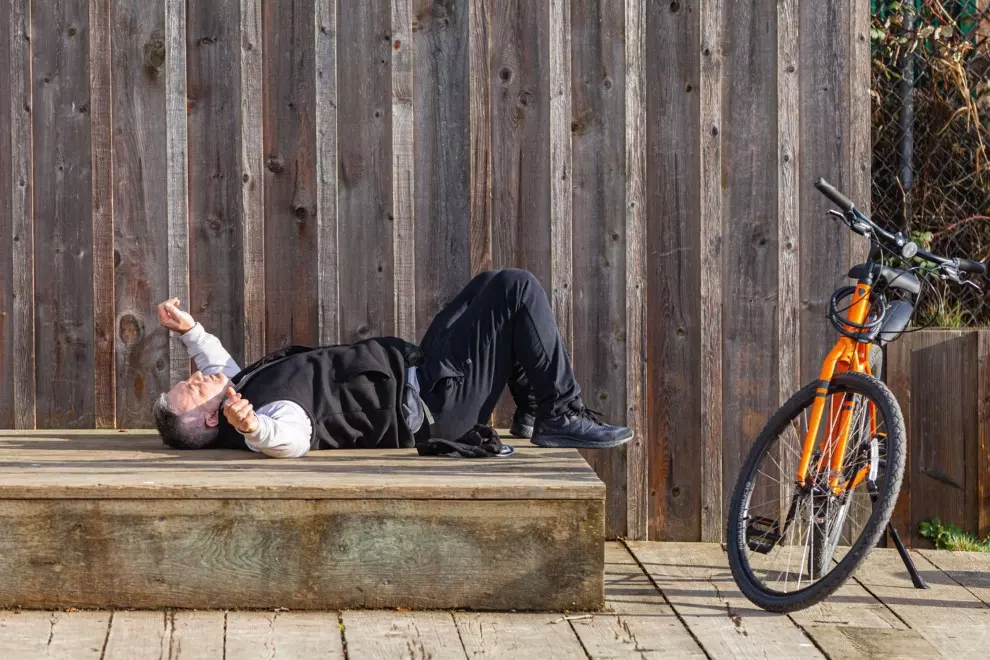
Single-leg balance
A cohort study in middle-aged adults found that those unable to complete a 10‑second one-leg balance test had an 84% higher risk of death, even after adjusting for age, sex, BMI, and health conditions. And another study showed that single-leg balance was more affected by age than other strength benchmarks, making it a reliable marker of neuromuscular aging. Having good balance on your feet is crucial when you’re older.
How to test:
Stand on a stable surface. Lift one foot off the ground, keep hands on hips, eyes open. Time yourself up to 30 seconds. Test both legs and average out your score. You can try with eyes closed if you want and added challenge.
- Fail: < 10 s
- Pass: ≥ 10 s
- Excellent: ≥ 30 s (if younger than 50, this is your minimum to pass)
- Advanced: ≥ 30 s with eyes closed
To improve:
Try single-leg deadlifts, yoga balance poses, or Tai Chi if you really want to be great at it. Alternatively, you can lift one leg when tying your shoes to regularly incorporate practicing balance with minimal time investment.
Grip strength
Low grip strength is linked to higher all-cause and cardiovascular mortality. Studies show that each 5 kg drop in grip strength increases mortality risk by about 16% and risk of cardiovascular death by 21%. Strong grip is a good predictor of overall strength, and one thing you don’t want to be when you’re old is weak.
How to test:
The gold-standard is to use a hand gripper or dynamometer.
- Pass for men: ≥ 40 kg
- Pass for women ≥ 25 kg
If you don’t have this equipment at home, you can try an alternative method. Hang from a pull-up bar, shoulders relaxed, feet off the floor. Time your hold to see how strong your grip is.
- Pass for men: ≥ 75 s
- Pass for women ≥ 45 s
Keep in mind that what matters most in this test is to maintain your grip strength over time. If you see a decline when repeating this test in a few years, then definitely start focusing on it.
To improve:
Farmer’s carries or hangs are great ways to improve grip. You can start with assisted hangs if you can’t hang at all. But any training with weights that you need to grip in your hand will help.
Sitting-rising test
This test evaluates flexibility, coordination, strength, and balance. Basically, you’re asked to sit down on the ground and get back up. To get the full score of 10 points, you can’t use hands or knees. A study showed that in adults 51-80, each 1-point score increase reduced mortality risk by about 21%, and scores below 7 are linked to 2–5× higher mortality risk. Being able to get of the ground, a chair, or a bed is something that will determine your independence as an older person, so this skill is key.
How to test:
On a non-slip, flat surface, barefoot, cross your legs as comfortable while standing. Sit on the ground, then stand using as little help as possible. Deduct 1 point for each hand and or knee used, and 0,5 for noticeable instability. The maximum you can get is 10 points. Here is a video showing how to do it.
- Fail: ≤ 7
- Pass: 8–10
To improve:
Most people have issues with hip and ankle mobility. Focus on improving those with targeted exercises. If you lack strength then squats are going to be the best choice.
VO2max
You may be familiar with this one as a cycling enthusiast. But here is what VO2max means for longevity. It measures how much oxygen your body uses during exercise. Studies show that each 3,5 ml/kg/min increase in VO2max lowers mortality risk by about 11%, and being in the middle to high fitness range is associated with 45–60% lower all-cause death risk.
Men (age 40–49):
- Excellent: > 45 ml/kg/min
- Good: 39–45
- Average: 32–38
Women (age 40–49):
- Excellent: > 36 ml/kg/min
- Good: 29–36
- Average: 25–28
If you’re younger, your VO2max benchmarks will be a bit higher. You can check them out here, for example.
If you don’t know your VO2max, you can estimate it with a running test. Warm up, then time yourself over a flat 2 km at max sustainable pace. Use this formula to calculate your VO2max.
VO2max = 0,21 × (km/min) + 2,78
Example: 2 km in 9 min → pace = 0,222 km/min → VO₂ max ≈ 0,21×0,222+2,78 ≈ 45 ml/kg/min
To improve:
To improve your VO2max, use a mix of zone 2 rides (moderate endurance pace) with threshold intervals and short VO2max repeats (1–3 min hard efforts with equally long rest). Check out a few workouts here.
What to make of your results?
If you’re a healthy active cyclist, chances are that most of these tests are easy to you. That’s good! But the goal isn’t to just barely pass. The goal is to create a healthy buffer when you’re young. We all lose a bit of balance, strength, mobility, and cardiovascular fitness as we age. Try to repeat these once every few years to make sure it’s still easy.