What makes a mountain stage?
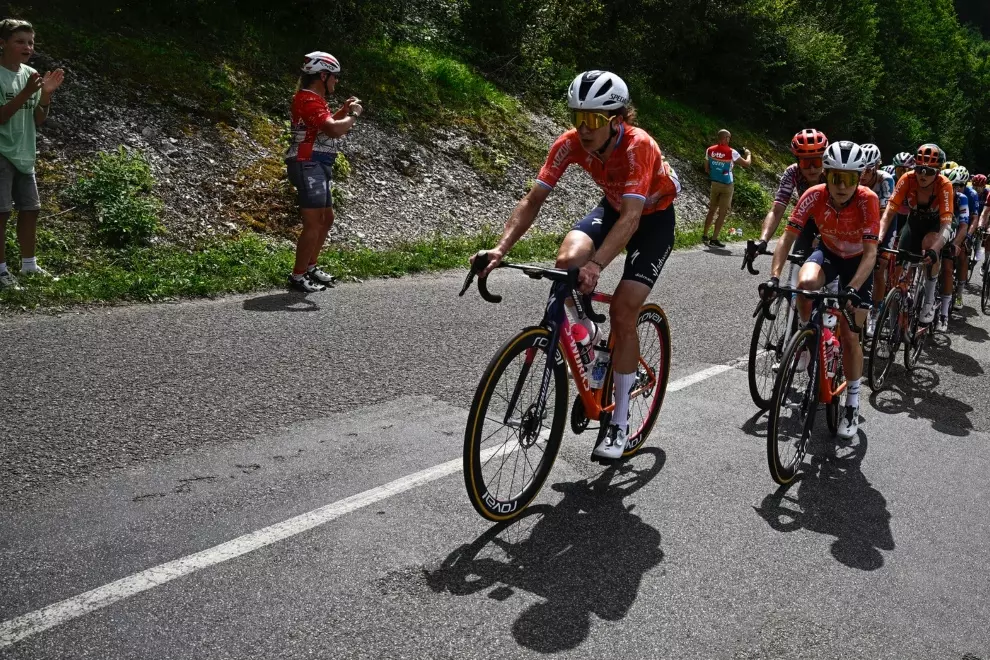
These are the Queen Stages of the Tour – the ones that break legs, dreams, and sometimes even GC standings. Think of stage 18 of this year’s Tour. Mountain stages feature long, steep climbs that can stretch over 10 km, often stacked back-to-back with minimal recovery. It’s where pure climbers and GC contenders rise above the rest. Here’s what a typical mountain stage looks like.
Distance: 130–190 km
Elevation gain: 3,000–5,500 m
Categorised climbs: Multiple Category 1 and Hors Catégorie (HC) climbs
Experience: This is a high-effort day with energy steadily drained by long, steep ascents and thinning air at altitude. The final climb sees a dramatic escalation of effort, with sharp accelerations and attacks.
How to design your own mountain stage?
If you’re not riding in the Alps, don’t worry, you can still simulate the effort of a mountain day at the Tour with smart route planning and a bit of stubbornness. Repeating climbs, stacking efforts, and fuelling like it is hour five of a queen stage can recreate the feel without booking a trip to France.
Take the quiz to find out what type of cyclist you are and scroll down to find your personalised path to summit glory.
The Couch Cruiser
Route planning
Distance: 20–30 km
Elevation: 300–500 m
Climbs: 1–2 climbs of 1–2 km each, no steeper than 5–6%
Special features:
- Loop or out-and-back with a “summit” café or viewpoint
- Bonus: repeat the same climb once to simulate Alpine déjà vu (optional!)
- Scenic photo ops on the way up = required
How to ride it
Take your time on the approach, then climb at whatever pace lets you keep smiling. Stop for photos, stretch halfway if needed, and don’t rush the descent. At the “summit,” channel your inner Pogačar – arms raised, espresso in hand. This is your Queen Stage, and the only thing you’re defending is your mood.
Zobrazit příspěvek na Instagramu
The Sunday Spinner
Route planning
Distance: 40–60 km
Elevation: 700–1,000 m
Climbs: 2–3 climbs, 2–4 km long, max gradient 7–8%
Special features:
- Build the route around one longer “main climb” near the end
- Choose roads with space to rest or soft-pedal between efforts
- Midpoint café stop highly encouraged
How to ride it
Pace the first climbs with caution, go by feel, not heart rate. Ride the longest climb near the end at a steady rhythm, sitting or standing as needed. If the legs say no halfway up, just pretend you’re on a domestique’s bad day. Bonus points if you finish with a slow-motion “summit finish” celebration. Or a pastry.
The Pedal Punisher
Route planning
Distance: 80–100 km
Elevation: 1500–2000 m
Climbs: 4–6 climbs, mix of 2–6 km lengths, gradients up to 10%
Special features:
- If you don’t live in the mountains, loop one local climb multiple times. 3–4 repeats of a 3 km hill at 6% add up fast.
- Use smaller climbs in quick succession. Linking several 1–2 km rises with short recovery mimics Alpine rhythm.
- Try “stitching” multiple nearby loops together to reduce boredom and simulate stage progression.
How to ride it
Pace early climbs in Zone 2–3. On repeats, aim for consistency, not hero laps. Use the first couple to settle in, then climb 1–2 at your threshold in the second half of the ride. Visualise each repeat as a different climb in the Alps, it helps. Save one hard effort for the final ascent: long, steady, and mentally sharp. If you curse your choice by km 90, congratulations: you’ve nailed it.
The Full-Gas Fanatic
Route planning
Distance: 110–140 km
Elevation: 2,500–3,500 m
Climbs: 6–8 climbs, 3–10 km each, with at least one HC-style climb (e.g., 8–10 km @ 7%+)
Special features:
- If terrain is limited, build your own “Queen Stage” by repeating climbs strategically. Repeat a 3–5 km climb 4–5 times at varying intensities. Use lap-based segments with short flat or downhill connectors to simulate multi-peak stages. Combine one longer climb (or the longest available) with a series of punchier repeats.
- Consider “out-and-back” formats where each return includes a climb.
How to ride it
Ride smart early, first climb at 90% FTP, settle into tempo for the next two. Use middle climbs to test yourself: alternate between the sweet spot and low-threshold. In repeats, treat each as a unique challenge (seated only, big gear, higher cadence, etc.). On your final major climb, execute a build from FTP to 110% – no surges, just progressive pressure. Fuel like you’re racing. Descend fast but smoothly. Segment titles should now include “epic,” “madness” or “altitude sickness”. You didn’t just do a big ride – you simulated a stage finish in Courchevel.