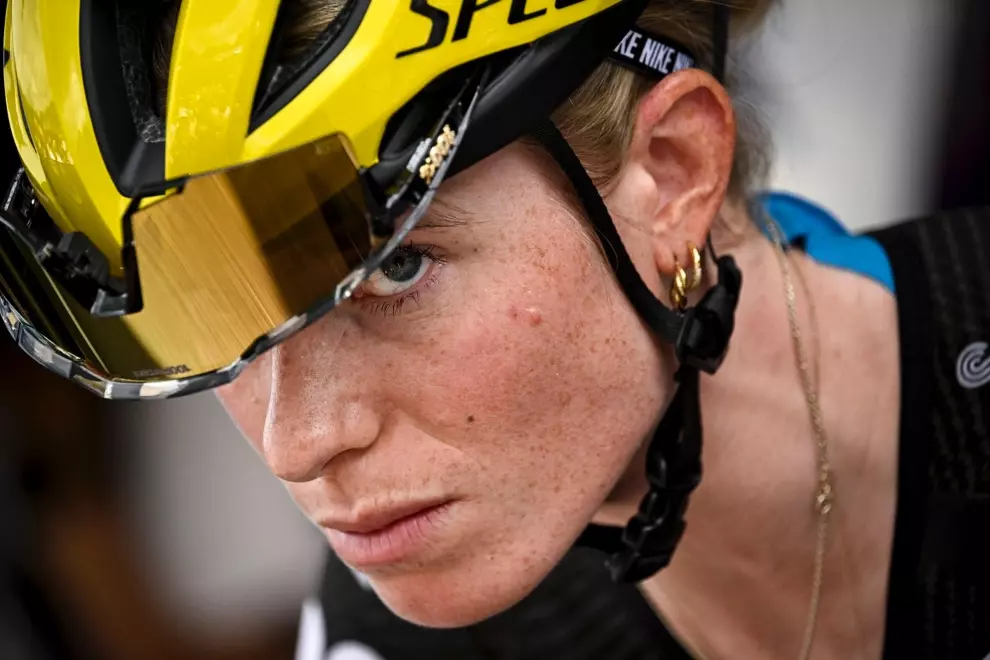
It is one of the most successful seasons a woman cyclist has ever had, a Tadej Pogačar kind of season, comparable only to Annemiek van Vleuten’s 2022, in which she won all three Grand Tours, and Marianne Vos in the early 2010s, when she routinely racked up 15 to 20 wins a season across cyclo-cross and road. But Vollering won more Classics than van Vleuten, and Vos did not win any multi-stage races during her “Cannibal” seasons.
Vollering now has 69 victories, third only to the 259 of Vos (which will never be equalled) and the 133 of Lorena Wiebes. Her six TdFFaZ stage wins are second only to Wiebes’ 7. There’s a chance that she can finish her career with 100 victories and five TdFFaZ titles. She should be in the conversation as one of the greats of all time, but she isn’t. How come?
A lack of recognition
Vollering has been the best rider on the women’s WorldTour for several years, and this year has established herself, in my view, as one of the greatest women riders of all time. So I have to wonder why no one ever says it and why, as it seems to me, she doesn’t inspire the same respect as Pogačar does or why she doesn’t have the same adoring fan base. For example, in a recent article in Cyclingnews, she was described as “one of the most versatile and prolific riders of her generation.” She is certainly much more than that.
One reason may be that the Tour de France Femmes (TdFFaZ) is only five years old and hasn’t yet acquired the same iconic stature as the men’s Tour, which has been run 113 times. And, in general, women’s professional cycling doesn’t yet have the same status as the men’s division, not even with its organisers, the Amaury Sport Organization (ASO), which this year showed only three of the race’s nine stages in its entirety on TV.
So the fact that she has won two of the five Tours and finished second in the other three doesn’t have quite the same impact as Pogačar’s five Tour wins. Nor does her feat of being only the second woman, after van Vleuten, to win all three Grand Tours in her career, which the Slovenian will try to accomplish in this year’s Vuelta.
In addition, since the women’s Grand Tours are much shorter than the men’s three-week races, the gaps to the also-rans are not nearly as large as Pogačar’s winning margins. (He should win the Vuelta by at least 8 minutes.) Would Vollering’s dominance resemble that of Pogačar if the TdFFaZ were three weeks long? I believe it would. (Just as I’m sure that if the 2024 TdFFaZ had had one more stage, she would have won it and would now have owned three victories out of the race’s five editions.)
What’s missing from Vollering’s palmarès is a world championship (she has finished second twice). But she is working now to rectify that. “World championships are incredibly difficult, of course, especially because you aren’t racing with your own team [but with riders from her country]. That makes it a real challenge to take control of the race. But it is definitely a goal of mine,” she told Wielerflits at a recent criterium in the Netherlands.
“I have genuine ambition. But first I need to let my body recover, and then my mind as well. My form is good. With a bit of extra training, I’ll be able to carry that momentum into the next phase. I feel healthy and am going to put in some solid training rides. After that, it’s go all-out in Canada.”
Not “feminine” enough?
I wonder, though, if she will finally receive the recognition she deserves if she wins the world championship this year. The problem, I think, is her personality. She is intense, combative, and intensely competitive; she also doesn’t suffer fools gladly and doesn’t mince her words. She sometimes races emotionally, which can cause her to make errors, such as failing to ride after arch-rival Kasia Niewiadoma-Phinney on Mont Ventoux in order to spar with former teammate Marlen Reusser, who was then leading the race. She can also be as cold and calculating in a race as a hired killer.
I’ll go so far as to say that she does not act “feminine” enough to please many people, in the sense of what the word feminine used to mean. Vollering is brutally honest and unafraid of expressing her feelings, especially anger, as everyone witnessed during the TdFFaZ, when she ferociously defended teammate Célia Gery after Niewiadoma-Phinney publicly accused the young French rider of trying to ride her into the barriers.
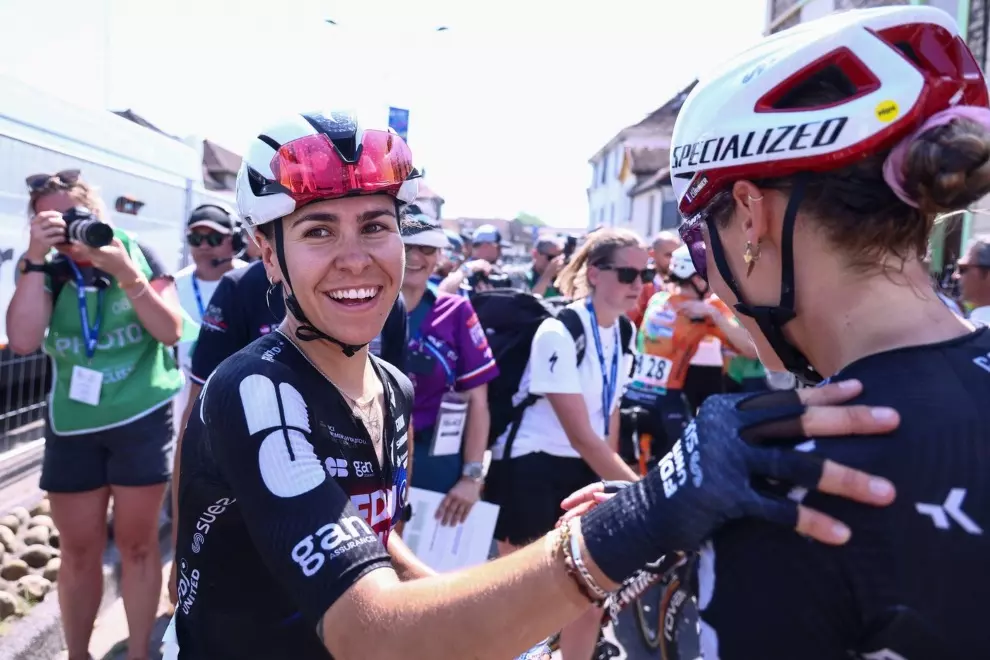
The 29-year-old Dutchwoman had to speak loudly because the accuser was the most popular woman’s rider in the peloton. Niewiadoma-Phinney has a great smile and a soft voice, and is approachable, amusing, intelligent, and charismatic. She has somehow acquired the image of a rider who approaches the sport with the innocent joy of a child and a relaxed attitude to winning. During this year’s TdFFaZ she said, “I never chase the victory for the sake of winning… I chase it for this beautiful feeling.”
This instinctual, passion-first approach combined with her impulsive racing style, dogged perseverance and perpetual underdog status have made her the darling of cycling fans around the world. She is also the clear favourite of TV commentators. When she lost the sprint to the line at the end of stage 5 of the TdFFaZ to Vollering, a TNT Sports commentator said, “Every cycling fan in the world wanted Kasia to win.” Whether that’s true or not, it certainly implied that every cycling fan in the world wanted, or should have wanted, Vollering to lose.
The women’s GOAT?
I’m curious to see how fans, analysts and commentators will view Vollering if she wins the world championship this year and has another dominating season in 2027. Niewiadoma-Phinney is clearly the second-best rider in the peloton, but how much better will she be next year, at 32 years of age? She has to worry about the young riders on the rise, such as her 23-year-old CANYON//SRAM teammate Antonia Niedermaier, 24-year-old Paula Blasi, and Lidl-Trek’s Isabella Holmgren, 21.
In my view, Blasi and Niedermaier are as close to catching up to Niewiadoma-Phinney as the Polish star is to matching Vollering. The now double TdFFaZ winner is 29 and in her prime. Barring accident or illness, I don’t see anyone challenging her dominance in a Grand Tour for at least two years. She is by far the best climber now, has become an excellent time trialist and a superlative one-day rider, which will be a great help in this year’s world championship.
But unless the TdFFaZ and other Grand Tours become two-week races, her dominance will never appear to be as pronounced as Pogačar’s. That’s good for women’s racing, as there was suspense to the very end in this year’s TdFFaZ, though in reality no one ever had a chance of beating Vollering. What went unseen in the race was that in stage 7, on the climb to the summit of Mont Ventoux, she gained 35 seconds on Niewiadoma-Phinney in the final kilometre. That’s how much better she is than her competition. If she stays healthy and maintains or improves her present form, she will almost certainly be considered one of the greatest women riders of all time.