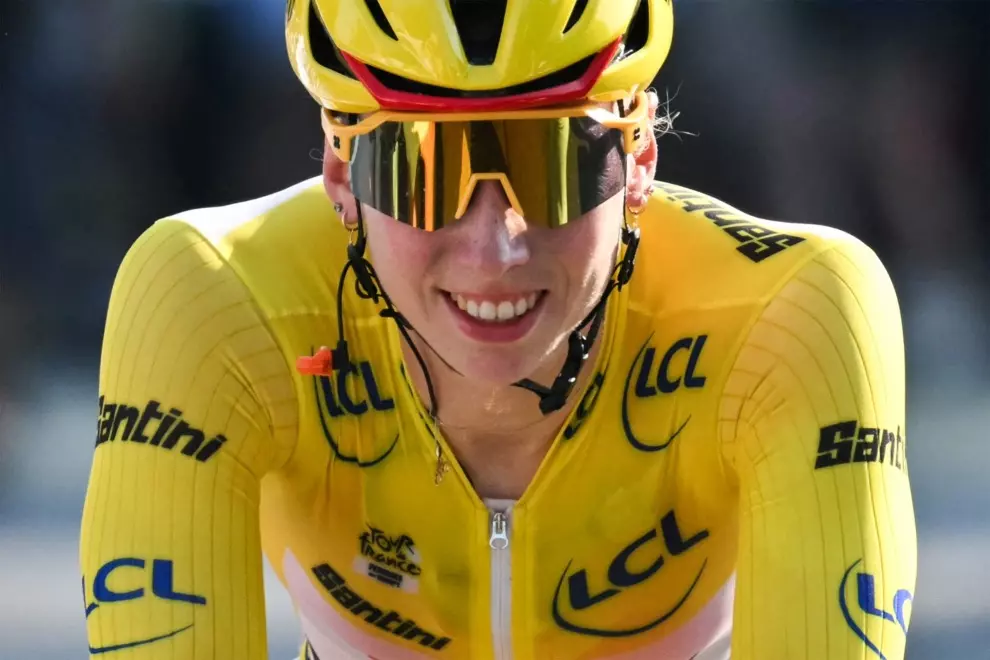
A dominant sprinter who climbs
Quick, what cyclist is the same age as Pogačar, will never win a Grand Tour, yet has won more races than the five-time Tour winner? Of course, it’s Wiebes, who now has racked up 133 victories in her career, to Pogačar’s 127, and is rightly regarded by many as the best female cyclist in the world.
On Saturday’s opening stage in Lausanne, Switzerland, she had to do some 1,700 meters of climbing, especially at the end, and then easily outsprinted Kim Le Court-Pienaar (AG Insurance–Soudal) and a bunch of GC contenders – because all the sprinters had been left behind on the final climb (2.6km @ 4.6%). GC co-favorite Demi Vollering (FDJ United–SUEZ) finished third. That gave Wiebes the first yellow jersey of the race and a lead in the green jersey competition, which she is favored to win.
Zobrazit příspěvek na Instagramu
But she downplayed the importance of winning the green jersey. “It’s not the biggest goal of the team to win the green jersey,” she told journalists afterwards. “It’s always nice to bring home a jersey, but it’s not that we aim for it now. I think after the weekend we will know more. Day by day we’ll see. The GC with Anna [van der Breggen] is also really important.”
As if to underscore that point during the race, she did not contest the available points at the intermediate sprint. “Beforehand, I said to the team that I didn’t want to go for the intermediate sprint because I didn’t want to go for that there and then lose in the final,” Wiebes explained. However, she changed her mind the following day.
Vollering mounted the first attack on that final climb, then dropped back to prepare for the sprint. But first Wiebes then LeCourt-Pienaar surged past her. However, she was not disappointed as the bonus seconds for her podium finish gave her a small, early advantage over her GC rivals.
“I certainly would have wanted to [win the stage], of course,” she said. “But anyway, ultimately I already have a few seconds in the general classification, and I think this whole Tour is going to be like this. I just competed for the podium, and that just feels good too. Very different from last year, so that feels good.”
In last year’s TdFFaZ opening stage, she ceded 7 seconds (including the finish line bonus) to eventual winner Pauline Ferrand-Prévot and 3 seconds to Niewiadoma. This time she leads both by 4 seconds.
Teamwork and another “killer” sprint
Sunday’s stage 2 ended with a gradual descent of some 28km, which gave sprinters and their teams who had lost ground on the route’s five categorized climbs the chance to rejoin the front of the race and charge en masse towards the line. Wiebes climbed all five of the hills (and collected 11 points at the intermediate sprint), while one of her main rivals, Charlotte Kool (Fenix–Premier Tech), did not, and never made it back into the peloton.
But the main danger came from a one-rider breakaway. The peloton and SD Worx spent much of last 40km of the stage chasing Lidl-Trek’s Riejanne Markus, the 2023 and ’24 Dutch national time trial champion. Markus had made her break just before the bunch caught the last rider of the day’s breakaway and eventually had a lead of 1:05 with 25km left to ride. This worried Wiebes enough to ask SD Worx’s GC contender Anna van der Breggen to help with the chase. She brought the gap down to 28 seconds at 13km. But Markus dug in and the gap seesawed as the stage became a race between the entire SD Worx team taking turns at the head of the bunch and Markus at the front of the race.
At 5km, her lead was still 31 seconds. Then Lotte Kopecky took over and brought the gap down to 17 seconds at 3km. It was only 6 seconds at 1km as the other sprint teams took part in the hunt. They caught Markus at 600 meters. Then Wiebes found space on the right side of the bunch, powered to the front with a few strokes of the pedal and again it was no contest. According to TNT Sports, she has now won 42 of the last 43 sprint finishes she has ridden in. If that’s not dominance, I don’t know what is.
“This one is special because the whole team worked incredibly hard for it,” she said afterwards. “The girls went full gas in the pursuit to bring it back in the finale, so that makes it even nicer to finish it off like this in the yellow jersey.” Kopecky had originally been set for lead-out duty, but she put all the gas she had into the chase. “At a certain point we decided that Lotte also had to start chasing,” Wiebes explained. “We needed everyone. Because of that, I knew it was up to me to find my own way through the sprint.”
Later, at the post-stage press conference, the 27-year-old Dutch rider tried to explain what makes her tick, er, um, sprint. “Especially as a child, I was quite shy, and so I’m not really a sprinter type off the bike,” she said. “Maybe with some other things, like if I want something, I directly do impulsive things. But I think really in a final [sprint] I switch something off and focus so much on this sprint. It’s like the killer instinct is coming up.”
“Killer instinct” is right.
“Unreal” Haugset’s record solo victory
When Haugset took off on her solo ride, no one – not spectators, not the other riders, I assume, and not me – gave it much thought, primarily because I didn’t see it since the TV feed provided by home broadcaster France Télévisions and licensed by race organizer ASO started 7 minutes too late. These same two parties showed every second of the men’s race, but will only show two stages of the TdFFaZ in their entirety. I wonder why.
In any case, as Haugset slowly built up a lead, the race entered France and a lone rider set off to chase her with 75km left to ride: Kopecky. I assumed, as I’m sure most onlookers also did, that it would be just a matter of time before she caught and passed Haugset. With 60km, the Norwegian’s lead was 1:20 over Kopecky and 3:50 over a peloton that didn’t seem to care very much.
The gap between the duelists up front stayed the same, as the peloton dropped farther back and the temperature rose to 37°C. (98.6°F.). But with 15km left to ride, Haugset led Kopecky by only 27km and the now-interested peloton was at 2:17 and closing. At 12km, Kopecky was within 10 seconds of the leader – but that’s as close as she would come.
The 27-year-old Norwegian champion found a second wind and Kopecky ran out of gas and stopped chasing – as did the peloton. At the finish, the gap was 1:24 to Kopecky, with Marianne Vos leading the bunch across the line, 2:48 adrift. With her jaw-dropping performance Haugset had set the record for the longest solo victory in any of the iterations of the Tour de France Femmes and had taken over the race lead by 2:02 over Le Court-Pienaar, with Vollering at 2:06.
“I never thought it was possible. Sitting here for the winner’s interview, it’s unreal,” she said afterwards, adding that she had considered waiting for Kopecky. “[The gap] wasn’t many seconds and I thought she will catch me. I thought, ‘Should I just drop down to her? Second is good.’ But I kept on. The [sports director in the] car was amazing, pushing me.”
She added: “I was thinking about all my teammates, everyone cheering from home and it was like, ‘I had to give it all.’ I can’t believe that she didn’t catch me. Winning in the Norwegian [championship] jersey, it’s fantastic.” But she was exhausted from the effort. “I was so dizzy at the end. I know my boyfriend will be angry at me for not celebrating, but I could not lift my arms off the bike. It was impossible.”