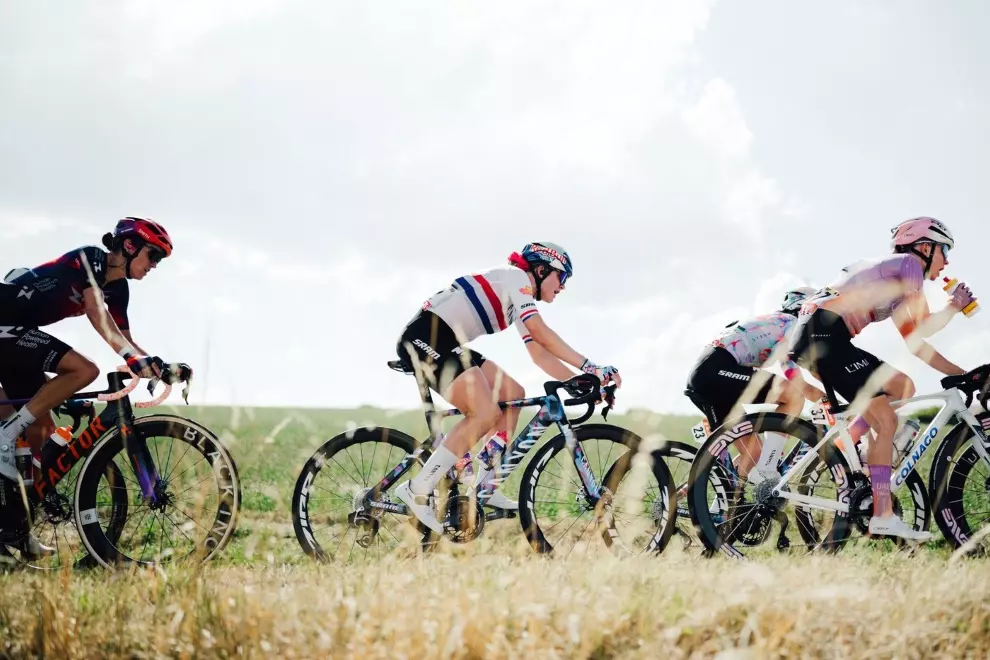
Demi Vollering notably worked in a flower nursery before committing to cycling full-time, Elise Chabbey balanced racing with medical school, and Pauline Ferrand-Prévot spent years dominating mountain biking before returning to the road. Annemiek van Vleuten didn’t even begin racing seriously until university.
Those stories have often been told as charming examples of resilience and the multifaceted talents of some of the sport’s most beloved riders. In reality, they reflected something much simpler: women’s cycling hadn’t yet become a sport where a talented 17-year-old could realistically expect to become a full-time professional. In fact, even at a pro level, many riders were forced to keep second jobs to help pay the bills.
And although this is still certainly the case for many women racing today, it’s beginning to change. There is better pay, better support, a clearer path forward for young riders who want to make a career in professional cycling. Perhaps nowhere is that change more visible than in the peloton assembling for this year’s Tour de France Femmes avec Zwift.
The age of the young professional
Men’s racing has long celebrated prodigies who win Monuments before they’re old enough to rent a car in some countries. Women’s cycling followed a different timeline.
Professional teams were fewer in number, salaries were lower, and junior development structures were inconsistent from one country to another. Even exceptionally talented riders often needed another career—or another sport—to support their ambitions.
Today’s young riders are entering an entirely different ecosystem. Many come through dedicated junior programmes, race internationally from their mid-teens, train with nutritionists and sports psychologists, learn to analyse power data almost as early as they learn race tactics, and are being scouted by WorldTeams long before graduation.
The question is no longer whether a gifted teenager can become a professional. Increasingly, that’s the expectation, and there are equipped experts on the ground to help make the transition possible.
This season has made the shift impossible to ignore
The 2026 season has offered example after example that youth is no longer simply knocking on the door of the WorldTour. It’s already made its way inside and is having a fundamental impact on the way races play out.
Cat Ferguson’s (20, Movistar Team) season captured both the excitement and fragility of this new generation. Still only 20, the British rider opened the year with victories at Trofeo Palma Femina, a stage win at Setmana Valenciana and the Navarra Women’s Elite Classic, establishing herself as one of the sport’s brightest young talents before a crash at the Giro d’Italia Women left her with double ankle fractures and ruled her out of what would have been her Tour de France Femmes debut.
The disappointment surrounding her absence speaks for itself. Not long ago, missing a first Tour at 20 would have been entirely unremarkable. Now it feels like the sport is missing one of its protagonists.
Elsewhere, Zoe Bäckstedt (21, Canyon//SRAM), has continued her steady transition from junior phenomenon to rider capable of influencing the biggest races. Canyon//SRAM has increasingly trusted her with leadership opportunities in major Classics, a reflection not only of her talent but of the confidence teams now place in riders barely out of the under-23 ranks.

Then there is the incredible rise of Paula Blasi (23, UAE Team ADQ). Just two years ago she was largely unknown outside Spain after switching from running and triathlon to cycling. This season she has won La Vuelta Femenina overall, claimed the Amstel Gold Race, climbed to second in the UCI rankings, and arrives at her first Tour de France Femmes, insisting she is there to support her teammates rather than chase yellow herself. Whether that remains true by the race’s final week or not, her trajectory illustrates how quickly exceptional talent can now be identified and nurtured.
French climber Marion Bunel (21, Visma–Lease a Bike) has also continued to justify the hype surrounding her development, emerging as one of the sport’s most exciting young stage-race prospects.
Puck Pieterse (24, Fenix–Premier Tech) perhaps represents the bridge between generations. Like Ferrand-Prévot before her, she arrived from mountain biking and cyclocross. Still, unlike many of her predecessors, she has been able to pursue road racing in a far more sophisticated professional environment. Rather than choosing one discipline forever, she has shown that modern riders can develop across several while still becoming genuine Grand Tour contenders.
A sport that finally knows how to develop talent
Taken together, these examples represent a significant shift within the sport. They also serve as a potent reminder that professionalisation isn’t simply about bigger budgets or more television coverage.
Changing infrastructure has played a key role in giving young athletes a realistic path forward. Women’s teams now invest in long-term athlete development rather than hoping talented riders eventually appear. National federations have expanded junior programmes and performance staff has grown. Sports science, nutrition and recovery are becoming standard rather than exceptional.
Julie Bego (Team Cofidis) is another rider who really embodies this shift within the sport. The 21-year-old French rider was already a junior world champion before stepping into the WorldTour with Cofidis, following a pathway that would have been difficult to imagine a decade ago. Rather than juggling studies or waiting years for an opportunity, Bego progressed through the junior ranks, gained experience at races such as the Tour de l’Avenir Femmes and arrived at the Tour de France Femmes as one of the sport’s brightest young prospects. Her rise illustrates how a more structured development system is allowing exceptional talent to be identified, supported and integrated into the professional peloton much earlier than previous generations.
She’s also an important reminder of another key impact that changing face of the peloton is having. Young riders now grow up with visible role models. A 14-year-old girl today may have watched the Tour de France Femmes every summer and can realistically imagine racing it herself. That was far harder to picture even a decade ago.
More than just younger riders
For decades, women’s cycling lacked the infrastructure to identify and support talented teenagers consistently. Today’s riders are benefiting from better coaching, stronger junior programmes, professional contracts, sports science and financial stability that simply didn’t exist for many of the sport’s biggest stars. These are hard-won gains, and they have transformed what a career in women’s cycling can look like.
At the same time, earlier professionalisation inevitably changes the experience of becoming an elite athlete. Young riders now arrive in the WorldTour with power numbers already scrutinised, expectations shaped by social media and contracts signed before they’ve had much chance to discover who they are away from the bike. That pressure isn’t unique to cycling; it’s become the norm across many professional sports, but it does represent a significant cultural shift for a discipline where many riders once arrived after university, after another career, or even after another sport.
Those unconventional journeys gave the peloton a remarkable diversity of experience. Riders like Annemiek van Vleuten, Demi Vollering and Elise Chabbey took very different paths to the top, not because they wanted to delay their careers, but because the sport left them little choice. Few would argue that women’s cycling should return to those days, yet it’s worth recognising that today’s more structured pathway will inevitably produce a different kind of athlete.
If this year’s Tour de France Femmes avec Zwift tells us anything, it’s that women’s cycling is in the middle of that transition. The favourites remain some of the sport’s most established names—Demi Vollering, Pauline Ferrand-Prévot, Anna van der Breggen and defending champion Katarzyna Niewiadoma-Phinney—but just behind them is a generation that has never known women’s cycling as a part-time pursuit. Riders in their late teens and early twenties are no longer turning up simply to gain experience; they’re expected to influence races, support leaders in decisive moments and, increasingly, become leaders themselves.
That’s perhaps the clearest sign of how far the sport has come. Not that the stars are getting younger, but that talented young women no longer have to wait years for the opportunity to become them.