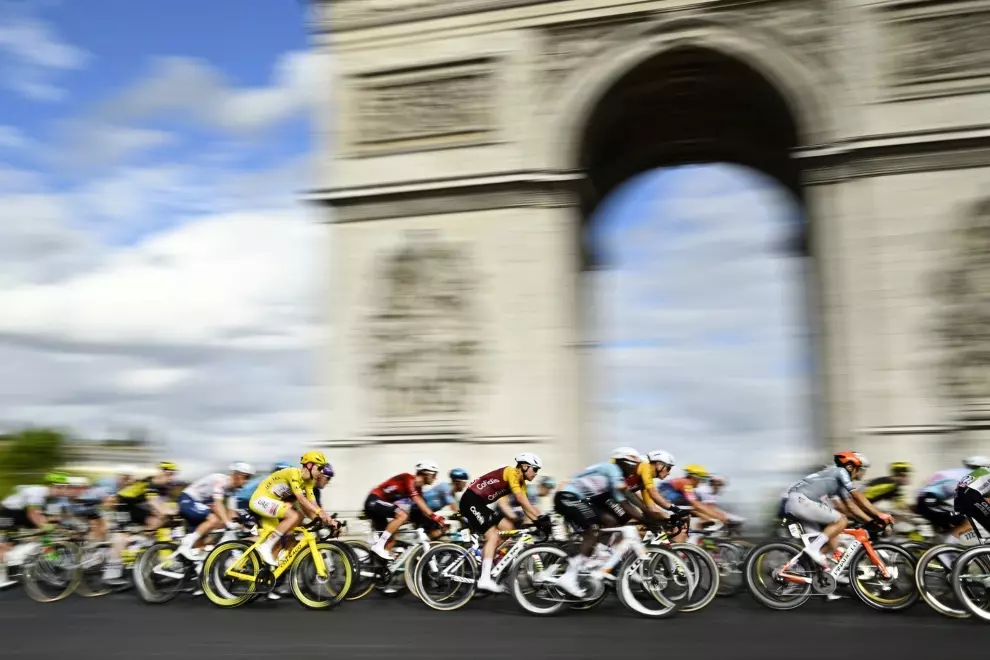
That climax exploded in the final four stages of the race and had numerous heroes: Tadej Pogačar (of course) and his UAE Team Emirates–XRG teammate Isaac del Toro; Mads Pedersen (Lidl-Trek) and Richard Carapaz (EF Education–EasyPost); Paul Seixas (Decathlon CMA CGA), Mathieu van der Poel (Alpecin–Premier Tech), Sepp Kuss (Visma–Lease a Bike), Lenny Martinez (Bahrain Victorious) and all the riders who, desperate for a victory with time running out, jumped into breakaways and animated those final stages.
And there could have been no more fitting conclusion to such an extraordinary race than Sunday’s final stage, which had been shortened because French security personnel were needed to fight fires around Bordeaux, so that the entire stage took place in Paris, with the astonishing finale played out in Montmartre and the Champs-Élysées (as written by Dan Brown and directed by Alfred Hitchcock).
Two of the greatest riders of all time, Pogačar and van der Poel, went head-to-head as they passed the Basilique du Sacré-Cœur with 11 km left to ride in the 88.7 km race, pursued by a group of sprinters and their support riders, all of them eager for an iconic win. The group came within touching distance of the two 500 metres from the finish. Then, in the wink of an eye, van der Poel found another gear and rocketed towards the line, as Pogačar – no doubt fatigued from his efforts over three weeks – faded. Van der Poel just managed to hold off the pursuers, but then collapsed from exhaustion – and so did I. What a race!
Oh, yes, I nearly forgot: This Tour, with its 54,450 metres of elevation gain and its heat wave, was the fastest Tour of all time, with Pogačar establishing the mark of 43.227 km/h. It also set the mark for the fastest stage of all time, 50.91 km/h on stage 11. Wow!
Unbelievable but true: Pogačar could have done better
Tadej Pogačar winning a record-tying fifth Tour de France was as unsurprising and inevitable as the sun rising, such is his superiority over his rivals. In fact, his winning margin of 6:26 over Remco Evenepoel (Red Bull–BORA–hansgrohe) was a little disappointing because it could have been substantially higher; and he might also have won more than five stages if he hadn’t ridden as teammate Isaac del Toro’s domestique on stages 15 and 20.
On stage 15, he tried to nurse a tiring del Toro to the summit finish on the Plateau de Solaison climb, but the young Mexican had nothing left. When Evenepoel (see below) surged past him, Pogačar stayed on his wheel all the way to the line without contesting the victory. On stage 20, he worked to prevent Paul Seixas (Decathlon CMA CGM) from pushing del Toro off the podium. But despite a perfectly executed strategy by his team, the 19-year-old had nothing in the tank and faded with about 33 km left to ride. That gave Pogačar ample distance and time to overhaul the eventual stage winner, Richard Carapaz. So why didn’t he?
Perhaps it was because he and UAE Team Emirates–XRG were worried about the constant talk about how his dominance was killing the suspense in the sport and that they were depriving other teams and riders of joy. That makes sense from a team perspective because, like all professional sports, cycling is also a business, and the Tour de France is big business. Look at the team website to see all the brands sponsoring it. They include Emirates Airline; XRG, the investment arm of the Abu Dhabi state-owned oil company; the virtual indoor cycling software platform My Whoosh, and the Emirati artificial intelligence and cloud computing company G42 – to name just a few.
Perhaps someone had worried that the brands were being damaged by the perception that Pogačar’s dominance was hurting the sport and disrespecting other teams and riders. Carapaz and Kuss, who were ahead of Pogačar on stage 20, are very popular riders, and to deprive them of a victory atop the Alpe d’Huez – as he had already done on the previous stage – might have been regarded as an arrogant bridge too far, especially as he was planning to win stage 21. It’s just a thought. But in truth, given Pogačar’s superiority, he could easily have won eight stages.
Zobrazit příspěvek na Instagramu
Is six a charm?
The obvious question that Pogačar’s fifth Tour de France win immediately poses is if he will go for a sixth Tour victory and stamp himself as the definitive greatest of all time. He has never spoken directly about going for the record of Tour wins, but he suggested on Saturday that he may call it quits sooner rather than later. “I definitely will not be doing this for too much [of a] long time, I think,” he said, after crossing the finish line arm in arm with del Toro on stage 20.
He will have to be more specific in the future because he will be asked that question far more often now. Do he and UAE worry that going for a sixth Tour win could be seen as disrespecting the legends of the sport with whom he now shares the record? That would be absurd. Someone will break that record eventually; and, in any case, Merckx, Hinault, and Induráin all tried to win the race for a sixth time but failed – Merckx infamously after being punched by a spectator. I think he should go for it. And why not a seventh victory as well? After all, he’s only 27. Only the most reactionary of cycling fans would find that feat anything but extraordinary.
The triumph of Seixas
Seixas was disappointed with his performance on stage 20, when he and his Decathlon CMA CGM team set up and executed the perfect strategy to push del Toro out of third place. When the small group of GC contenders reached the penultimate climb, the Col de la Sarelle (12.8 km @ 7.3%), he had Nicolas Prodhomme and Mathew Riccitello in front of him and ready to drag him up the mountain. But…
“I cracked. Voilà. That’s how it is,” Seixas said. “I wanted to go as deep as possible, but there was a moment where I was on my limit, and I cracked. I hoped to be stronger than usual, but in the end I exploded.”
Any athlete or other performer who has reached for the stars and encountered the force of gravity will understand his disappointment and frustration. But he has nothing to reproach himself for. On the contrary, fourth place in the Tour at the age of 19, in his first-ever three-week stage, is a remarkable accomplishment. He will be much stronger next year. The sky is truly the limit for the kid.
It’s also telling that, rather than accepting fourth place as the exceptional result it is, he risked it by going for the podium. Kudos to him and the team for being aggressive and not settling for the remarkable; they wanted the out-of-this-world, which a podium finish would have been. “For me, it was third or nothing, and today for me it’s nothing.” he said. Then, perhaps realising he was fourth in the Tour de France on his first attempt, he added: “In a few days, with a bit of air, there will be some pride.”
As Team Manager Julien Jurdie told reporters on Sunday, “Three weeks ago in Barcelona, it’s clear that we’d barely have imagined that Paul could have taken a top five finish in his first Grand Tour and in the Tour de France. […] I can’t forget the way Paul has fought so hard throughout the three weeks; that’s what’s been most impressive of all. What with the heat in the first half and the speed throughout, it’s pretty amazing what he’s managed to achieve. Mentally speaking, he’s a monster. He’s a real champion.”
I ate my hat
I sautéed an old Panama Hat in butter and garlic and ate it with fries, a small salad and an excellent Bordeaux wine because I had doubted Evenepoel’s ability to climb a big mountain. I stand corrected. Bravo to Remco and Red Bull for using a radical strategy to prepare him for the Tour, with only training and no competitive racing at all in the two months preceding the race. It seems to have worked. Remco struggled on early climbs but came good just in time, on stage 15. Remco found his inner mountain goat and beat Pogačar to the summit finish line on the Plateau de Solaison. He also finished an excellent second on the second Alpe d’Huez finish on stage 20.
But, wait a minute. On both those stages, Pogačar was riding for del Toro and didn’t seem to want to win, and Remco couldn’t stay with Pogačar on the first Alpe ascent, when Pogačar meant business, finishing 2:29 behind the now five-time Tour winner.
Hmm. Yes, he was clearly the second-best climber in the race after Vingegaard crashed out; but he always had been. And when the Dane left the race, he was leading Remco by 34 seconds, with the big climbs still to come. So, which is the real Remco? How good a climber is he really? How much did he improve? I’m beginning to wish I had my hat back.