And whether you are watching from home, riding your own local loop, or lucky enough to be there on the roadside, this Tour is going to be properly Epiq. Škoda We Love Cycling’s Tour de France 2026 hub brings the race closer with Epiq Moments Bingo, real-time POV content from the route, race updates, analysis and on-site experiences for fans heading to the stages. In other words, whether your Tour position is “pressed against a barrier on a mountain” or “on the sofa with snacks and very strong opinions,” you are covered.
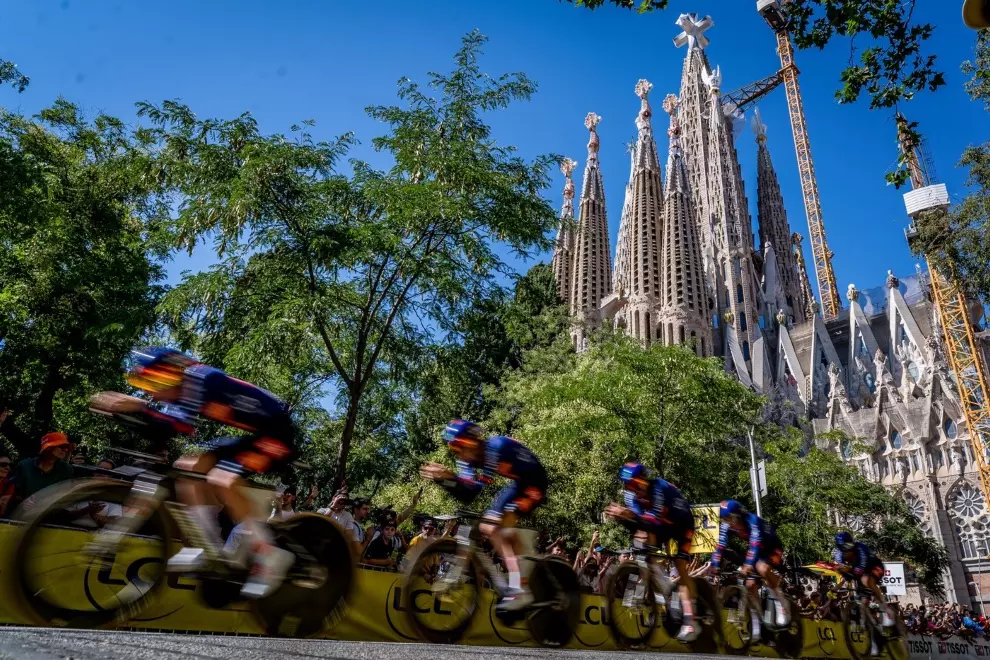
Instead of a gentle opening stage for the sprinters, the Tour begins with one of cycling’s most elegant and unforgiving disciplines. A good team time trial looks beautifully smooth: riders rotating at high speed, holding perfect formation, slicing through the city as if they have rehearsed it for months. A bad one looks like a group project where everyone has a different deadline.
The Barcelona route should make for a spectacular start. The finish toward Montjuïc adds just enough difficulty to make things interesting, especially for the general classification riders. This is not the kind of opening stage where the favourites can hide at the back and politely wait for the race to begin properly. The race begins immediately, stopwatch included.
This year’s team time trial format also adds another layer of pressure because individual rider times count. That makes the day more than just a test of team strength. It is also a test of timing, positioning and judgment. Go too hard too early, and someone important may start looking very lonely. Hold too much back, and the yellow jersey may already be riding away.
Zobrazit příspěvek na Instagramu
For the overall contenders, Saturday is an important first checkpoint. Tadej Pogačar starts as the defending champion and the rider everyone will be watching. Jonas Vingegaard is once again expected to be his main rival, while Remco Evenepoel brings the kind of time-trial power that can make even small gaps feel significant.
Of course, the Tour will not be won on day one. Cycling people say this every year, usually right before spending three hours analysing a seven-second difference. But the opening stage can still shape the mood of the race. A strong performance gives confidence. A poor one creates questions. And in the Tour de France, questions have a habit of becoming storylines very quickly.
The first week is not exactly designed for a soft landing. After Barcelona, the race keeps the pressure on, with stages that should reward sharp positioning, disciplined teams and riders who can stay switched on when the road refuses to behave. The early mountain touch at Les Angles means we may not need to wait long to see who has arrived with real depth and who is still hoping to ride into form.
From there, the race has the kind of structure that invites control but rarely allows it for long. There are days for the sprint trains, certainly, but also enough broken terrain and awkward transitions to tempt the opportunists, punish hesitation and force the GC teams to make decisions before they would ideally like to. The final week in the Alps, with Alpe d’Huez appearing twice, gives the route a suitably heavyweight finish without needing to overpromise drama. The road will take care of that.
The bigger question is how long the race stays tactically open. If Pogačar, Vingegaard and Evenepoel are all within range after the first mountain tests, we could be looking at a Tour shaped less by one decisive ambush and more by repeated pressure: seconds here, fatigue there, teammates disappearing at inconvenient moments, and the sort of small weaknesses that only become obvious once everyone is already deep in the red.
That is usually where the Tour does its best work. Not in the neat pre-race predictions, but in the slow collapse of certainty. A team that looked untouchable in week one can start counting domestiques by week three. A rider who seemed limited can suddenly become dangerous if the race opens in the right place. And every calm post-stage interview should probably be translated as: “We survived today. Please do not ask about tomorrow.”
So here we go. Barcelona gets the first word, the stopwatch gets the first argument, and the yellow jersey gets its first temporary owner. The 2026 Tour de France is finally here. And as ever, the real story will begin somewhere between the plan, the legs, and the moment the race stops listening to anyone.