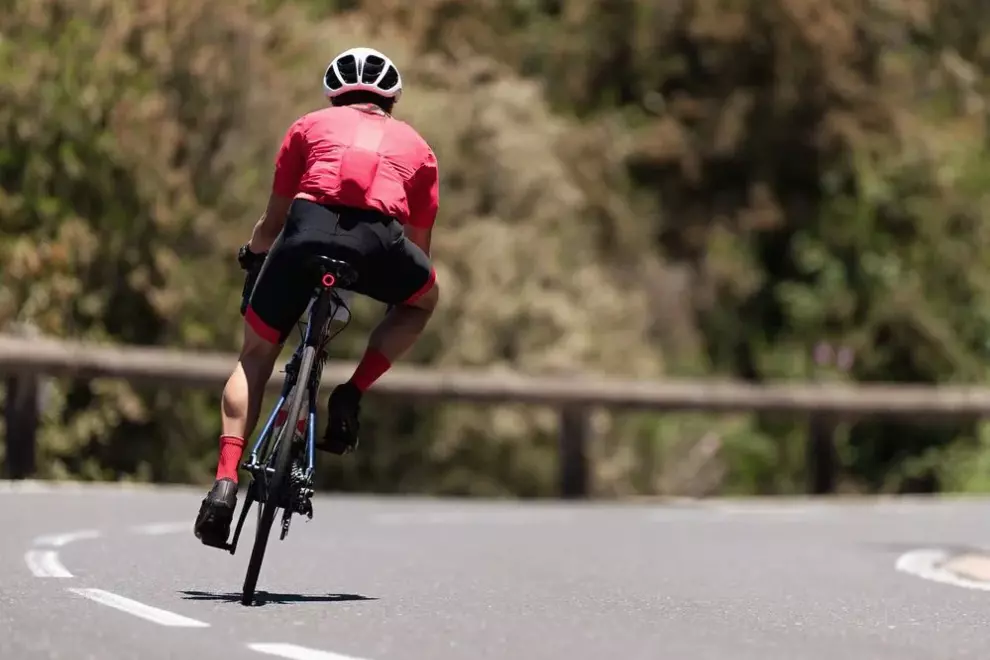
My bike setup
I don’t have the type of road bike that costs more than a regular car. But it’s still equipped with most modern niceties: disc brakes, electronic shifting, and a carbon frame that accommodates tyres up to 38 mm. For my rides around Prague, I tend to use 32 mm tyres. The road quality isn’t always great, and I often ride over gravel and cobbles. The extra comfort is a worthy trade-off for the few watts lost to air drag or rolling resistance.
The L’Étape route is mostly on smooth roads, so I could switch to 30 or even 28 mm tyres. But given my current fitness level and the fact that this is my first race, I decided to stick with my 32 mm tyres. That’s what I’m used to, and familiarity is key.
One pain point has been my 11-speed Ultegra groupset with a 52-36 chainring and an 11-30 cassette. I often found myself grinding up longer and steeper climbs. So, I upgraded to an 11-34 cassette. This will allow me to maintain a good cadence even on the steepest hills and in the later stages of the race.
Essential gear
Outside of the bike itself, I’m planning to carry the following:
- A multi-tool
- An extra TPU inner tube
- Tyre levers
- A mini-pump
I chose TPU because it’s lighter and has less rolling resistance than typical butyl tubes. It’s more expensive, but I rarely get punctures, so it’s worth it. I’m using tubeless on my mountain bike, but on a road bike, I prefer the simplicity and ease of maintenance of the inner tube setup, and I’m willing to give up the few watts it would save me.
I’m still debating whether to use a small under-saddle bag for these items or just stow them in my jersey pockets. A few practice rides in the last month before the race should help me decide.
Zobrazit příspěvek na Instagramu
L’Étape Hilly Stage course overview
The medium-length L’Étape Hilly Stage this year is 105 km long with roughly 1,500 m of elevation gain. Only about 20 km of the course are flat; the rest is a mix of climbing and descending.
When I uploaded the official GPX file to my Garmin, it identified 15 separate climbs, with 5 of them meeting Category 4 standards. It’s clear that most of the race will be rolling terrain, up and down, with a few sharper tests. The overall profile is as follows: the route starts relatively flat for the first 10 km, then the climbing and descending begin and continue until about kilometre 84. After that, it’s mostly flat again until the final kicker to the finish line. It will be important to get into a good group and draft as much as possible during the flat sections.
The race includes two climbs that count toward a KOM competition:
The first climb at the 10 km mark: 2,4 km at a 5,3% average gradient. This climb includes a few downhill sections that dilute the average gradient. It feels more like 6% or more. My current PR on a Strava segment that closely aligns with this climb is 5 minutes and 55 seconds, and I want to improve there.
The final kicker to the finish line: 1,3 km with a 5% gradient, mostly on cobbles, and it ramps up to 9% in some places. This one is really close to where I live, so I want to do well there.
Feed stations are located at 21 km, 47 km, 75 km, and 84 km. My plan is to use mainly the one at 47 km,where I will replenish my bidons, but if it’s a really hot day, I may have to use the one at 84 km as well.
My pacing strategy
Given the up-and-down course profile, my racing inexperience, and the unknown element of riding alongside 1,400 other cyclists, it’s hard to come up with a detailed pacing strategy that feels realistic. Instead, I have a few goals and general ideas to guide my effort:
Safety first: I will keep my distance on downhills and avoid taking risks, especially at the start of the race when rider density is high. Not crashing is my number one priority.
Monitor effort: I will keep an eye on my heart rate and power numbers to ensure I ride the first half of the course well within my limits.
Ride smart: I want to make good use of drafting on the flats and descents and push hard on the climbs. This will be key to achieving my goal time.
KOM ambition: I want to give my best effort on both of the KOM climbs. I’m interested in finding out if I can squeeze in the first half of all riders. That would be a success.
Goal times
Estimating my goal average pace for L’Étape was tricky. I can maintain roughly 25 km/h on longer hilly training rides solo, but I’ve never done the full 105 km with 1,500 m of elevation. On the other hand, I’ve done a 60 km group ride with around 600 m of elevation at nearly 30 km/h.
My conservative goal is to complete the race in under 4 hours, which would mean an average pace of 26,25 km/h. This is what I think I should be able to do mostly on my own if I nail my nutrition, and it’s not an extremely hot day.
My dream goal is to finish in 3,5 hours, averaging 30 km/h. This would require not only perfect nutrition and pacing but also reliable drafting for most of the ride.
My overall time is likely to be influenced by the wind and temperature conditions, so another competitive goal I have is to place in the top half of the field in finish time.
I’m still almost 4 weeks away from race day, so there’s time to sharpen my fitness and taper properly to ensure I’m fresh and fit at the start line. I’ll go into my plans for the tapering phase and how I’m preparing for riding among 1,400 people in my next article.