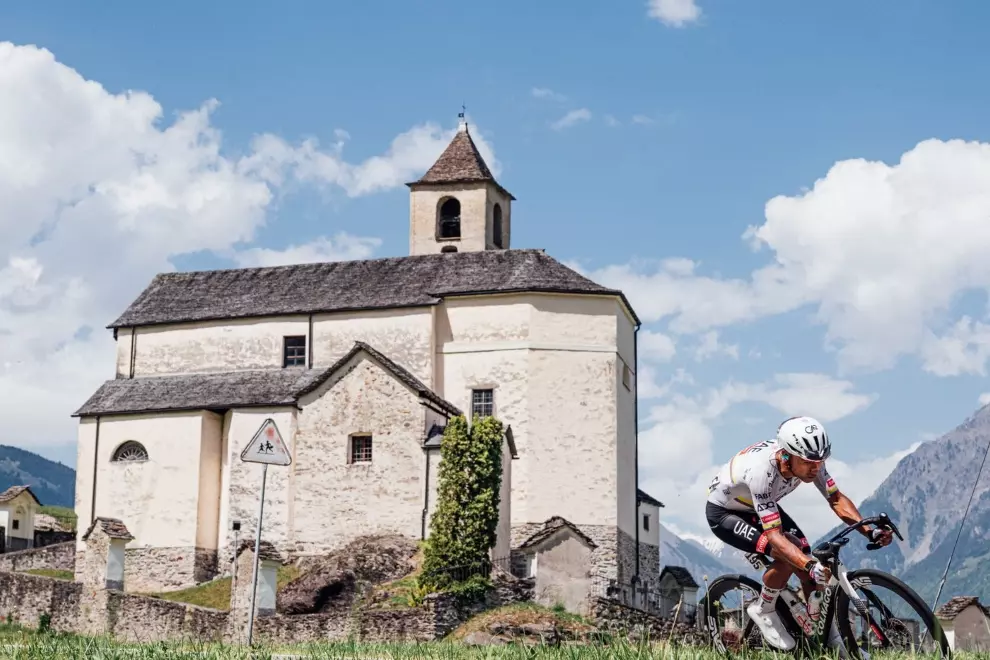
Jonas Vingegaard (Visma–Lease a Bike) was the overwhelming favorite to wear the Maglia Rosa, or pink jersey, as winner of the general classification, and he has lived up to everyone’s expectations, winning four stages and amassing a lead of more than 4 minutes over the rider in second place, Felix Gall (Decathlon CMA CGM).
It was generally believed that the race for the purple jersey would be between Jonathan Milan (Lidl-Trek), who won the points classification in all three Grand Tours he has entered, and 22-year-old Paul Magnier (Soudal Quick-Step), considered a future superstar.
Magnier took a quick and substantial lead in the competition by winning stages 1 and 3. But everything changed after stage 4, which was won by Jhonatan Narváez (UAE Team Emirates–XRG). The three-time Ecuadorian champion is not a sprinter. He is what is known in the sport as a puncheur, or puncher, a good climber, but not good enough for the big mountains, and a fast sprinter, but not fast enough to beat a rider like Magnier in a sprint. But here he is, four days from the end of the race, and leading a contest that is almost always won by a sprinter.
Category B stages and their influence
To explain why, I first have to talk about stage classification. A Category A stage is a pure sprint stage because it is pancake-flat and almost always ends in a traditional bunch sprint. The winner of these stages is awarded 50 points; there are four such stages in this Giro.
Category B stages are described as being “rolling sprint stages” of “low difficulty” because they are supposed to feature minor rolling terrains and are therefore expected to end in a reduced or full bunch sprint. The winner of these stages is also awarded 50 points and there are also four such stages in the race. That makes a total of eight stages supposedly designed for sprinters.
Then you have the so-called medium-mountain stages, which can also feature lots of rolling terrain as well as pretty difficult climbs and are therefore tailor-made for puncheurs like Narváez because sprinters can’t climb well and GC riders don’t want to waste their energy on them. The winner of such a stage is awarded only 25 points. Now back to the race.
Zobrazit příspěvek na Instagramu
Partly because of the Category B sprint stages, Narváez now leads the race for the purple jersey and is favored to win it. As of Wednesday, he has won three stages, and one of those stages – stage 4 – was a Category B stage and envisaged for sprinters.
It was an odd decision by organizers to make stage 4 a Category B stage since it contained a difficult climb about 45km from the finish line. At 14.4km with an average gradient of 5.9%, that mountain was hardly “minor rolling terrain” or a “medium mountain” and would be a tough climb for sprinters under ideal conditions.
But it was made impossible by the Movistar team, which drove the peloton up the ascent at a high pace, for the purpose of dropping the best sprinters so that their own good-climbing sprinter, Orluis Aular, would have the sprint all to himself. Unfortunately, he kicked off his sprint too early and too far away from the finish line and was easily beaten by Narváez. I believe that this stage should have awarded only 25 points since it was clearly designed for puncheurs. In other words, organizers “gifted” Narváez 25 points.
Intermediate sprints and bad luck
There are, of course, other reasons why he is so close to winning that purple jersey. For example, because Narváez is a good climber, he can join breakaways on mountain stages and win the intermediate sprints found along the course, which offer 12 points to the winner. The three-time Ecuadorian champion won such a sprint on Saturday’s stage 14, which gave him the lead in the points classification by a single point over Magnier.
Then there was stage 6, which was clearly a sprinter’s stage. And it was heading for a bunch sprint finish when two riders in front of the peloton crashed on the rain-slick flagstones of Naples, holding up the rest of the sprinters and allowing Davide Ballerini (XDS Astana) to grab a lucky victory. Magnier managed to extricate himself from the crash scene in time to finish third, giving him 25 points, or 25 less than he had a right to expect.
And there was last Sunday’s stage 15, another stage a sprinter was expected to win, for it was flat and ended with four 16.6km loops over the flat streets of Milan. But a four-rider breakaway fought tenaciously in Milan, and the peloton mistimed its chase because it underestimated the difficulty of catching a strong breakaway on a course with many corners. Fortunately for Magnier, he was the best of the rest and picked up 14 points for finishing fifth, which put him back in the purple jersey.
Then Narváez managed to escape with a breakaway early on Tuesday’s stage 16 and picked up another 12 points at the intermediate sprint, leaving him only 2 points behind Magnier, who was clearly worried. “I will try to keep the jersey, but Narváez is now targeting [it],” he said after stage 16. “We saw that in the intermediate sprints, and he was even up there in the Milan sprint. I will have to fight for it.”
Narváez takes the lead again
So, Wednesday’s stage 17, a day of medium mountains, was vital and favored the UAE rider. As expected, Magnier and the other sprinters were dropped on the first climb, and Narváez joined the third breakaway group, which contained 18 riders and eventually joined the front group with 116km left to ride on the 202km course from Cassano d’Adda to Andalo.
Long story short, the Ecuadorian took the maximum 12 points at the intermediate sprint but did not have the legs to go for the stage win, finishing ninth, 1:44 behind the winner, Michael Valgren (EF Education–EasyPost). He now leads the points classification with 157 points, to 145 for Magnier.
Of the remaining four stages, only the final one, in Rome, is considered a pure sprinter’s stage. The other remaining stage designated for sprinters is – unfortunately for the young Frenchman – the Category B stage 18, which is a very lumpy stage with many uncategorized climbs and a short, but very steep climb (1.1km @ 11.3%!) near the finish.
In other words, advantage Narváez.