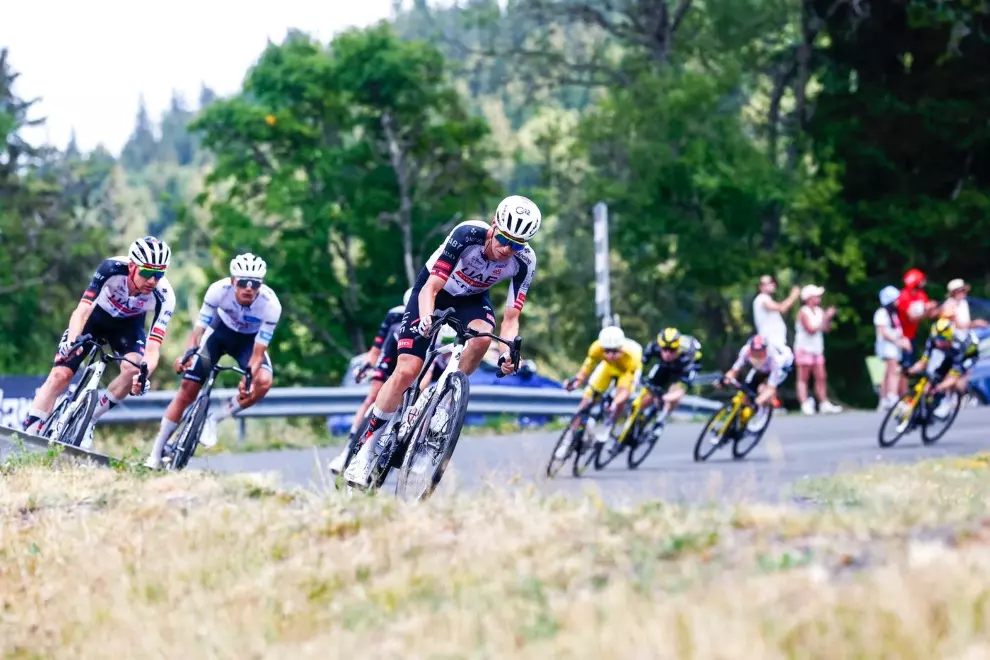
Red weather alerts have been issued for many parts of central France in recent days. As a result, stage 9 was shortened by 30 km, and rules on feeding were relaxed so that riders could take on more liquids and ice. Nevertheless, the riders are not happy, not at all.
“It’s a tough Tour de France; I can’t immediately remember a tougher edition,” Visma–Lease a Bike’s Matteo Jorgenson told Dutch website In de Leiderstrui. “This is certainly the hottest. The heat is having a very bad effect on me. I have always been more of a cold-weather rider. It’s a challenge to deal with it, although I got through the last stages better and was able to conserve some energy. I didn’t have to dig deep anymore, so that is a good sign heading into the second and third weeks.”
“I think more the story is how bloody hot it was all day,” Tom Pidcock (Pinarello Q36.5) said after stage 3. “I don’t think I’ve done such a hard race in such heat before; it was ridiculous. It was like a warzone. I think we went through about 10,000 bidons today as a peloton. I just didn’t have anything in the final; I was a bit cooked, so that was some day.”
And it was tough even before the start, he told L’Equipe. “Getting out [of the bus] to go to the sign-on, it was like when you open the oven and look inside – everything hits you in the face.”
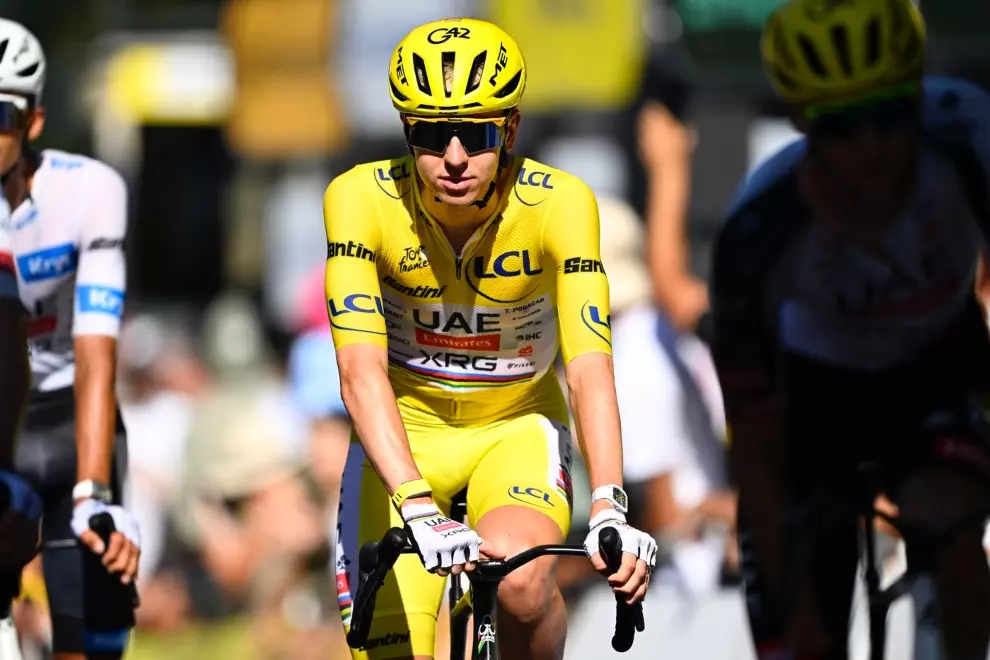
Even the usually unflappable Tadej Pogačar (UAE Team Emirates–XRG) is feeling the heat. After stage 9, when temperatures reached a reported 38ׄ°C, he’d had enough of it. “If I had the power, I would change all the calendar and not race in July and August in hot places,” he said. “I’d do a completely different calendar. But it’s not something I can do.”
The race leader went on to say, “Maybe the next step is to start the stages earlier. Yesterday there was a proposal to start at 10 [a.m.], but it doesn’t change anything because then you finish in the heat. You need to start at eight or nine, or even before. It’s a little bit [rubbish], but I think the body can adapt to waking up at five o’clock in the morning and doing a stage at eight.”
Numerous races have been plagued by excessive temperatures in the past two or three years, but not so much before that; and the heat waves are becoming increasingly numerous and more severe. That suggests, to me as well as most climate scientists, that they are the result of climate change and will likely be the (heat) wave of the future.
If climate change is the reason for the excessive temperatures in cycling, then the best solution would be to take the appropriate steps to slow and reverse it. Enough ink has been spilt describing the necessary measures that individuals and, most importantly, governments must take to achieve that goal. While many people have stepped up and done what little they can to not contribute to climate change, most governments have done too little or nothing at all, apparently afraid of alienating corporations who claim that so-called green deals will reduce their profits.
So much for the long term. For the short term, as Pogačar inferred, the professional cyclists’ union, Cyclistes Professionnels Associés (CPA), has been in discussions with Tour de France organisers about the possibility of starting selected stages earlier in the morning. CPA representative Staf Scheirlinckx said that the proposal was being taken seriously. “This proposal is no longer untouchable,” he told WielerFlits. “We’re talking about next year, because for this edition, it’s virtually impossible from a logistical point of view.”
A general shift of the entire Tour to morning starts is unlikely, however. Rather, a selective approach is under consideration, he said; only the stages in regions notorious for extreme heat could be moved forward – the Cantal, for example, and the region around Carcassonne. In addition, a protocol is under discussion that would enable organisers to switch quickly if temperatures rose unexpectedly and significantly, even outside the “heat areas”.
The fact that this option is being seriously considered is a breakthrough, Scheirlinckx noted. But the decision is not the responsibility of a single stakeholder. Riders (via the CPA), teams, organisers, and the UCI must all agree. It is, therefore, a long process. But when the health of the riders is concerned, action is usually taken relatively quickly. “I don’t think anyone wants on their conscience that in 10 years’ time, half the peloton is suffering from lung problems because they ruined them riding in hot weather,” Scheirlinckx said.
On Tuesday’s stage 10, won by Pogačar, the temperature topped off at 31°C. That’s still hot, but an improvement on previous stages. Let’s hope that it is a sign of weather to come so that the riders of the Tour will only have to battle the mountains and each other. As for the future, unless the weather pattern changes, the UCI will eventually have no choice but to alter the Grand Tour calendar and avoid much of the summer. Perhaps one-day races can be run in the heat, with the three-week stage races moved to more clement months.