So, how come The Belgian Opener, Strade Bianche, Tour de Flanders, Paris-Roubaix, Milano-Sanremo, and Amstel Gold still manage to gather the cream of the crop of the cycling world? Weather forecasts are ignored, road conditions are questionable at best, and the temperatures feel more suited to skiing than bike racing. Yet the start lists remain stacked.
Tackling those routes at any time of the year would be a challenge. Doing it in early spring feels suspiciously like someone’s idea of a practical joke. Despite the friendly name “Spring Classics”, many of these races start in March, which is still very much winter, especially in Belgium.
That’s precisely why the peloton keeps coming back. The Spring Classics strip cycling down to its most honest form. Out there, riders are not just racing each other. They are racing the road, the distance, and whatever conditions the day decides to throw at them. Winning is legendary, but simply reaching the finish line is an achievement in itself. In these races, survival alone earns respect.
What keeps these races so high on the elite’s priority list is the traditions that made them untouchable.
So, let’s talk about these traditions.
Omloop Het Nieuwsblad
The Spring Classics need a proper opening ceremony. In Belgium, that ceremony involves cold wind, narrow farm roads, and the disturbing realisation that indoor winter training may not have been enough.
Omloop Het Nieuwsblad began in 1945 when the newspaper Het Volk decided to organise its own race after a dispute with a rival publication that controlled the Tour of Flanders. The idea was simple: open the Belgian season with a race that reminded everyone what Flemish cycling really looks like.
That reminder usually arrives somewhere around the Muur van Geraardsbergen, a brutally steep cobbled climb that has no respect for modern drivetrains.
Riders grind their way up between screaming crowds while their rear wheels bounce like loose shopping carts. If the race hasn’t split apart by then, the Bosberg finishes the job.
Omloop is rarely the most prestigious race of the spring, but it plays a critical role. It wakes the peloton up. The roads are narrow, the weather is unpredictable, and the cobbles make sure nobody arrives with illusions about how the next two months will unfold.
In Belgium, spring doesn’t start when the flowers bloom. It starts when the peloton hits the cobbles.
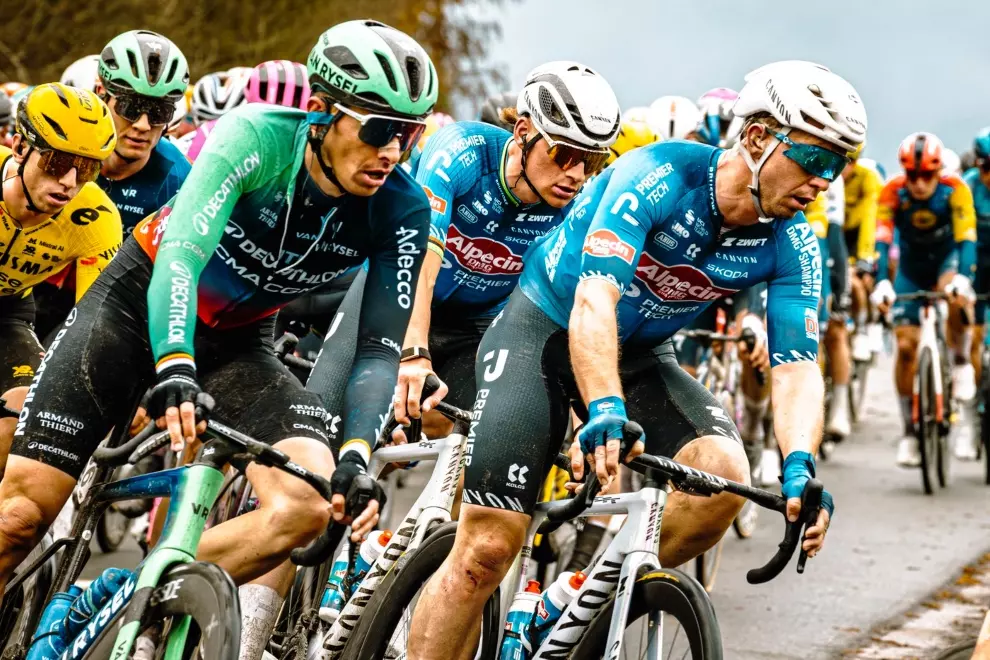
Strade Bianche
Some races have built their reputation over a century. Others just look at the calendar, add a few dozen kilometres of gravel, and let the road handle the rest.
Strade Bianche was introduced in 2007 by RCS Sport as a tribute to Tuscany’s historic strade bianche, the pale gravel roads that connected villages long before asphalt decided to civilise things. The idea sounded romantic enough. White roads, rolling hills, beautiful scenery. What could possibly go wrong?
Quite a lot, as it turns out.
The trouble usually begins somewhere in the middle of a dusty Tuscan sector where the road suddenly tilts upward, and the gravel starts behaving less like a surface and more like a caffeinated toddler. Riders bounce, slide, and briefly consider why, oh why, they have come here. In dry years, the dust turns the race into a moving sandstorm. In wet ones, the roads transform into a pale mud that sticks to everything… Say goodbye to these precious five-figure-costing gears.
Then comes the final act: Via Santa Caterina, a brutally steep ramp that drags exhausted riders into Siena’s Piazza del Campo. By the time they reach the square, they look less like winners of a bike race and more like zombies who learned how to ride a bike.
Strade Bianche may be young, but it proved one thing very quickly. Give cyclists a beautiful road, and they’ll enjoy it. Give them a terrible one, and they’ll build a tradition around it.
Tour of Flanders
I’m not sure if this proverb exists yet, but we should definitely coin this one I read on a Reddit post: “Some races are difficult. Others are Belgian.” Tour de Flanders is definitely the best proof.
Tour of Flanders was first organised in 1913 by the newspaper Sportwereld, partly to promote the publication and partly to showcase the stubborn hills and cobbled farm roads of Flanders. Over time, it became something far bigger: a national ritual conducted on bicycles.
The trouble begins with the hellingen, the short Flemish climbs that appear one after another like poorly timed punchlines (just like this one). They are steep, narrow, and paved with cobbles that seem determined to eject riders back down the hill. The most famous of them, the Koppenberg, has gradients approaching 20 per cent and stones so uneven that maintaining forward motion is no longer guaranteed by sheer physics. A prayer or two is usually in order here.
Crowds pack the roadside like spectators at a medieval festival, shouting encouragement while riders grind upward at walking speed, wheels slipping and profanities loudly shared with the world… and oddly cheered even louder. Somewhere later in the race, the Oude Kwaremont and Paterberg deliver the final verdict, usually leaving only a handful of riders still capable of pretending this is under control.
Flanders doesn’t hide its intentions. The race was designed to be hard, and over a century later, it still doesn’t see the point in changing to accommodate some pish-posh elite riders with their electronic gears and 12-gram bikes.
Paris-Roubaix
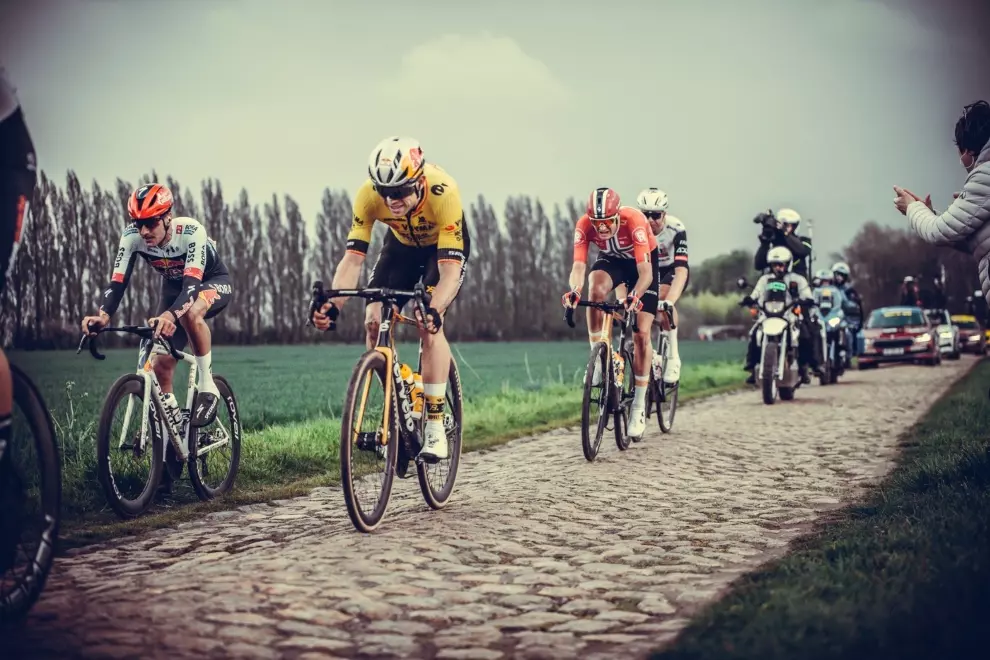
If the Tour of Flanders feels like a celebration of hard roads, Paris-Roubaix feels like a stern warning.
The race was created in 1896 by two textile manufacturers from Roubaix who wanted to promote a new velodrome in their town. Their solution was simple. Send riders across northern France on the roughest farm roads available and see who arrives at the track first. Apparently, nobody thought to check whether those roads were suitable for bicycles.
Somewhere in the middle of the race, the peloton enters the Trouée d’Arenberg, a narrow cobbled sector through a forest that looks less like a road and more like a historical preservation project for medieval pavement. Bikes rattle violently, riders bounce across the stones, and mechanics quietly cry in the backseats of team cars, who will also need a very expensive repair after going through this hell.
Indeed, the nickname Hell of the North is not just a marketing slogan. It’s a warning sign that somehow each year gets ignored by hundreds of the best riders in the world.
The cobbled sectors keep coming. Mons-en-Pévèle. Carrefour de l’Arbre. Each one shaking riders and machines a little closer to surrender. By the time the survivors reach the Roubaix Velodrome, they are usually coated in dust or mud and riding whatever still works.
The winner receives a cobblestone trophy, which is fitting. In this race, the road is the main character, and it likes to leave a mark.
Milano-Sanremo
At first glance, Milano-Sanremo doesn’t look particularly cruel. The roads are paved, the scenery along the Ligurian coast is postcard material, and there are no cobbles waiting to dismantle your bicycle. Then you notice the small detail that the race is almost 300 kilometres long.
Milano-Sanremo was first held in 1907, created by the newspaper La Gazzetta dello Sport as an early-season challenge linking the industrial north of Italy with the Mediterranean coast. Over a century later, the concept remains largely unchanged: ride for most of the day, try not to make any mistakes, and prepare for the moment when everything suddenly explodes.
That moment usually arrives on the Cipressa and the Poggio, two climbs that appear after nearly seven hours of racing. Neither is particularly terrifying on paper. The magic comes from their timing. Riders hit the slopes with tired legs, rising tension, and the quiet understanding that this is where the race must finally be decided.
Milano-Sanremo doesn’t attack riders with violence like the cobbled classics do. It simply waits until they are completely exhausted and then asks one final question: Who still has something left?
Amstel Gold
Some races are shaped by mountains. The Amstel Gold Race was shaped by a country that looked at its lack of mountains and decided to compensate with an alarming number of short hills instead.
The race was first held in 1966, created by Dutch promoters who wanted their own major classic to rival the Belgian and Italian monuments. Since the Netherlands isn’t exactly famous for towering climbs, the organisers built a course in Limburg that twists through narrow roads and packs more than thirty short, punchy ascents into a single day.
The most famous of these is the Cauberg, a climb that appears near the finish and has spent decades delivering the final blow to riders who were already hanging on by stubbornness alone. It isn’t long, but after a full day of relentless up-and-down racing, length becomes a secondary concern.
What makes the Amstel Gold Race special is its rhythm. There is almost no flat road long enough to relax, no stretch where the peloton can fully reset (which is genuinely impressive, considering it’s in the Netherlands). The race constantly rises, dips, and turns like a nervous heartbeat.
By the time the riders reach the final climbs, the race has quietly done its job. Legs are empty, the field is shattered, and the only thing left is to lift a giant beer and take a sip.
Why the Classics are still Classics
Modern cycling has become faster, lighter, and far more controlled than it was when most of these races were invented. Equipment evolved, training became scientific, and race tactics now unfold with the help of radios and data. Yet every spring, the peloton still returns to the same roads that ignore most of that progress.
The cobbles in Belgium haven’t been smoothed. The gravel roads in Tuscany haven’t been paved. The Poggio still appears after nearly 300 kilometres, and the Cauberg still waits to punish whoever thought the day was almost over. The traditions remain stubbornly intact.
That is exactly why these races continue to matter. The Spring Classics remind everyone that cycling is not only about perfect preparation and calculated watts. At its core, it is still a contest between riders and the road beneath their wheels.