Sooner or later, you’ll want different roads. Different climbs. Something that isn’t the same loop you’ve memorised down to the potholes. And that’s when the bike needs to travel before it rides. Sure, you can shove it into the boot with the front wheel off, wrapped in nylon, rattling against everything you pretend you don’t care about. People do it every day. But at some point, you either accept the chaos or you decide to transport your bike like a civilised person.
Investing in a good bike rack is more than just a fashion statement. It’s actually the easiest, cleanest, and most practical way to transport your bike, with as little damage to it or your car.
So let’s talk bike racks. Specifically, the ones worth considering in 2026, before gravity, friction, and bad ideas get their turn.
Best for heavy bikes and e-MTBs: Thule EasyFold XT 2
Thule makes its racks like Germans make tanks. Overbuilt, calm under pressure, and quietly watching with a dose of superiority.
The EasyFold XT 2 exists for bikes that joined the fat acceptance movement long ago and refuse to step on a scale. e-MTBs. Long-travel enduro rigs. Anything that makes lesser racks develop opinions and start flexing in public. Here, nothing flexes. Nothing negotiates. You roll the bike on, clamp it, and the rack accepts the assignment without enthusiasm or complaint.
Rated for serious kilos per bike, wide trays, long wheelbase support, and a clamp that grips firmly without turning your frame into a science experiment. At speed, it’s unsettlingly uneventful. No sway. No noises. No mirror-checking rituals. Just miles disappearing while the bikes sit there enjoying the ride.
It folds completely, which feels like sorcery the first time you do it, and it’ll live in your boot when not in use.
Unfortunately, just like German tanks, these things cost money – a lot of it. It’s one of the most expensive racks on the market. It’s also one of the heaviest. Naturally, it requires a towbar, which means paperwork, money, and commitment.
But if you love enduro, e-MTB, or DH rides and you have a specific bike for the task that weighs about 3 well-fed whales, Thule’s EasyFold XT2 is your rack.
Best for small cars and light bikes: Saris SuperClamp EX 2
The SuperClamp EX 2 is for people who like cycling but don’t want their car to look like it’s compensating for something. This rack is light, compact, and doesn’t really care if your car is a normal city car, not one of those monstrosities you wonder how they are road-legal.
It doesn’t stick out half a meter behind the car. It doesn’t turn parallel parking into an event. It doesn’t require a warm-up set just to lift it. You mount it, load the bike, and still recognise your vehicle afterwards.
It works best with bikes that remember what gravity feels like. Road bikes. Gravel bikes. Sensible MTBs that haven’t been fed creatine. The trays are narrow but precise, the clamps are secure without being aggressive, and everything tightens down with just enough force to feel reassuring, not alarming.
On the road, it behaves. No rattling soundtrack. No interpretive dance over bumps. At highway speed, it stays composed, as long as you remember this is not the rack for motorised refrigerators pretending to be bicycles.
Of course, there are a few trade-offs. Weight limits are real. Long wheelbases start feeling cramped. e-MTBs should look elsewhere. And if you like overbuilt hardware for emotional reasons, this won’t scratch that itch.
But if you drive a hatchback, value your sanity, and ride bikes that don’t need a forklift, the SuperClamp EX 2 is exactly enough.
Best for maximum stability at highway speeds: 1UP USA Heavy Duty Double
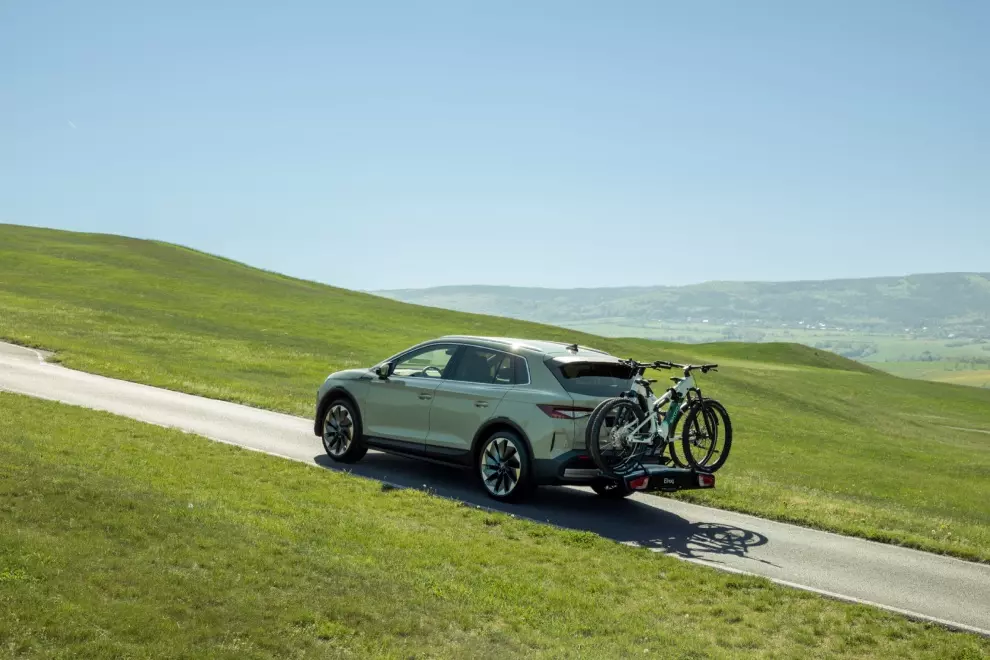
The 1UP Heavy Duty Double looks like it was designed by someone who doesn’t believe in marketing, plastics or moderation. It’s just metal. A lot of it. Machined, tightened, and assembled with the main goal of seeing the dawn of humanity. Yes, this rack will outlive you, your children, and your children’s children, and even our robot overlords, who will inevitably run us.
This is the rack for long drives. Motorways. Bad asphalt. Crosswind that relentlessly tries to steal your bike. Once mounted properly, it does not move. Not a little. Not “within tolerance”. It just sits there, locked in, while everything else on the road feels suspiciously flimsy by comparison.
Loading is straightforward but not friendly. There’s no soft encouragement, no ergonomic reassurance. You place the bike, clamp the wheels, tighten everything down, and the rack agrees to hold it. A straightforward business transaction.
At speed, it’s almost boring. No sway. No oscillation. No sudden noises that make you reach for the mirror like a nervous tic. Just kilometres disappearing while the bikes remain exactly where you left them.
Unlike your Spotify playlist, having an all-metal bike rack has its drawbacks. It’s not light. It’s not pretty. It’s not intuitive the first time. And it’s not cheap once you start adding extra trays, because you will.
But if you regularly drive fast, far, and fully loaded, this is the rack that turns highway speeds into a non-event, which is the highest compliment you can give anything bolted to a car.
Best rooftop bike rack: Thule ProRide 598
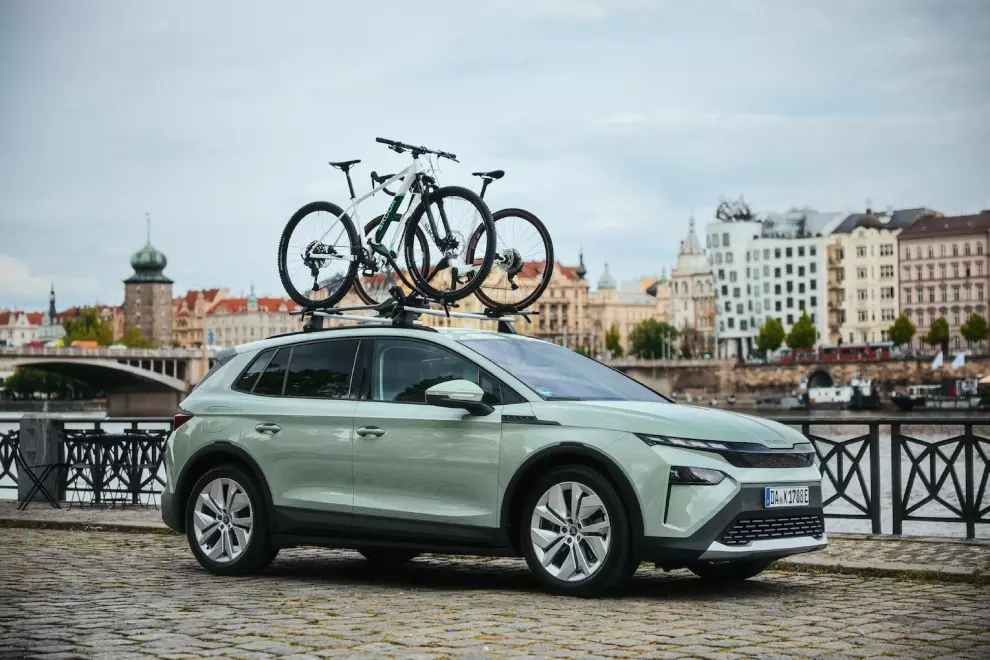
Rooftop racks are for optimists. People who believe lifting a bike overhead after a long drive is still a reasonable life choice. Among those optimists, the ProRide 598 is the one that actually respects your time. This rack is simple, predictable, and a tad boring in the best way possible.
You lift the bike up, drop the wheels into the tray, tighten the frame clamp until the torque dial clicks, and you’re done. No frame gymnastics. No guessing how tight is too tight. The bike sits upright, centred, and obedient. It works brilliantly with road and gravel bikes, and with MTBs that haven’t discovered mass gain as a lifestyle. Once locked in, it stays put. Wind noise is there because, you know, physics, but nothing shifts or loosens once you’re moving.
At speed, it’s stable enough that you almost forget it’s there. Almost. Until you approach a garage, underground parking or anything with a height limit, and suddenly remember everything.
Now, of course, there are some trade-offs. For starters, you have to lift the bike. Over your head. Repeatedly. Carbon frames are fine; heavy bikes are not. e-MTBs should absolutely stay on the ground where they belong.
But if you don’t have a towbar, want full boot access, and enjoy the quiet superiority of carrying your bike above traffic, the ProRide 598 remains the benchmark.
Best boot, hatch or trunk-mounted bike rack: Saris Bones
This is the rack category nobody wants to talk about, but plenty of people begrudgingly rely on. It looks odd, like a piece of modern furniture that wandered into the wrong industry, but it works. The arched frame keeps bikes away from the car, the straps hold tension surprisingly well, and once it’s mounted correctly, it’s far more stable than its appearance suggests.
It’s best with lighter bikes. Road, gravel, older MTBs that don’t think they’re motorcycles. Load it carefully, take five minutes to do the straps properly, and it behaves. Skip that part, and it will remind you why preparation matters. On the road, it’s fine for short to medium trips. Not heroic. Not reckless. Just fine.
If those trade-offs are not enough, there are some more. Frame contact is unavoidable. Carbon needs protection. Paint will eventually suffer. High motorway speeds feel optimistic. And heavy bikes push it past its comfort zone very quickly.
But if your car setup leaves you with no other option, the Saris Bones is the least-bad solution. And sometimes, the least-bad is exactly good enough.
My personal best: IVTEC WideGrip
One of the biggest issues with all of these bike racks is that they need space to be stored when not in use. And unfortunately, space is something I personally don’t have a lot of. So my personal best is the one that takes the least amount of space when not mounted on my car. It’s the IvTec WideGrip.
One of the biggest issues with all of these bike racks is that they need space to be stored when not in use. And,unfortunately, space is something I personally don’t have a lot of. So my personal best is the one that takes the least amount of space when not mounted on my car. It’s the IVTEC WideGrip.
The whole thing comes down to three small pieces that live on your roof bars and don’t demand their own parking spot in the garage. No folding rituals. No steel monument leaning against the wall.
You mount the bike upside down, which looks wrong, feels wrong, and works surprisingly well. Less frontal area means slightly less fuel consumption, and the bike sits lower than you’d expect. Aerodynamics by accident, but I’ll take it.
Stability is the real party trick. The bike rests on the rear tyre and the handlebars, not hanging by optimism or clamped like a hostage. Once strapped, it feels planted, even when the road isn’t.
There are trade-offs, because of course there are. You still need to watch your height, especially around garages and trees that want to touch the road someday. There’s a 120 km/h speed limit, which is fine unless your right foot has unresolved issues. And yes, an upside-down bike will draw attention. People will stare. Some will ask questions. But hey, at least it’s a cool conversation starter. Imagine finding your future wife this way… I mean, still a better love story than Twilight.
Despite this 20-year-old joke, the IvTec is perfect for my needs. It fits my space, my habits, and my very low tolerance for mounting bikes on my car.
Still, to each their own, right?