This isn’t about turning yourself into a yogi. It’s about restoring movement where cycling steals it: hips that stop extending, spines that stop rotating, hamstrings that remember only one length. Do this well, and you’ll sit better on the bike, produce power more efficiently, and arrive at the first hard rides already ahead.
Why cyclists need mobility (even if they stretch “sometimes”)
Cycling is profoundly repetitive. Thousands of pedal strokes lock the hips into flexion, encourage spinal stiffness, and teach hamstrings to work only through a narrow range. Over time, this shows up as:
- Hip flexor tightness limiting extension at the top of the pedal stroke
- Lumbar stiffness reducing comfort and breathing efficiency
- “Tight” hamstrings that are often weak and under-loaded, not short
Mobility work isn’t about chasing flexibility for its own sake. It’s about accessing usable range of motion. A range you can control and produce force in.
Off-season rules for mobility work
Before exercises, a few principles that separate useful mobility from wasted floor time:
- Short and frequent beats long and heroic
Ten minutes, four to five times a week is better than one painful hour. - Move, don’t just hang
Passive stretching has value, but cyclists need controlled motion. - Breathe normally
If you’re holding your breath, you’re not improving mobility. You’re tolerating discomfort.
Hips: Restore extension and rotation
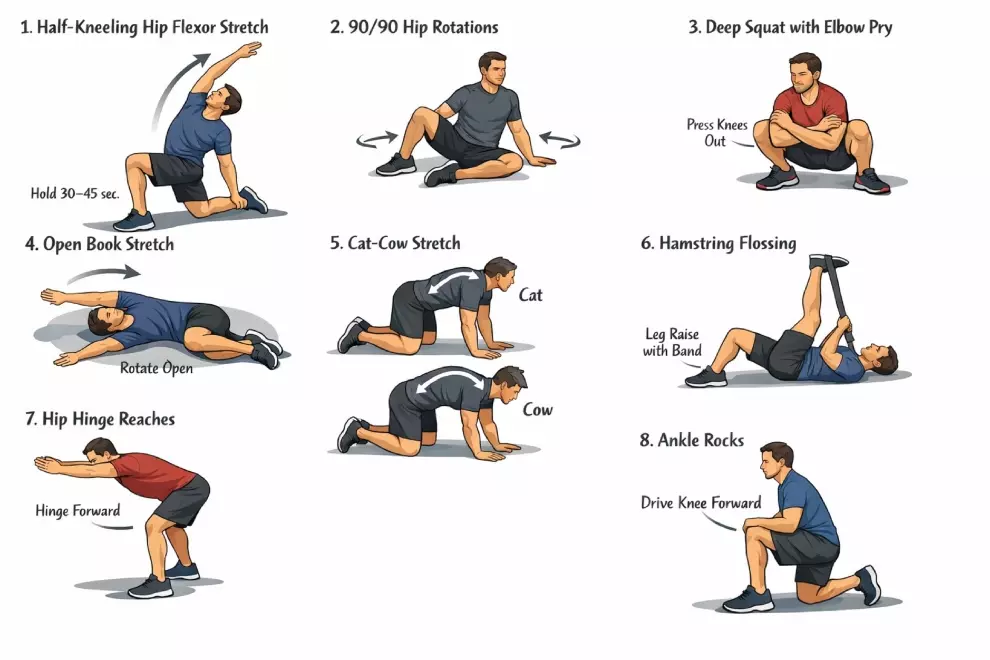
1. Half-kneeling hip flexor stretch with reach
Why it matters: Counteracts the constant hip flexion of riding.
- Kneel on one knee, other foot forward
- Lightly tuck the pelvis (no aggressive arching)
- Raise the arm on the kneeling side and reach slightly back and across
- Hold 30–45 seconds, breathing steadily
Focus on lengthening, not forcing depth.
2. 90/90 hip rotations
Why it matters: Restores internal and external hip rotation—often lost in cyclists.
- Sit with one leg in front, one behind, both at 90°
- Rotate knees side to side without using hands if possible
- Move slowly, staying tall through the spine
This is gold for knee tracking and saddle comfort.
3. Deep squat hold with elbow pry
Why it matters: Reintroduces full hip flexion under control.
- Drop into a deep squat
- Use elbows to gently push knees outward
- Shift weight subtly side to side
If heels lift, elevate them slightly. Don’t force depth at the cost of balance.
Spine: Get rotation back
4. Open books (thoracic rotation)
Why it matters: Cycling fixes the spine forward; rotation disappears.
- Lie on your side, knees bent
- Rotate top arm open while keeping knees stacked
- Follow the hand with your eyes
This improves breathing mechanics and reduces neck strain on the bike.
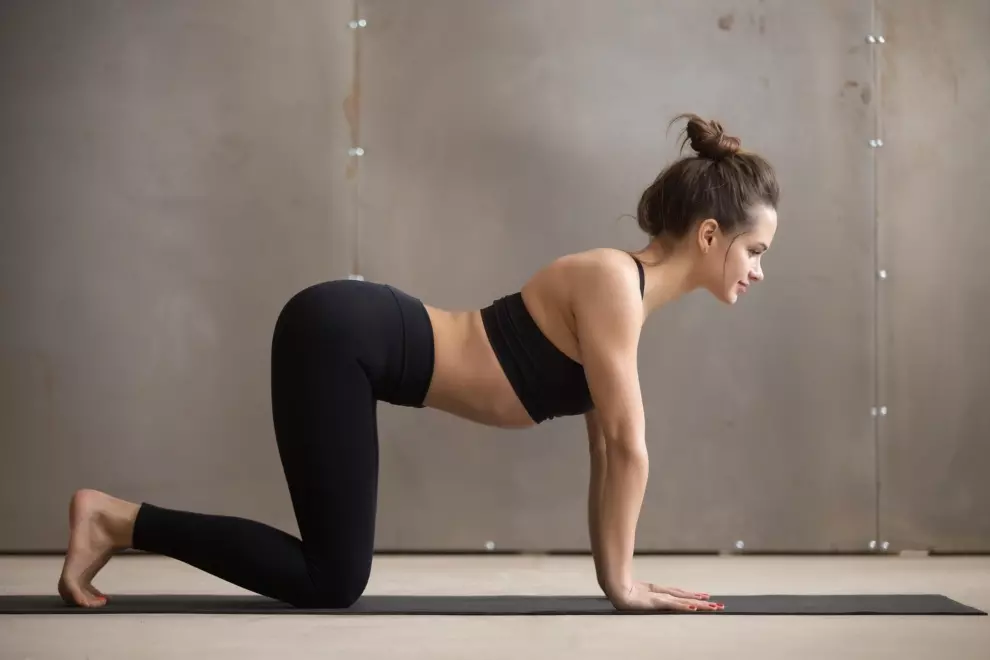
5. Cat–cow with slow control
Why it matters: Reintroduces segmental spinal movement.
- Move slowly through flexion and extension
- Emphasise articulation, not speed
- 6–10 deliberate reps
Think control, not stretch.
Hamstrings: Strength through range, not just stretch
Cyclists often stretch hamstrings endlessly without improving function. The missing link is loaded lengthening.
6. Hamstring flossing (lying leg raise with strap or band)
Why it matters: Improves neural glide and tolerance to length.
- Lie on your back, one leg straight
- Raise leg with band, gently extend and bend the knee
- Stay within pain-free range
This should feel smooth, not aggressive.
7. Hip hinge reaches
Why it matters: Teaches hamstrings to load at longer lengths.
- Stand tall, soft knees
- Hinge at hips, reaching hands forward
- Maintain a neutral spine
This carries over directly to better posterior-chain engagement on the bike.
Ankles: The overlooked limiter
Restricted ankle dorsiflexion can subtly affect knee tracking and saddle stability.
8. Ankle rocks
Why it matters: Improves comfort and pedal smoothness.
- Half-kneeling position
- Gently drive knee forward over toes
- Keep heel down
Slow, controlled reps beat forcing range.
How to put it together
A simple off-season mobility session:
- 2 hip exercises
- 1 spinal rotation
- 1 hamstring drill
- Optional ankle work
Total time: 10–15 minutes
Do it:
- After easy rides
- On rest days
- In the evening while watching something forgettable
Consistency matters more than variety.
The payoff come spring
Riders who commit to mobility in winter report:
- Easier position changes
- Less low-back fatigue
- Better force transfer at higher cadences
- Fewer “mystery” niggles early in the season
You won’t feel heroic doing mobility work. That’s the point. It’s quiet, unglamorous, and disproportionately effective.
Winter doesn’t just build base fitness. It builds the body that can actually use it.