That’s what happened to Astana Qazaqstan (today XDS Astana) when the great sprinter Mark Cavendish joined the team in 2023 in his quest to set the record for most Tour de France stage victories. He eventually succeeded, getting his 35th victory in the 2024 Tour and supplanting Eddy Merckx in the record books. But the team had focused so much on helping Cavendish in his quest that it neglected other riders and spurned other races, notching only 12 wins in 2024. As a result, Astana had to go on a spending spree on the transfer market in order to retain its WorldTour status.
The same could be said of Soudal Quick-Step and Remco Evenepoel’s desire to win the Tour de France. Evenepoel joined Deceuninck–Quick Step in 2019, when it was one of the most successful teams on the road, with 68 victories, winning one-day races and Grand Tour stages with the likes of Julian Alaphilippe and Elia Viviani. Evenepoel was 19 then and already attracting attention, but he had not yet expressed his Tour de France dream.
He rode in his first Grand Tour in 2021, crashing out of the Giro. He rode in his first Tour de France two years later, finishing third. At some point during his career at the various iterations of Soudal Quick-Step, he complained to the boss, the outspoken Patrick Lefevere, that he needed more and better support riders in his quest to defeat Tadej Pogačar and Jonas Vingegaard in the Tour. Lefevere obliged, signing Mikel Landa in 2024 and Valentin Paret-Peintre in 2025 and shifting resources to help his superstar succeed in his quest. It didn’t work and, in the process, changed the DNA of a team that had been very successful.
But the team is back for 2026. Evenepoel is at Red Bull–BORA–hansgrohe, Lefevere has retired, and Soudal Quick-Step has signed the likes of Jasper Stuyven, Laurenz Rex, Dylan van Baarle, and Alberto Dainese to accompany Tim Merlier in reviving its sprinting and one-day chops. And they have another budding one-day superstar in 21-year-old Paul Magnier. Stuyven – who won Milan-Sanremo in 2021 and Omloop Het Nieuwsblad the previous year – will help Merlier in the Tour sprints and Classics, mentor Magnier and go for victories when he can.

“With Remco leaving, I think the team wanted to go back to what they really love, what’s in their DNA, and get back to where they were a few years ago,” he told journalists at a training camp media event earlier this month. “QuickStep were the standard. Everyone looked at them. It’s crazy to see how it changed and that Lidl-Trek (his former team) became known as the best team for positioning in the Classics.”
Stuyven brings an aggressive attitude that is required for a team going for one-day victories. “Hopefully,we’re not scared to take on Mathieu van der Poel and Tadej Pogačar in the race,” he said. “If you always stay behind and always try to rely on other teams, it means you are always one step behind. It’s better to be in front.”
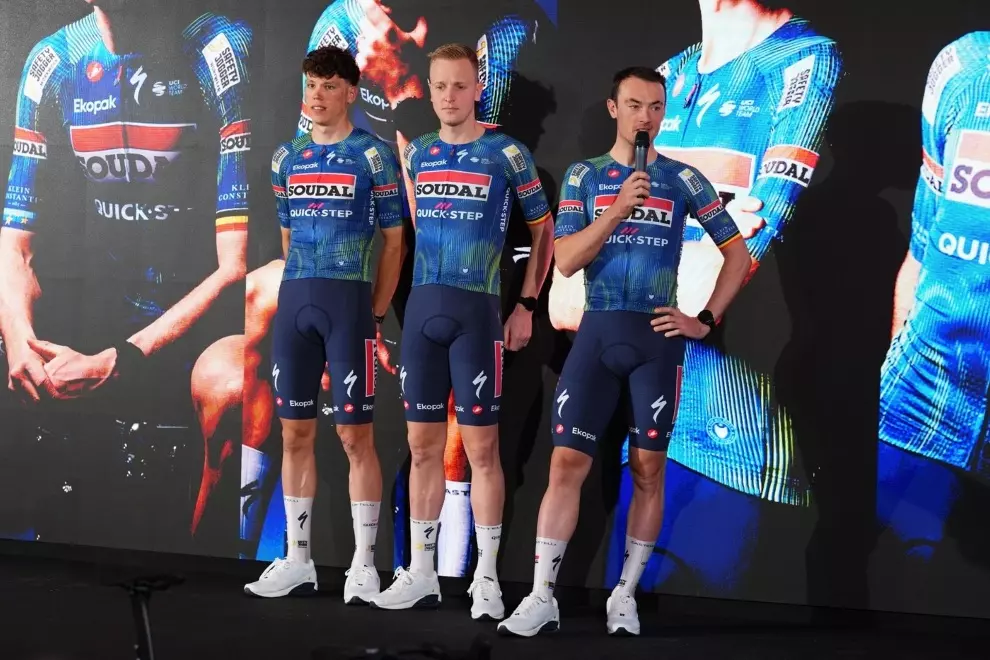
Early this month, at the team presentation, team manager Jurgen Foré noted that Soudal Quick-Step will no longer go for Grand Tour GC wins, focusing instead on stage victories in all three races. “I hope to see some bold racing,” he said. “We hope to win on all terrains: sprints, mountains, time trials and breakaways. We want a victory in a major Classic, and, of course, the Flemish and Ardennes Classics have a special place in our hearts. Grand Tour stages are also important to show off to our sponsors.”
Merlier will be a key rider in the team’s strategy, but he is 33 and may be slowing down. That’s why Magnier – who extended his contract until 2029 – is vital to the team’s current and future success. The Frenchman won an impressive 19 races last year, but struggled in the Classics. That makes Stuyven and Merlier doubly important because they will be mentoring an essential piece of the team’s future.
“I think he just misses a bit of maturity, which is not a big problem,” Stuyven said of Magnier. “Jonathan Milan (Stuyven’s former teammate) was also still quite young two years ago. I think Paul knows how to handle it. He’s also super open and eager to learn. I noticed that he made mistakes in races, so still being so successful was impressive. I think he has a lot more potential.”
It could be said that QuickStep’s partnership with Evenepoel was something of a failure, since he failed to achieve his main goal and notched his biggest wins while wearing, not the team jersey but that of his homeland, Belgium. And for the team, its one-day dominance faded – though it won 54 races last year, thanks to Merlier and Magnier; Evenepoel notched only 5 wins for the team. But it seems that Soudal Quick-Step is now back doing what it does best, and the sport is better for it, too.