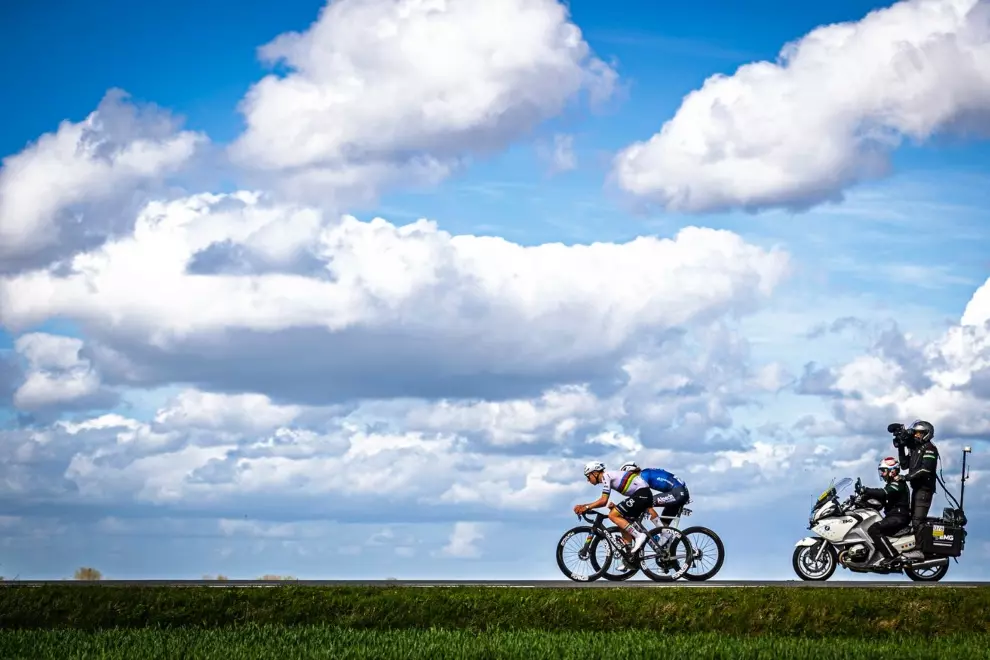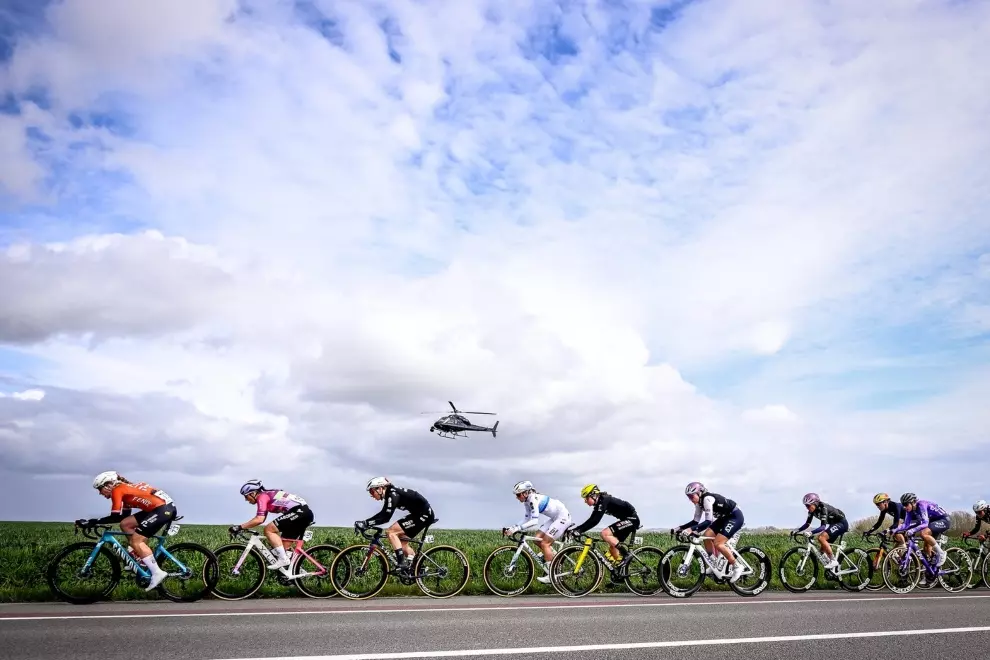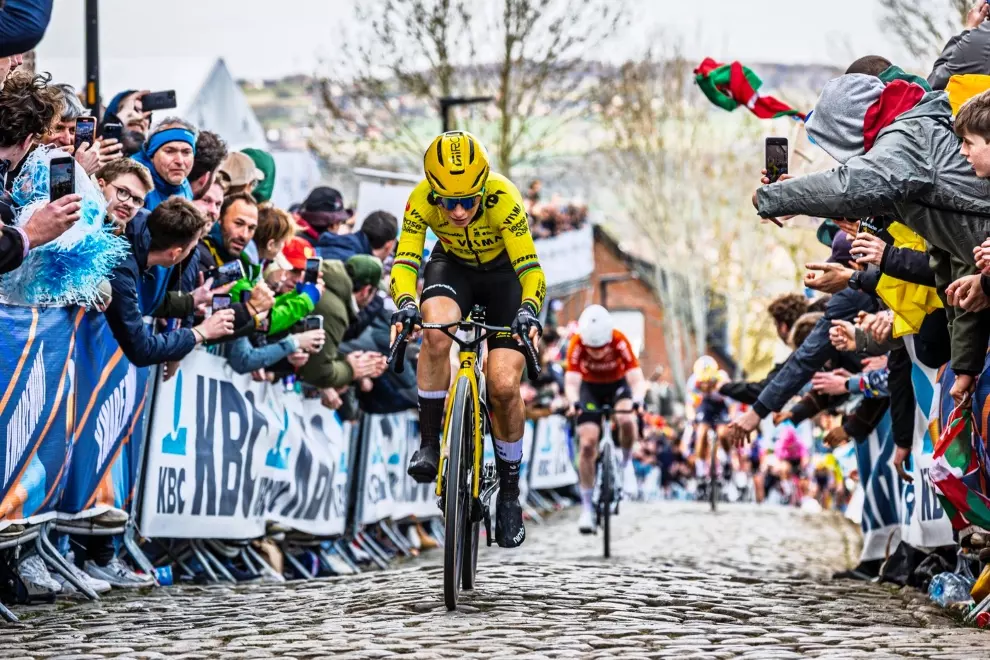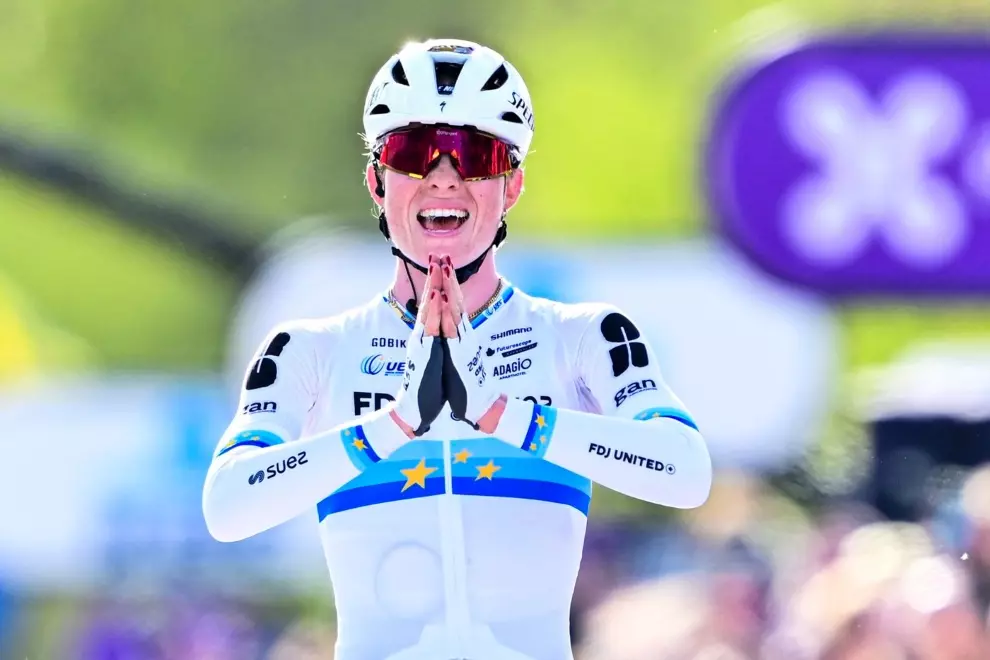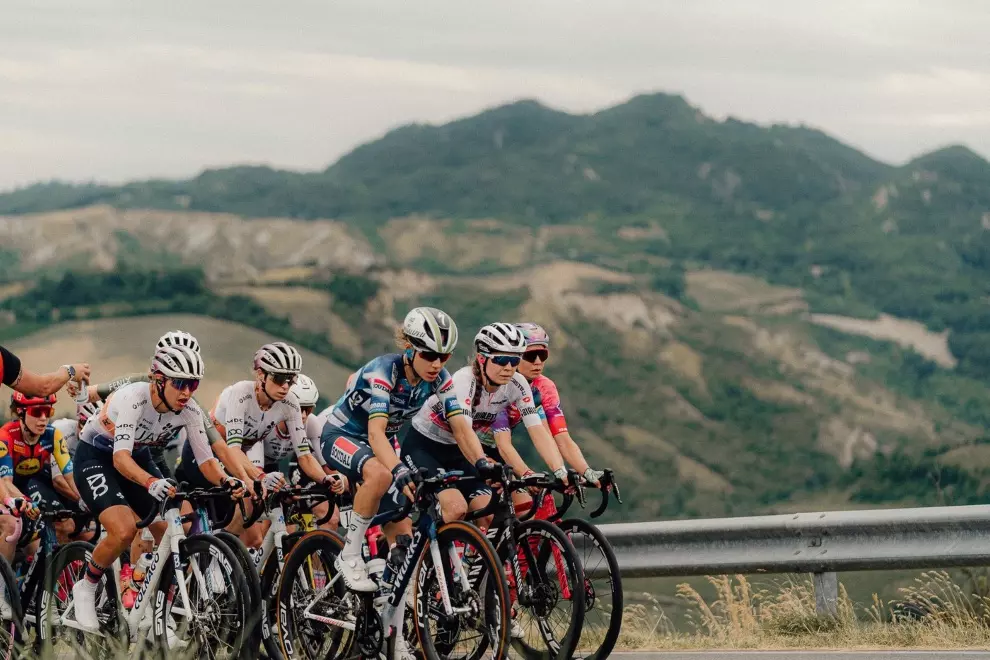
This year felt like riding through the middle of a long stage: legs warm, terrain changing, decisions being made that won’t pay off for another few kilometres. There were big moments, of course. But there were also organisers committing to better representation, riders refusing to be defined by a single discipline, and federations beginning (slowly) to invest in the long game. It was a year of consolidation, and that might be exactly what women’s cycling needed.
Road Racing: Classics, stage races and the Tour de France Femmes avec Zwift ripples
Unsurprisingly, the spring classics delivered. In March, Demi Vollering reaffirmed her punchy form with a win at Strade Bianche Donne, attacking on the gravel sectors and ascending to victory in Siena.
April brought La Flèche Wallonne Femmes, where Puck Pieterse, already making waves as one of cycling’s most versatile talents, secured her first major one-day classic win atop the iconic Mur de Huy, outpacing Vollering and seasoned climber Elisa Longo Borghini.
Not far behind, Amstel Gold Race Ladies Edition saw Mischa Bredewold capitalize on a well-timed attack on the Cauberg to solo to victory, proving that depth beyond the traditional “big three” (Vollering, Vos, Longo Borghini) is real and growing. And Liège–Bastogne–Liège Femmes delivered one of the season’s great feel-good stories when Kimberley Le Court of AG Insurance-Soudal won in a four-rider sprint, showcasing how national champions from outside the traditional powerhouse nations are breaking through on the WorldTour stage.
Stage racing reinforced that repeat excellence still matters. The Itzulia Women in the Basque Country, always a hard-fought three-day tester before the Tour, was claimed for the third time by Vollering, who also swept the mountains classification. Performances like these have helped justify her role as a perennial GC contender in week-long and Grand Tour formats alike.
Then came the Tour de France Femmes avec Zwift, now in its third edition and tougher than ever with nine stages across varied terrain. Coverage expanded, fan engagement grew, and there was plenty of drama to go around: the 38-year-old legend Marianne Vos took the opening stage win in Plumelec, reminding the peloton why she remains one of the sport’s all-time greats. On the final day’s mountaintop finish in Châtel, Pauline Ferrand-Prévot unleashed a long solo attack to secure not just the stage win but the overall title.
Yet the race also highlighted a persistent reality: total prize money across all classifications remains modest, around €264,000 for the whole Tour, with the general classification winner’s prize of €50,000 only about 10 % of the equivalent in the men’s race.
Multi-discipline dynamo: Cycling’s cross-pollination
One of the ways the women are coping with the economic realities of their sport also marks another highlight that made 2025 especially compelling: the cross-disciplinary journeys of its stars. Puck Pieterse’s sprint to La Flèche Wallonne, after a strong spring across varied racing formats, is a case study in this new model. Not to mention known mountain bike darling Pauline Ferrand-Prévot claiming the Tour de France Femmes avec Zwift.
On the cyclocross front, season highlights included Lucinda Brand dominating a UCI World Cup round in Namur with clinical power and tactical precision, even against the well-rounded Pieterse. European champion Inge van der Heijden kept up her momentum with multiple wins, including Exact Cross Kortrijk, asserting deeper competition in cyclocross beyond the usual suspects. Meanwhile, young talents like Makena Kellerman claimed U23 national titles in the U.S., pointing to emerging depth in alternative pathways into elite racing.
In mountain biking, veterans and rising stars continued to claim marquee wins: Jenny Rissveds stood atop XCO podiums at UCI Mountain Bike World Series events such as Les Gets, highlighting how early-season form and race savvy translate across surfaces. In 2025, gravel racing also reached a milestone with the UCI Gravel World Championships, where the women’s elite race unfolded over a punchy, challenging course and crowned champions in what’s quickly becoming one of the most spectator-friendly formats outside traditional road cycling. Lorena Wiebes ultimately took the title in a dazzling sprint finish, overtaking Marianne Vos and Silvia Persico, after solo leader Shirin van Anrooij was caught in the final meters.
Rwanda 2025 set a new tone going forward
For the first time, at the 2025 UCI Road World Championships, the women’s elite and junior races unfolded in a context that actively questioned the sport’s traditional centre of gravity. Hosting the World Championships on the African continent exposed long-standing assumptions about where elite cycling belongs, who gets access to world-class racing environments, and who is visible when the sport’s biggest spotlight turns on.
The women’s programme was treated with the seriousness it deserves. Riders spoke openly about the difficulty, long climbs at altitude, relentless pacing, and tactical complexity. But perhaps the most important impact happened away from the results sheets. Seeing women’s World Championship races take place in Kigali mattered for the riders lining up, and for the girls watching from the roadside. Visibility at this scale reframes cycling not as a distant European tradition, but as a global sport with space for new stories, new champions, and new pathways.
Representation Matters: Opening the peloton’s doors wider
With that in mind, it is fair to reiterate that the peloton has remained, in many ways, geographically and culturally narrow. In 2025, that reality was challenged in a way that felt genuinely hopeful.
At Rouleur Live this autumn, Ashleigh Moolman Pasio stood alongside Team Amani and longtime collaborator Xylon van Eyck to announce the launch of something unprecedented: the first purely African UCI Women’s Continental Team, set to debut in the 2026 season. The team will be composed entirely of Black African riders, with its inaugural roster drawn predominantly from East Africa, and led by a Rwandan woman, Xaverine Nirere.
Zobrazit příspěvek na Instagramu
In a sport where “development pathways” often begin thousands of kilometres away from where raw talent actually lives, this mattered, not as a symbolic gesture, but as infrastructure. A team built by African women, for African women, designed to give riders access to racing, mentors, and professional experience without asking them to leave their context behind just to be seen.
Coming in the wake of the Rwanda World Championships, the announcement felt like a continuation of a wider shift, one that asks who cycling is really for, and who gets to imagine themselves on the start line of a WorldTour race. `
What’s actually changing, and where there’s still work to do
Nevertheless, alongside expansion comes growing pains. Despite a step in the right direction when it comes to representation, the UCI confirmed that the Women’s WorldTour will shrink to 14 teams in 2026 due to financial pressures and rising operational costs, even as some strong performers struggle to secure sustainable budgets. This paradox, more races but a leaner team landscape, reminds us that growth must be accompanied by investment in team stability.
Fragmented broadcast, growing attention
Top races like the Tour de France Femmes and the Ardennes classics enjoy expanded coverage, boosted by broadcasters and digital platforms alike. Reports highlighted a surge in audience numbers and engagement, which in turn strengthens the commercial case for women’s racing. But outside the marquee moments, coverage remains inconsistent, and smaller WorldTour races still struggle to deliver reliable live feeds. The sport needs greater depth in its broadcast coverage if it wants to rival men’s cycling in terms of sponsor valuations and fan engagement.
Development, pathways, and athlete welfare
The trend of riders shifting disciplines, from cyclocross and MTB into road and gravel, underscores a more holistic athletic culture emerging in women’s cycling. But these blurred lines also create logistical challenges: coaching, calendar planning, and recovery pathways must adapt if athletes are to compete at elite levels in multiple formats without burnout.
At the same time, structural improvements such as stronger national support systems, clearer commercial strategies from federations, and discussions on maternity rights continue to unfold, albeit unevenly across countries and programmes.
Looking ahead with eyes wide open
So, what do we take from 2025?
The sport now has enough depth that progress can be uneven, debated, and even frustrating. Riders can race across disciplines without it being treated as a novelty. Fans can follow full seasons rather than isolated highlights. Conversations about money, broadcast quality, and working conditions are happening in public.
That doesn’t mean the work is done, far from it. Salary security remains fragile, media coverage is still inconsistent, and growth risks creating new inequalities if it isn’t managed carefully. But 2025 showed that women’s cycling is no longer just asking for space; it’s learning how to use it.
And that’s worth celebrating. Here’s to a 2026 that sees more diversity, discussions of rider welfare, and women achieving incredible feats on two wheels!