A declaration of confidence
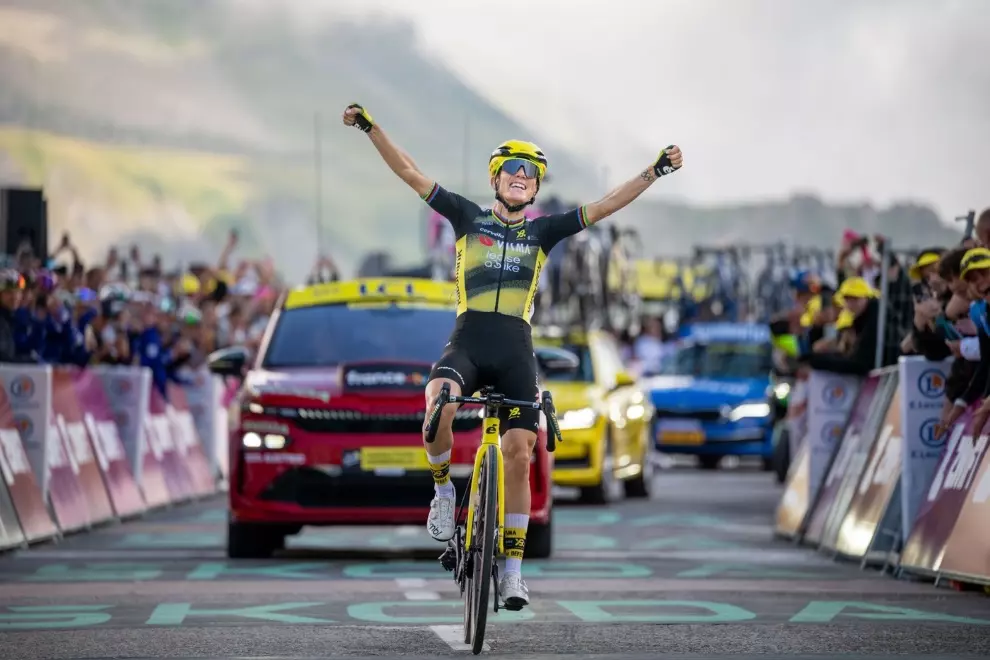
“I… really think that I can be more consistent during the full season. I would like to win more Classic races, and also I want to try to win Tour de France again and to be world champion next year,” Ferrand-Prévot said recently on Visma–Lease a Bike‘s Inside the Beehive podcast. This suggests that she wants to win every race she enters next year, since last year she finished third in the Strade Bianche Donne and second in the Tour of Flanders before winning Paris-Roubaix Femmes and had a disappointing world championship in Rwanda, finishing a well-beaten 16th behind surprise winner Magdeleine Valieres of Canada.
Then she uttered a statement that should send alarm bells through the training camps of her rivals and make them work a little harder in training this winter: “So I think – I don’t know why – but I have a feeling it will be a super good year for me because I learned so much last year that now I know what I have to do, and I just can do what I learned from last year.”
What she did was lose about 4 kg, which amounted to nearly 10% of her body weight, for the TdFFaZ, a strategic, controlled “cut” with her team nutritionist to boost her watts-per-kilo capacity for the mountains. This elicited an intense debate about elite athlete weight management and setting a new training standard, and also provoked some rather abhorrent abuse about how she treated her body.
Ferrand-Prévot later insisted that this was a temporary and controlled strategy to ensure peak performance. However, just after the race she said, “Because my preparation was so hard for the Tour de France, now I don’t really see myself doing the same again. Maybe it’s just because I’m tired and want to have a small break. Over these past months, dedicating myself to this has been good, it’s paid off. But it’s also been really hard. That’s why I couldn’t do it multiple times in the year. It’s so much sacrifice.”
How she has ‘changed the game’
Apparently, she has changed her mind and seems more than willing to repeat the strategy next year. What this means for women’s road racing should be game-changing. As the World and European time trial champion, Marlen Reusser, told the Tages-Anzeiger at the time, “Ferrand-Prévot has set a new standard. When riders are so successful with this, it puts pressure on all of us.” And she added: “We were secretly hoping she wouldn’t be successful with it.”
Reusser also said that she would not follow her path. “I’m not built to be the lightest rider in the peloton,” she said. “And I don’t want to force my body to become something that it is not.”
Reusser had a marvellous 2025, winning the Tour de Suisse Women and coming second in the Vuelta España Femenina and Giro d’Italia Women. But she crashed out on the first stage of the TdFFaZ and was not able to measure herself against Ferrand-Prévot. Perhaps she won’t have to next year as well, since the Frenchwoman is not targeting the Vuelta or the Giro and Reusser will presumably concentrate on defending her ITT title in Montreal rather than go for the road win.
But what about the riders who are targeting the Tour and the World Championships next year, especially Demi Vollering? How has the 2025 Tour runner-up and wanna-be world champion reacted to the gauntlet Ferrand-Prévot has thrown into next season with her bold ambition and optimism?
Vollering is up for the challenge
Vollering is probably the rider most affected by Ferrand-Prévot’s “radical” training regimen since winning the TdFFaZ has been her primary objective since it was first run in 2022. She finished second in that race (to the great Annemiek van Vleuten), won it in 2023, finished second (to Kasia Niewiadoma, by 4 seconds) the following year and second again this year, 3:42 behind Ferrand-Prévot. That 3:42 represents quite a gulf in terms of performance. Will Vollering follow her rival’s weight-loss path to level the playing field?
Speaking to L’Équipe in October, she said, “The Tour and the World Championships are always on my mind; I wish I had succeeded. But that’s sport – it’s what makes things more beautiful. If I manage to do it in the future, it will make those moments even more special.”
Asked if those were her main objectives for 2026, Vollering said, “Of course. That is great motivation. To be in great form for the Tour is one of the most exciting things to look forward to.” And, of course, she was asked about Ferrand-Prévot’s return to road cycling. Her answer was, “Every strong runner pushes me to be better, to improve. So it’s definitely a good thing.” Asked then what she needed to improve, Vollering said, “Actually, quite a lot of things.”
I wonder if that includes her diet. If 2026 turns into a duel between Vollering and Ferrand-Prévot, it should be a fascinating year in women’s cycling.
It sounds as if Ferrand-Prévot’s radical approach to winning has changed the women’s World Tour playing field and that there could be a thrilling rivalry next year between arguably the two best female cyclists in the world.