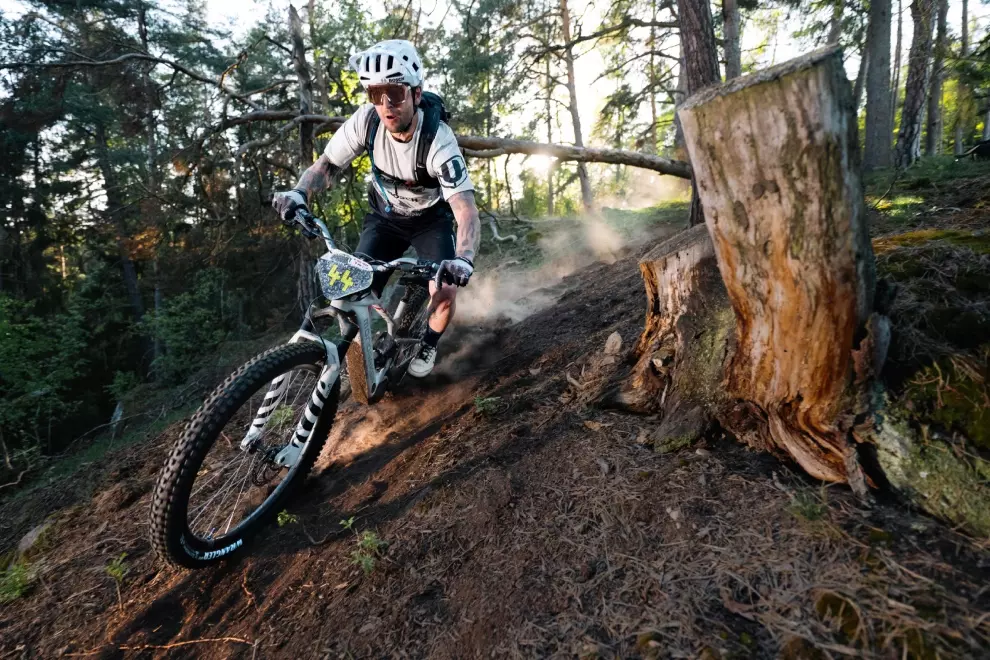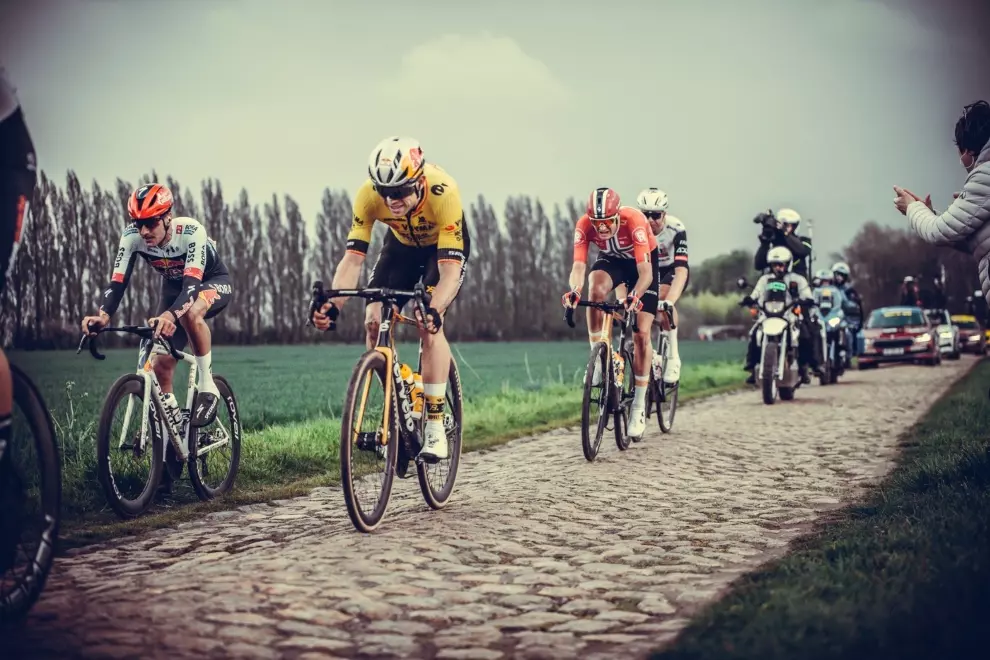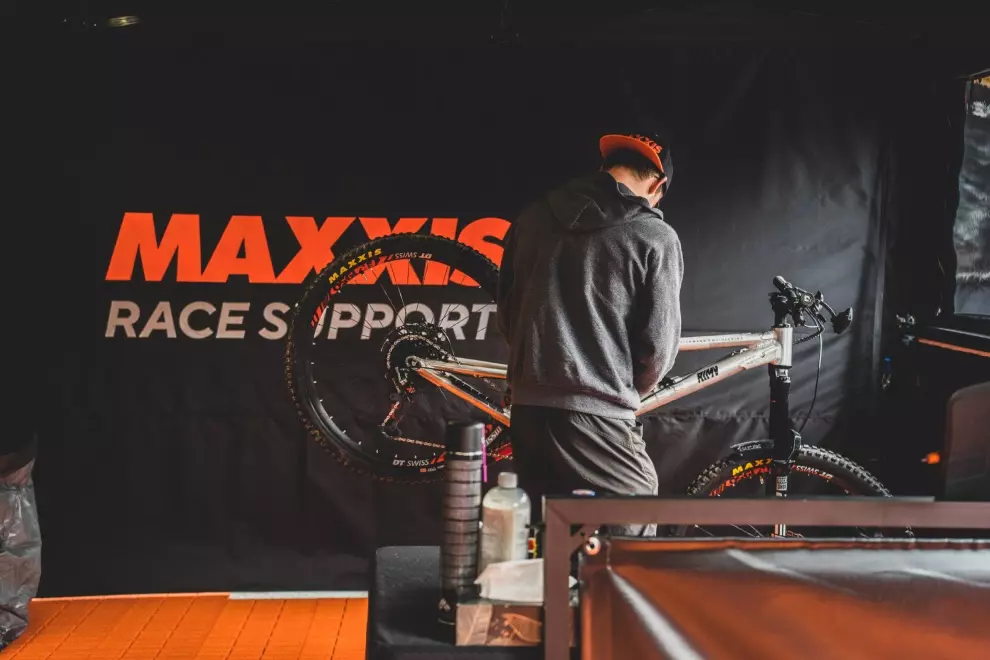
They are the highest of all ends. I wanted to know how they came to life, so I went undercover at Maxxis’s top-secret research facilities. Months of meticulous spywork revealed their deepest secrets. By this, I mean I researched everything available, and spoke to people who actually know things. Close enough.
Either way, this is your tyre’s origin story.
The idea before the rubber
Before your tyre was, well, a tyre, it was a problem. Not a generic one, not a mathematical puzzle – the kind of riding problem that appears at full speed during a World Cup run. Every Maxxis model begins as a direct response to feedback from riders who operate so close to the limit that most people would need medical supervision just to watch them. More grip without losing speed. More precision without extra weight. More stability without turning the tyre into a soft, folding apology. These demands become the blueprint for the piece of rubber, making your bike look almost professional.
While those athletes pray to various deities before the next corner, the engineers remain devoted to the holy trinity: compound, tread, and casing. That’s why each Maxxis tyre starts long before the rubber hits the moulds. The engineers begin by tuning hardness, damping, and the balance between base polymers and fillers to find the exact relationship between traction, rolling efficiency, and durability. Softer mixes bite harder but wear sooner. Harder mixes roll faster but lose mechanical grip. There is no perfect solution, only a perfect balance for a specific job.
Sometimes that balance is discovered the hard way. Maxxis Marketing Manager for Europe, Olga Möschter (that’s right, I know people), shared how the High Roller III came to be. During development, one of their pro DH riders asked for a tyre that performs more consistently in mixed conditions. The previous version snapped too abruptly from centre knobs to shoulder knobs, which felt fine until riders hit mixed terrain at race pace. They wanted a smoother transition, consistent braking, and predictable cornering, even when grip changed from dust to wet roots in half a second. That single complaint became an entire redesign: new spacing, new knob support, and a new shoulder layout that behaved like it actually wanted to keep the rider alive.
This is how tyres start their lives. A rider identifies a problem that should not exist at the speeds they insist on riding. Engineers gather sketches, formulas, and late-night arguments about rubber physics. The tyre does not exist yet, but its character is already forming. Once a tyre has a purpose, it needs a personality, and that begins with the compound.
Zobrazit příspěvek na Instagramu
The tyre personality
Ask around, and most riders will swear the tread gives a tyre its personality. Not even close. Long before the knobs are even considered, the tyre gets its personality in the compound lab, where rubber stops being a passive material and turns into a controlled response to force.
For Maxxis, the starting point is hardness tuning, damping characteristics, and the ratio between base polymers and fillers. Softer blends increase traction and surface conformity. Harder blends improve wear and rolling efficiency. The job is not to find perfection. The job is to decide which compromise serves the discipline best.
Rebound is the first behavioural clue. XC compounds snap back to shape as fast as possible because efficiency is the entire point, and wasted energy is a sin. Enduro compounds settle somewhere in the middle, stable enough for technical terrain but not so sluggish that they feel stuck to the ground. Downhill compounds behave with deliberate patience. Slow rebound keeps the tyre glued to rock faces and roots long enough to prevent riders from forming sudden, intimate relationships with the forest floor. Maxxis blends rebound profiles through lab measurements and field validation until the behaviour matches exactly how the tyre will be ridden.
Hysteresis is the quiet architect behind that grip. When rubber deforms, it absorbs energy. When it reforms, it fails to give all of it back. That missing energy becomes heat, and that heat becomes traction. XC tyres minimise hysteresis to keep rolling resistance low. DH tyres embrace it because sliding at full speed is bad for podiums and worse for collarbones. Temperature plays its own games. Rubber stiffens in the cold and softens in the heat. Engineers compensate with fillers and polymer chains that settle the compound into the correct stiffness window so the tyre behaves predictably regardless of climate. Every additive has a purpose. Silica shifts wet traction. Carbon black adjusts wear and elasticity. Plasticisers manage flexibility. A single percentage change can turn a tyre into a masterpiece or garbage.
Studies on deformation and energy loss guide these decisions. High-speed cameras track how rubber collapses under load. Force sensors reveal how much energy disappears at each compression cycle. Rolling-resistance rigs expose inefficiencies that cost seconds over long distances. None of this is glamorous, but it is the difference between a tyre that cooperates with terrain and one that behaves like a spoiled toddler at a candy store. This is where the tyre becomes something real. It now has a personality shaped by science, pressure, compromise, and ambition.
Once that personality forms, it needs a face.
The tread patterns and their role
A compound gives the tyre its personality, but the tread decides how that personality behaves on the ground. This is the part riders love to argue about because knobs look simple. They are anything but. Every height, angle, spacing, and cut exists for a reason, and changing any of them alters how the tyre negotiates pressure, speed, and disorder. Knob height controls how far the tyre sinks into terrain before it fights back. Lower knobs roll faster because they deform less, which is why XC tyres feel like they are cheating physics when the surface is firm. Taller knobs bite deeper, especially in loose soil, but they demand more energy with every rotation. The wrong height on the wrong terrain feels like dragging a plough with excellent branding.
Spacing dictates how well the tyre clears debris. Mud tyres need broad voids so soil has somewhere to escape instead of clinging to the tread and turning it into a smooth rubber cylinder. Hardpack tyres stay tight and compact, keeping deformation low and stability high. That difference separates a clean corner from a “worst crashes compilation” moment. Siping controls flexibility. Small cuts allow knobs to fold in controlled ways when the tyre leans, which increases the contact patch without sacrificing structural support. A well-siped shoulder block grabs the ground at angles that would otherwise feel like a mistake.
Then there are the recognisable Maxxis patterns that appear on trails everywhere. The Assegai layers its knobs to create predictable cornering even when the ground pretends to be optional. The Minion family uses braking edges that feel like they were designed by someone who really wanted you to stop on command. The Shorty and Wetscream specialise in mud, carving channels through the worst terrain so the tyre stays connected to something that vaguely resembles ground. And of course, the High Roller III, with its wide spacing, reinforced lugs, and smoother transition, keeps the tyre composed through dust, roots, sand, and, probably, lava as well, though the last one hasn’t been confirmed by Maxxis. Not yet, at least.
Designing these patterns is not artistic expression – it is controlled geometry. Engineers start with simulations, build prototypes, and feed them into high-speed testing rigs that reveal how each knob behaves under load. Those results are then tested on real trails, where riders do their best to destroy months of lab work in a single afternoon. Nothing exposes a weak pattern faster than an athlete riding with the confidence of someone who believes consequences are something you only read about in books.
Of course, none of this works without a body that can survive the impact, which brings us to the casing.

The casing: Your tyre’s armour
The casing is the part of the tyre that does not get nearly enough credit. Riders love to obsess over knobs and compounds, but none of that matters if the body underneath folds, tears or panics at the first sign of real pressure. The casing is the skeleton. It decides how the tyre flexes, how it absorbs impacts, and how much punishment it can take before the tyre gives its 5-second leave notice.
Stiffness comes first. A tyre that flexes too much feels vague and unpredictable. A tyre that flexes too little loses grip because it cannot conform to the terrain. Engineers tune this balance by changing the threads per inch, adding protective layers, and adjusting the angles of each ply. TPI matters, but it is not a magic number. High TPI creates a supple feel but sacrifices strength. Lower TPI builds a stable platform but feels harsher. Maxxis uses both, depending on what the tyre is expected to survive.
Misconceptions follow riders everywhere, and Maxxis confirmed the most persistent one. Many riders believe softness or low pressure automatically produces grip. In reality, unsupported rubber and collapsed casings create the opposite effect. The tyre deforms too deeply, loses structure, and stops behaving the way the compound was designed to. Proper casing support is what makes the grip usable instead of theatrical.
Then come the reinforcements. EXO adds lightweight sidewall protection that keeps trail tyres from collapsing when rocks appear without notice. EXO Plus goes further and gives modern aggressive riding enough security to survive questionable line choices. DoubleDown is a step above that, built for riders who push enduro tyres into downhill territory with the confidence of people who do not buy their own rims. The full DH casing sits at the top. Two layers of heavy fabric and robust rubber that allow a rider to hit something sharp, fast, and entirely avoidable, yet ride away as if nothing happened.
These layers also control deformation under load. A well-built casing spreads impact forces across the tyre instead of sending them directly into the rim. That difference is easy to feel. One version keeps you rolling. The other leaves your wheel shaped like the infinity sign. Heat matters too. Aggressive riding generates temperature spikes that can soften rubber and change behaviour. Proper casing construction reduces that effect, so the tyre feels consistent from the start of the run to the end. Predictability at speed is not optional for riders who race against clocks.
No casing, no matter how advanced, can save you from a line choice that insults basic geometry, but a good one will at least make the disaster look far less severe on camera.
Once the structure is complete, the tyre is ready for the real examination on the trail.
The trail
Lab tests can predict a lot, but they cannot recreate the decisions riders make when speed takes over judgment. That is why every tyre leaves the safety of controlled conditions and enters the stage where physics meets human-induced madness. The trail exposes everything. A knob that looked perfect on a screen might fold the moment the rider leans harder than expected. A casing that stayed composed in the lab might collapse after a rock strike that nature had no business placing there. This is where brands like Maxxis face their real examination.
Pro riders take the first swing. Their job is straightforward. Ride fast enough to stress the tyre in ways that science struggles to measure. Maxxis confirmed that the lab comes first, but laboratory data only sets the baseline. Field testing reveals how the tyre actually behaves when the surface changes every ten metres, and traction comes in unpredictable units. A tyre might track beautifully across granite but lose conviction on roots. It might brake confidently on steep pitches but hesitate during weight transfers. These differences push engineers toward the next round of adjustments.
Prototypes rarely survive long. Some fail spectacularly, others retreat quietly, ashamed of their performance in real life. Still, there are a few that show promise, but not enough to earn a place in the real world. The process is not linear because riding isn’t either. Terrain changes, speed changes, forces change, and the tyre must respond without hesitation. The versions that adapt to this chaos are the ones worth refining.
Maxxis also revealed that elite riders test prototypes that the public will never see. Some include altered compounds with different rebound curves. Others use tread layouts that explore the edge cases of traction. These experimental versions exist to confirm ideas, challenge assumptions, and sometimes to prove beyond doubt that a specific direction should never be attempted again. Each one helps refine the version that might eventually reach production.
As the prototypes evolve, the gap between athlete demand and engineering reality starts to close. Every successful test shapes the tyre’s final form. By the time one model emerges as a candidate for release, it has already endured more punishment than a rear tyre dragged across a parking lot by a teenager convinced skids make them cool in front of the girls.
But there is one final hurdle, because the tyres that survive testing must prove they are ready for the fastest races in the world.
When a tyre becomes championship-ready
The final stage of development is where Maxxis stops exploring possibilities and starts confirming certainty. A tyre that reaches this point must prove it can deliver identical performance from the first corner to the last, no matter how much heat, force, or terrain chaos the course produces.
Maxxis defines competition readiness with clear requirements. The tyre must meet strict lab metrics, then show the same grip, structure, and rolling behaviour when pushed at elite speed. Predictability becomes the deciding factor. Any tyre that changes character mid-descent returns to revision. Racing drives this refinement. World Cup courses expose weaknesses that lab equipment cannot, which is why many design breakthroughs start with athlete demands, not engineering ambition.
As testing narrows, engineers fine-tune compound response, tread support, and casing stability so the tyre behaves consistently under repeated impacts and rising temperatures. Only models that hold their identity through all of it earn Maxxis approval. A tyre that graduates from this stage has proven it can perform for riders who push equipment far beyond what most people consider reasonable. Each of these tyres exists because it was created to solve a specific racing problem, and those solutions shape the models riders use today.
The final result
A finished tyre never hides its origins. Every Maxxis model carries the signature of the problem it was designed to solve. The differences between them are not marketing categories. They are engineering responses to very specific demands made by riders who discovered the limits of existing designs and asked for something better.
The Aspen and Aspen ST show this clearly. Both exist to turn watts into motion with as little drama as possible, but the ST pushes speed to the edge, built for short bursts of aggression where rolling resistance cannot steal a single second. The regular Aspen adds versatility for real courses where the terrain changes its mind every lap. The Forekaster solves a different problem. It is built for the kind of trail riding that feels a little too confident for XC and a little too honest for enduro. Its tread gives controlled chaos a sense of direction.
Zobrazit příspěvek na Instagramu
The Minion DHF and DHR II approach cornering and braking as two separate sciences. One creates stability under lean. The other provides authority under speed loss. Together, they form the backbone of modern aggressive riding. The Assegai exists because a predictable grip is a performance advantage. It gives the rider the confidence to commit. The High Roller II thrives in loose over hard, where surfaces behave like unreliable acquaintances. The Shorty and the Wetscream address mud with a level of seriousness usually reserved for structural engineering.
None of these tyres is an accident. Each one is a direct answer to the terrain it was designed to master. But no matter how a tyre was born, its real story begins only when it touches the ground under your bike.
The real test is the one you will make
A tyre can survive the labs, the prototypes, the engineers, and the World Cup riders who treat terrain like a suggestion. None of that compares to the moment it lands on your bike because this is where its story stops being theoretical. Trails do not care about design briefs. They care about commitment. A tyre that behaves perfectly for athletes at the top of the sport still needs to prove itself when the rider is tired, underprepared or slightly too confident for the conditions.
Choosing the right tyre matters because every model was built with a purpose. When that purpose aligns with the terrain you ride, the bike feels sharper, calmer, and more capable. When it does not, the ride turns educational. Maxxis tyres earn their reputation on the world’s hardest courses, but the real test comes on local trails, where riders learn exactly what their equipment can handle.
A tyre’s origin may involve engineers, athletes, and more testing than most bridges receive, but the real evaluation begins the moment you commit to a line you should not have trusted. Maxxis has done everything possible to keep you upright. The rest is between you, gravity, and the decisions you make when blind optimism trumps skill.
Header picture credit: Boris Beyer @maddogboris