Luring Evenepoel and Vingegaard
“We’re trying to set up a real battle between some ‘grande campione’, some real big names,” he told the publication. “But I only like to announce things when they’re a done deal.”
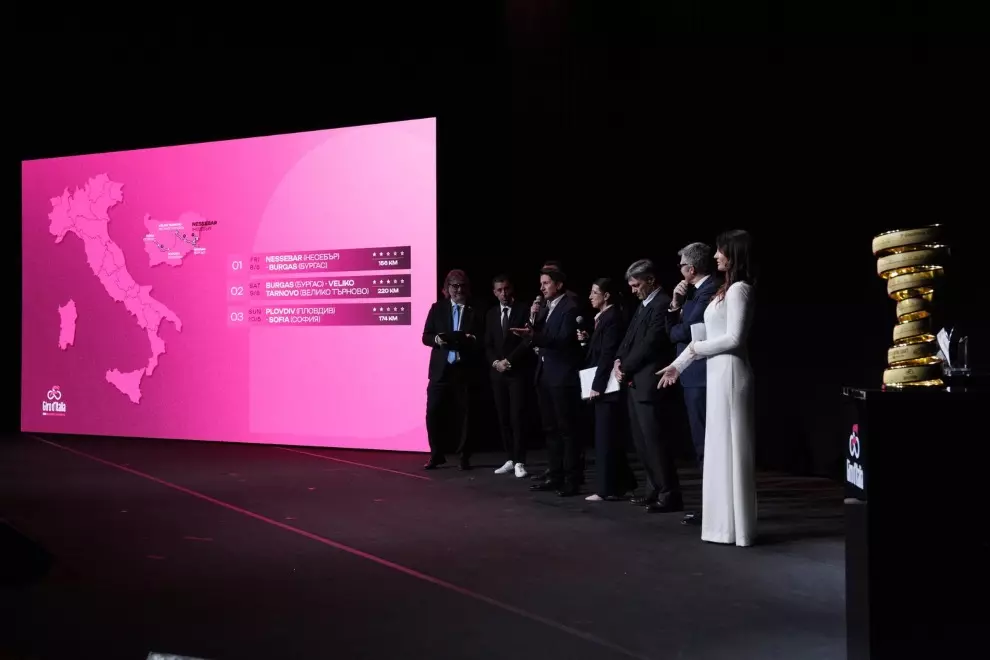
In that, he was confirming what outgoing Giro director Mauro Vegni had said Monday at the presentation of next year’s route: “If I were Jonas Vingegaard, I wouldn’t let a chance like this escape me. If he won the 2026 Giro, he’d complete the Grand Tour set.” He then added: “We’ve heard both Vingegaard and Evenepoel want to ride the Giro. They’d be two big-name riders. Even [Tadej] Pogačar will be back sooner or later.”
Coincidentally, Vingegaard – who has two Tour de France titles (2022, 2023) and won this year’s Vuelta a España – has been thinking about riding the Giro next year, even if it means reducing further his chances of beating Pogačar in the Tour next year. “Winning all three Grand Tours or the Tour de France in 2026?” he reflected in the pages of La Dernière Heure. “I think I’d rather win the three Grand Tours. The Giro is still left.”
A “softer” race
The Giro’s strategy is understandable because superstars attract sponsors and money, but it’s a shame in a way because last year’s Giro was a wonderful race, won dramatically on the penultimate stage by Simon Yates. In any case, the strategy has moved race organisers to “soften” the 2026 Giro by reducing altitude gain from the more than 52,000 meters of 2025 to 49,150 meters next year. And the summit finish on the queen stage, stage 19 (5,000 m of elevation), while very steep, is only a category 2 climb (5 km at ~10%).
Now, this is not as drastic a climbing reduction as in 2024, when organisers laid out only 42,900 meters of elevation to tempt Pogačar to ride the race without impairing his chances for the Giro-Tour double. (He rode and he doubled.) But the idea is the same. Will Vingegaard go for it and sacrifice what may be one of his last realistic chances to win the Tour (he’ll be 30 in 2027)? We’ll see. And what about Evenepoel? Organisers have included a flat 40.2 km time trial that fits him like a tailored suit. And he has a bone to pick with the race, having crashed out in 2021 and abandoning again in 2023 after testing positive for Covid while leading the race.
Zobrazit příspěvek na Instagramu
More stages for sprinters
Sprinters will also be happy with the Giro, because there are at least seven stages, perhaps eight, which are likely to end in bunch sprints, unless a breakaway or two is allowed to make it to the finish line. In the recent debate over pleasing spectators with increasing mountain drama or attracting all of cycling’s superstars, including Jasper Philipsen and perhaps even his Alpecin-Deceuninck teammate Mathieu van der Poel, the Giro has opted for the latter.
“This year’s Giro has a lot of stages that are like a Classics, so we hope to attract riders who will go for stage wins, while also creating a fascinating GC battle,” Bellino said. “I agree with the idea of having a balanced GC battle. But we want to have all the best riders at the Giro, not just one or two.”
The Giro will start on May 8 on the Bulgarian peninsula of Nessebar with a flat 156 km stage that should end in a bunch sprint. The first three stages of the race will be run in Bulgaria, with stage 3 ending in the capital Sofia. The race ends on May 31 with the traditional triumphal procession in and around Rome.
One more stage (but less climbing) for the Giro Women
The Giro d’Italia Women will kick off on May 30 in Cesenatico and conclude on June 7 in Saluzzo, after nine stages, one more than in the previous two editions. The course runs over 1,153.7 km and comprises some 12,500 meters of elevation gained, including two summit finishes: the stage 4 ITT and stage 8, at Sestriere. That final climb comes after the riders tackle the Colle delle Finestre for the first time in the history of the race. It’s 18 km long, half asphalt and half gravel, with gradients consistently around 9%, and ramps up to 14% near the bottom.
Last year, home nation favourite Elisa Longo Borghini (UAE Team ADQ) won the race by 18 seconds over Marlen Reusser (Movistar) without winning a stage. But her three podium finishes were good enough to secure victory. This year’s course is 215 km longer but has about 1,500 km less in elevation gained, which could change the dynamics of the race in favour of someone like Reusser, who climbs well and is very fast. However, it’s likely that the stage 8 summit finish could decide the winner. If not, the final stage, which starts and ends in Saluzzo, contains a few climbs, including the category 1 Montoso, but will likely be decided in a breakaway in which a rider like Reusser could dominate.
And what about that stage 4 time trial, which goes almost straight up for more than half of its 12.2 km length, offering ramps of up to 14%? A fast climber like Reusser could take the race lead there and seek to defend it until the end. There are also three stages for sprinters and a few chances for Classics riders, so everyone should be pleased with the course, including the spectators.