A little history
Considering the recent modest accomplishments of French riders in the discipline, it’s a surprise to learn that cyclocross originated in France in the early 1900s as an off-season training method for road cyclists – for which it is still used today by some riders, notably Wout van Aert. Riders would race each other through fields, forests, and over obstacles to maintain fitness and add variety to their training.
A French soldier, and later secretary-general of the French Cycling Union, Daniel Gousseau, is generally credited with founding the sport by organising the first French championship in 1902. In 1910, Octave Lapize publicly attributed his winning that year’s Tour de France to his winter cyclocross training, which helped spread the discipline’s popularity across northern Europe.
Cyclocross was officially recognised by the UCI in the late 1940s, and the first world championship was held in Paris in 1950. It was won by a French rider, Jean Robic. In fact, French riders filled the world championship podium that year and won the next eight world championships as well, five in succession by André Dufraisse. But that was the end of French success. Since 1958, only one French rider has won the ‘cross world championship, Dominique Arnaud, in 1993.
The first women’s cyclocross world championship was held in 2000 and was won by a German rider, Hanka Kupfernagel. As of this writing, the great Marianne Vos holds the record for the most cyclocross world championships, eight, a record Mathieu van der Poel is likely to match next year.
Dutch women rule
It will come as no surprise to cyclocross aficionados to hear that Dutch riders have won 15 of the 26 Elite Women’s world championships held so far, with Fem van Empel having won the last three. Equally unsurprising is the fact that Belgian riders have won 30 of the 76 Elite Men’s world championships held so far, with van der Poel accounting for six of the last seven, the only outlier in that period being Tom Pidcock’s victory in 2022, when the Belgian superstar did not take part.
But why have Dutch women and Belgian men dominated the sport and continue to do so today? And why is this dominance gender-related? For example, the top five UCI-ranked women riders for 2026 are all Dutch, beginning with Lucinda Brand, who has won four races in a row and eight out of the last 10 races she has ridden. Her points total for the year is 3,400, which is more than the 3,299 points of the entire Belgian team and the 2,805 of France. So, of course, the Dutch team’s total of 7,438 points is more than the combined total of those two teams. That is dominance.
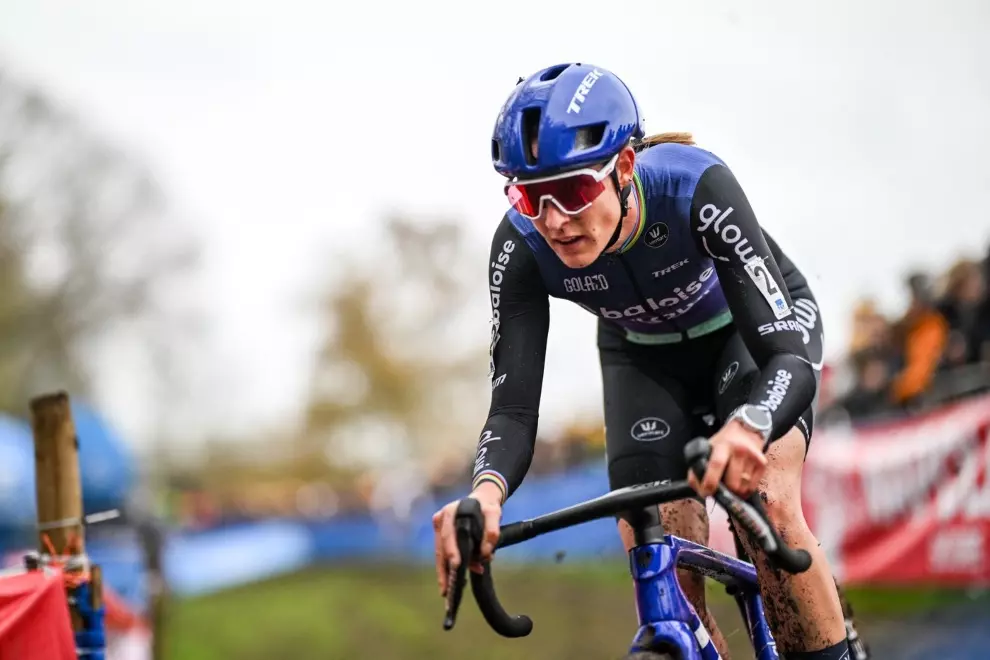
There are a number of factors for the success of the Dutch women. For one thing, the Netherlands boasts many well-equipped cycling clubs that nurture talent from a very young age. This ensures a high volume of young female riders entering the sport, which, in turn, creates a highly competitive atmosphere from a young age. In addition, Dutch girls often train and compete with one-year-younger boys in youth races, which helps build confidence.
Then there’s the historic success of riders like Marianne Vos, Annemiek van Vleuten, and, now, Brand, which gives young girls consistent role models for inspiration. Women’s cycling is highly respected in the Netherlands, further encouraging participation, and the national cycling federation and commercial sponsors provide substantial support, including training camps and professional teams, which offer clear pathways for talented riders to advance to the elite level. The Netherlands is also a truly gender-egalitarian society, which means that talented girls are encouraged to pursue the sport from a young age and receive as much support as boys do.
Poor grassroots for Belgian women
That is not the case in Belgium, where the girls’ grassroots infrastructure is far behind that of the Dutch,as there are significantly fewer races for junior women there. In one analysis, only six free-to-enter junior women’s races were held in the 2021-2022 season, compared to 28 for men. This disparity means young women have fewer chances to gain racing experience and develop their skills on varied courses.
And while Belgium has a strong cycling culture, historical barriers and a lack of focus on women’s cycling have meant fewer girls get into the sport compared to countries like the Netherlands. As a result, a Belgian woman has never finished in the top three of the U23 World Cup standings. In contrast, five of the last seven winners have been Dutch. And the figures for the U23 World Championships (which were first held for women in 2016) are just as bad. Belgium has won a single medal in this event, gold by the French-born but naturalised Belgian Marion Norbert Riberolle in 2020. Otherwise, they did not have a single podium finish.
Belgian men have it better
In contrast, Belgian men have won six of the 12 U23 world championships held since 2014 (though the Dutch have won the last two, by the impressive Tibor de Grosso). The reason is the extensive network of youth and provincial races, combined with local funding initiatives, all of which ensure a continuous stream of new male talent. This infrastructure appears to be missing on the women’s side.
In addition, robust sponsorships (teams, equipment, venues) and consistent prize money attract and retain talent. This means that riders can specialise in cyclocross without relying on road contracts. And there’s the Belgian terrain and weather: muddy, cold winters are perfect training grounds to hone cyclocross skills, so Belgian riders develop bike handling, running, and pacing in heavy conditions from a young age.
Superstars like Sven Nys (father of Thibau) and, today, van der Poel have inspired and continue to inspire generations of male riders to commit to cyclocross. The lack of a sufficient grassroots infrastructure for Belgian women and the resultant lack of success mean that Belgian girls have no such models to inspire them, as the Dutch have.
Interestingly, the results of last Sunday’s junior and U23 World Cup races suggest that the hegemony of Belgian men and Dutch women may be challenged in the near future. The women’s junior race was won by the immensely promising Czech 17-year-old Barbora Bukovská, who also won the U19 European championship. Three Czech riders, two Spanish women, one French woman and one English rider finished in the top seven spots; the best Dutch finisher was eighth. The men’s junior race was won by a Frenchman, Soren Bruyère Joumard, while the Dutch rider David Haverdings took the U23 race, with Belgians finishing off the podium.
Is there a change in the wind, rain and mud? Let’s hope so.