Let’s continue this series, where I’ll do my best to convince you that your old bike has officially been left behind, with a look at tyres – the simplest upgrade that completely changes how a modern road bike feels.
When narrow was the norm
Back in 2015, 23 mm tyres were the default on most mid-range road bikes. They were pumped to 100 psi or more because back then, harder meant faster. The 25 mm versions were considered comfort tyres, something for endurance road bikes. Tubeless setups existed but were rare and fiddly, and hardly anyone outside the more experimental corners of the industry used them. I certainly didn’t even know they existed.
On the mountain bike side, it was a different story. Tyre widths were already wider, but not by much compared to today. A 2,1” tyre was the standard for cross-country, and a 2,3” looked big. The real revolution for MTBs was tubeless. By 2015, tubeless was popular in MTB magazines but still far from widespread among riders.
For me, wider tyres were the first upgrade I really wanted to make, but couldn’t. And to be honest, the inability to fit tyres wider than 25 mm into the frame of my 2015 Giant TCR was one of the key factors in the decision to finally buy a new bike.

From harsh to plush
In 2025, 28 mm tyres are the new normal, and it’s common to see 30 mm or even 32 mm on endurance bikes in setups for cobbles or rougher roads. Many modern road frames are built with clearance for 35 mm or even more. This basically lets you turn your road bike into a gravel-capable machine with a simple tyre swap. I love that level of versatility.
The difference in comfort with wider tyres is dramatic. Being able to run 50 psi instead of 100 makes a huge difference. Lower pressures smooth out road buzz, reduce fatigue, and make long rides feel easier on the body. What’s surprising is that they also don’t make you slower. In fact, many of today’s wider tyres roll just as fast, or even faster, than their skinny predecessors.
Why wider is faster now
It’s not just a trend to go wider – data is backing it up. Over the past decade, rolling-resistance tests have shown that wider tyres can be just as efficient when inflated correctly. The contact patch is shorter and wider, meaning less deformation and energy loss.
Add to that a better grip, especially on rough or wet surfaces, and it’s easy to see why even the pro peloton has made the switch. Ten years ago, Tour de France riders were on 23s. Today, most race on 28 mm tyres, even on mountain stages, because the comfort and traction gains far outweigh the minimal aerodynamic penalty.
For everyday riders like me, it’s a win-win. More speed on rough roads, less fatigue, and fewer flats. For a side-by-side comparison, check out this test.
The mountain bike world went first
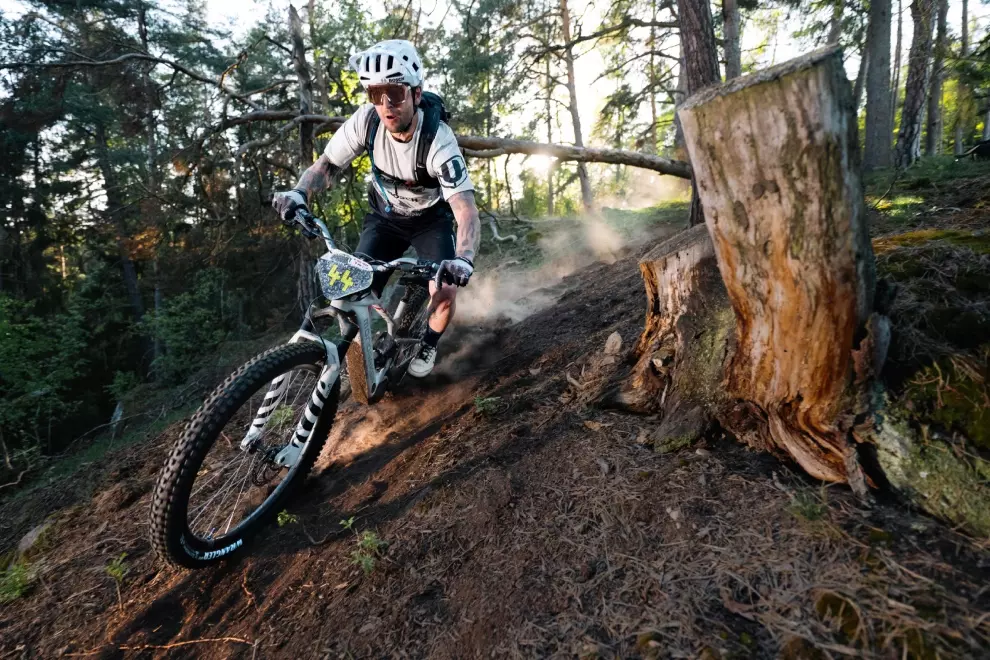
Just like on the road, mountain bike tyres have grown wider over the past decade. What used to be a 2,1” cross-country tyre is now more likely to be 2,35”, and trail bikes often run 2,5” or even 2,6” widths. The extra volume adds comfort and control, but the real revolution was the mass adoption of tubeless setups.
Today, most new mountain bikes come tubeless-ready, and for good reason. Running lower pressures without worrying about pinch flats transforms the ride: more traction, more comfort, and much more confidence when the trail gets loose.
Compared to a 2015 setup, the difference is night and day. Modern tyres track better through roots and rocks, grip harder in corners, and let you ride faster with more control. All thanks to a combination of tubeless systems, wider rims, improved compounds, and smarter tread designs.
Inner tubes aren’t dead yet
A lot of road cyclists have switched to tubeless as well, though the advantages are less significant than on mountain bikes. Unless you ride something like ten thousand kilometres per year, chances are you would be better off with TPU inner tubes. Yes, inner tubes also haven’t escaped technological progress.
They’re incredibly light, often around 40–50 g each, and offer rolling resistance close to that of a good tubeless setup. You install them just like regular butyl tubes, so there’s no sealant, no mess, and no compressor needed. They also hold pressure better over time.
The downside? They’re pricier than standard tubes, and some models can be a bit delicate to install. But they’ve become a favourite for riders who want the performance edge without the fuss of tubeless maintenance.
So, is it worth it?
Absolutely. If you’re coming from a 2015 bike, switching to wider tyres, whether tubeless or TPU, will feel like night and day. The improvement in comfort alone is worth it, and the bonus is that you won’t be giving up any speed.
For me, this was one of those changes that truly transformed how I ride my road bike. When I first hit a stretch of cobbles on my 32 mm tyres, I was amazed at how I glided over, instead of bouncing across like I used to. I don’t have such a direct comparison with my trail bike, but I’ve ridden some of the harshest terrain this year without a single flat, and that alone is hard to imagine when I think back to riding mountain bikes as a kid.
I bet you’ve caught the bug now, and that new bike idea is starting to take shape. But don’t worry, by the time we’re done with this series, that new-bike idea will be fully formed. We’re only halfway there.